
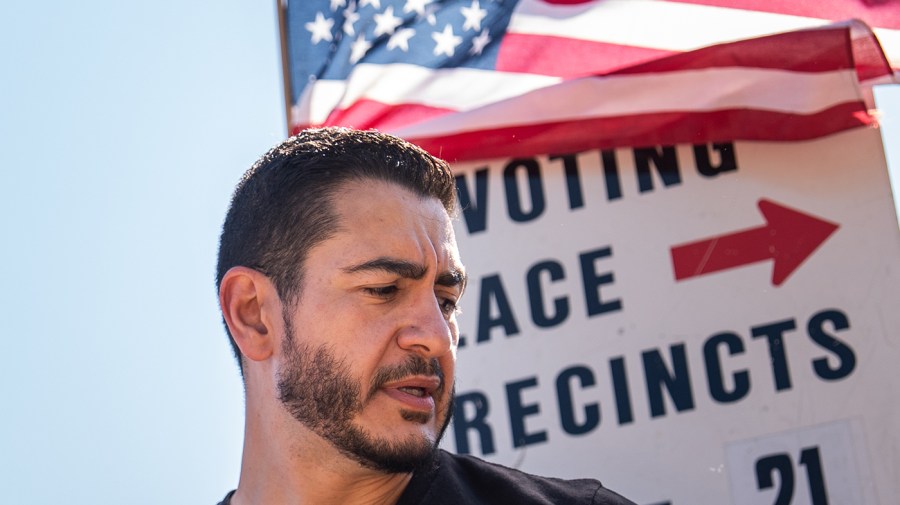
Abdul El-Sayed, Michigan’s newly elected Democratic senator, made clear on Thursday that he supports President Trump’s announced plan to halt U.S. aid to Israel, while going further than the administration by calling for restrictions on American weapons sales to the country as well. The alignment is striking, not because it signals ideological agreement with Trump, but because it reveals how the politics of U.S.-Israel policy have shifted dramatically enough to produce unexpected convergence across party lines, driven in part by sustained public pressure over the war in Gaza.
“I agree with him on that,” El-Sayed said on MSNBC’s “Morning Joe.” “I don’t think that we should be continuing to subsidize a foreign military that has done the worst things with our money. I agree. I’d love to work with him on doing that.”
A Policy Shift With Real Consequences
On Tuesday, Trump announced he had reached an agreement with Israeli Prime Minister Benjamin Netanyahu to halt annual U.S. assistance to Israel, saying the country had “become a very successful country” and remained “a great ally” that Washington would still support if needed. The announcement, if it holds, would represent one of the most significant reorientations of American foreign policy in decades. Israel has long ranked among the largest recipients of U.S. foreign aid, with that assistance requiring congressional authorization and embedded in funding frameworks that currently run through fiscal year 2028.
How the administration actually unwinds that commitment by December 2026 remains an open and serious question. The legal and legislative architecture around U.S.-Israel aid is not easily dismantled by executive announcement alone, and Congress will have a central role in determining whether this shift materializes in practice.
El-Sayed, who defeated former Republican Representative Mike Rogers in Tuesday’s Michigan Senate race, had campaigned explicitly on ending U.S. military aid to Israel and redirecting those funds toward domestic priorities. His position is not new, but his arrival in the Senate gives it institutional weight it previously lacked.
Beyond Aid: Weapons Sales and the Language of Genocide
Where El-Sayed departs sharply from Trump is on weapons sales. Trump has indicated that Israel would retain the ability to purchase American arms even after annual assistance ends. El-Sayed rejected that distinction, saying the U.S. should not continue selling weaponry he described as being used to commit “genocide and apartheid.” That framing is not incidental. El-Sayed has consistently characterized Israel’s conduct in Gaza as genocide, pointed to Israeli policies in the occupied West Bank, and criticized restrictions on access to basic resources in the Gaza Strip, where tens of thousands of Palestinians have been killed since October 2023.
He was also deliberate in separating his criticism of the Israeli government from any animus toward Jewish people. “We’re told that if you want to stand up against the murder of innocent Palestinian children, that’s somehow about hate for anybody,” he said. “It’s about equal love for those Palestinian children.” He added that he is equally committed to protecting Jewish children and families in the United States, drawing on his own experience as a Muslim parent concerned about his children’s safety in an increasingly polarized climate.
This distinction matters and deserves to be taken seriously rather than dismissed. Conflating criticism of a state’s military conduct with ethnic or religious hatred is an analytical error with real political costs. It shuts down legitimate debate about American complicity in documented civilian harm, and it has been used to silence voices, including Jewish voices, that oppose the war.
The Broader Stakes for Democratic Politics
El-Sayed’s willingness to find common ground with Trump on this specific question does not reflect a broader ideological softening. He was explicit on “Morning Joe” that politics should be about enforcing the rule of law and delivering for the public, not pursuing retribution against political opponents. “It’s not about retribution. It should never be about retribution,” he said. That framing positions him as someone interested in outcomes rather than performance, which is a meaningful distinction in the current Senate Democratic caucus.
His election from Michigan, a state with one of the largest Arab American communities in the country, is itself a signal of where grassroots progressive energy has moved on foreign policy. The Democratic Party’s leadership spent much of the past two years trying to hold together a coalition fractured by Gaza, and El-Sayed’s arrival suggests that the pressure from below has not dissipated. It has organized, run candidates, and won.
The harder test will come when the rhetoric of ending aid meets the institutional inertia of a funding framework that both parties have sustained for generations. El-Sayed has made clear he wants to push beyond where Trump is willing to go. Whether that produces real policy change or remains a statement of values will depend on how much leverage progressive senators can actually exercise in the months ahead.