
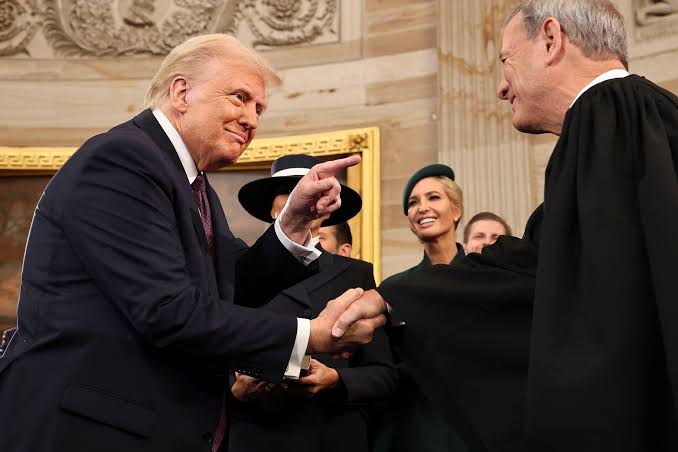
While President Donald Trump’s courtroom defeats dominate the news cycle, the Supreme Court is methodically pursuing a far more consequential agenda — one that legal scholars warn will fundamentally reshape American constitutional law for decades to come.
University of Chicago law professor Aziz Huq, writing in The Atlantic, argues that the Roberts Court’s recent rulings against Trump on birthright citizenship and global tariffs should not be mistaken for judicial independence or a moderate turn. The defeats, Huq contends, are largely incidental — the product of a president whose impulsive, erratic moves occasionally conflict with the court’s own long-term constitutional blueprint, not evidence that the justices are acting as a meaningful check on executive overreach.
The blueprint Huq describes is sweeping. Chief Justice John Roberts and his conservative supermajority are, according to Huq, executing a plan of “deep constitutional change” that targets three pillars of American governance: the First Amendment, the Fourteenth Amendment’s equal-protection clause, and the constitutional balance of powers between the branches of government. Each pillar is being quietly dismantled, term by term, with relatively little public outcry.
On campaign finance, the trajectory is unmistakable. Roberts authored the Citizens United v. FEC decision, which interpreted the First Amendment to strike down limits on corporate election spending. This term, the court extended that logic further in National Republican Senatorial Committee v. FEC, invalidating longstanding laws that restricted coordinated spending between political parties and candidates. The practical effect is to flood electoral politics with even more unaccountable money — a development that disproportionately benefits entrenched economic interests over ordinary voters.
The court’s treatment of the Fourteenth Amendment is, if anything, more alarming. Ratified after the Civil War specifically to guarantee equal protection under the law to formerly enslaved people, the amendment is being, in Huq’s words, “repurposed to do the opposite of what it was intended.” The Roberts Court has used equal-protection doctrine to roll back race-conscious admissions policies and has, Huq argues, “essentially neutered” the 1965 Voting Rights Act — legislation that generations of civil rights activists bled and died to secure.
The restructuring of executive power completes the picture. The court has granted the president near-absolute authority to dismiss federal officers, a ruling with consequences that extend well beyond any single administration. Among its effects are:
Huq’s central argument is that Trump wins only when his agenda happens to align with the Roberts Court’s own vision. When it doesn’t, the justices have, in Huq’s framing, “little patience for impulsive, erratic swerves by a president who will be gone in three years” — particularly when those swerves risk derailing a longer constitutional project the court has been advancing for two decades. The losses Trump suffers are tactical; the court’s gains are structural.
The warning embedded in Huq’s analysis is that the public and the press risk misreading the moment. Treating each Trump defeat as evidence that institutions are holding the line obscures the degree to which those same institutions are, simultaneously, rewriting the rules of American democracy in ways that will outlast this presidency by a generation.