
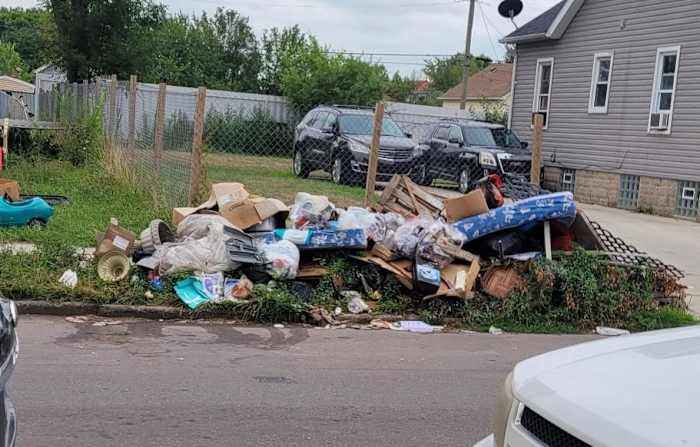
For Caulette Djakonow, the pile of illegally dumped trash that accumulated outside her Dayton Street home in Detroit was never just an eyesore. Djakonow has stage four lung cancer, and the mounting heap of waste in front of a nearby vacant lot — left to grow for more than two months — represented both a genuine health hazard and a daily indignity inflicted on a woman who had spent decades building a life in her family home. “I am stage four lung cancer and I don’t want the last of my life to be looking at garbage,” she said. That she had to fight so hard, for so long, simply to have her street kept clean is a story about what happens when municipal services fail the people who need them most.
The dumping had begun gradually, as illegal dumping in under-resourced urban neighborhoods so often does — a bag here, a broken appliance there — until the lot near Djakonow’s home became a magnet for refuse that no one seemed willing to remove. She did what any resident is supposed to do: she called the city’s waste services, repeatedly, over the course of weeks. The response she received was not a cleanup crew but a bureaucratic timeline. She was told that if the responsible party could not be held accountable, the matter would go to court, a process that could take another two to three months on top of the time already lost. “So, what you’re telling me is that I have to look at this garbage for another five months?” she recalled asking. No one disputed the math.
Djakonow’s home had always been a point of pride — the kind of well-kept house that draws compliments from visitors. By the time the pile had grown to its worst, those same visitors were asking a different question entirely. “When people come to my home, and I have a nice home, the first thing they say is ‘Wow, it looks so nice,'” she said. “Now, it’s ‘What the hell is that?'” The emotional toll of that shift, compounded by her illness, is not incidental to this story. It is the story: a resident doing everything right, receiving nothing in return, while her quality of life deteriorated in plain sight.
It was only after Djakonow contacted Local 4, a Detroit television station, and Local 4 contacted the city, that anything changed. The intervention was swift — almost startlingly so, given the months of inaction that had preceded it. The Department of Public Works dispatched crews the very same morning, clearing not only the pile outside Djakonow’s home but several others in the surrounding area. She opened her front door that Saturday and stopped. “Oh my god! It’s gone,” she said, and called the station immediately to share the news. The relief in her voice was unmistakable. So was the implicit question it raised about why a phone call to a news outlet proved more effective than months of official complaints.
Eva Torres, the District Six manager for the city’s Department of Neighborhoods, expressed satisfaction that the city had been able to respond quickly once alerted, and used the moment to highlight the tools residents have at their disposal. The Improve Detroit app, available on phones and laptops, allows residents to photograph problems and route them directly to the relevant city department. Torres also noted that residents can call their district manager directly. These are genuinely useful resources — but their existence does not explain why Djakonow’s repeated calls to waste services produced nothing while a single media inquiry produced a crew by morning. The gap between those two outcomes is where accountability lives, and it deserves scrutiny.
What this episode illustrates is a familiar and corrosive dynamic in cities where public services are stretched thin and enforcement of illegal dumping is slow: the burden of a broken system falls heaviest on the residents least equipped to absorb it. Djakonow is not angry, at least not in the way she has every right to be. She is grateful, effusively so. “Thank you so much,” she said. “I was so happy when I woke up and saw that. I was like ‘Hallelujah!'” She says she now plans to work with the city to prevent the dumping from returning — a commitment that speaks to her decency, and to the fact that she should never have been put in this position in the first place.