
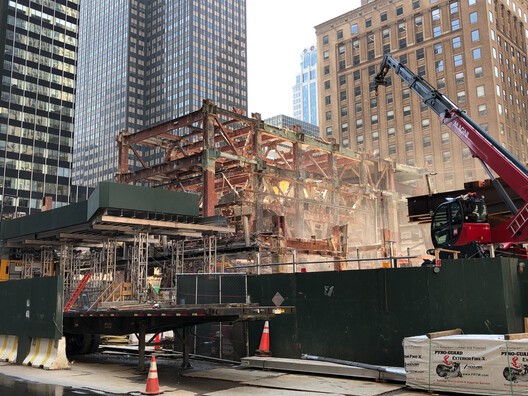
Construction waste is choking cities. Now, a growing number of governments on both sides of the Atlantic are converting abandoned industrial buildings into hubs designed to recover, sort, and redistribute building materials — redirecting debris away from landfills and toward a functioning circular economy.
Brooklyn Takes the First Step
In the final week of August, New York City’s Economic Development Corporation announced a one-year pilot program at the MADE Bush Terminal in Sunset Park, Brooklyn. The site — a historic 20-acre industrial property whose full name stands for Manufacturers, Artisans, Designers, and Entrepreneurs — had already been undergoing private redevelopment, with century-old warehouses being adapted to preserve the area’s industrial heritage while extending the useful life of materials already on site. The new circular construction hub would add a public-interest dimension to that work: a dedicated space for recovering, storing, sorting, and redistributing construction materials at scale.
The city selected Our Temenos, a Brooklyn-based, certified M/WBE ecological landscaping firm specializing in habitat restoration, low-waste landscape design, and material reuse, to operate the hub. The partnership emerged through NYCEDC’s “Ideas for Impact” Request for Expressions of Interest — an open solicitation inviting nonprofits, startups, academic institutions, and community organizations to propose initiatives aligned with the agency’s economic development priorities. Our Temenos rose to the top of that process, and the collaboration was formalized ahead of the pilot’s launch.
The stakes are not trivial. As DSNY Commissioner Gregory Anderson made clear, construction and demolition already account for a massive share of New York City’s waste stream. The pilot is designed to generate real-world data on the feasibility of reuse-oriented construction supply chains — testing material intake, handling, and resale activities while NYCEDC simultaneously evaluates the long-term operational model and its economic viability. The work feeds directly into the city’s Green Economy Action Plan and its 2024 operational guide, Clean and Circular: Design & Construction Guidelines. By the end of the testing year, the city expects to understand what infrastructure investments would be needed to scale interim material storage, handling, and reprocessing across the five boroughs.
Brussels Builds on European Momentum
New York’s announcement did not emerge in a vacuum. Across Europe, city governments had already been moving in the same direction, repurposing past industrial heritage to serve explicitly sustainable development goals. In Brussels, city authorities announced plans to convert a disused warehouse in the Ganshoren district — on the citydev.brussels Darwin site — into a 6,000-square-meter regional logistics hub called the ReUse Park. The project, backed by the 2021–2027 European Regional Development Fund, was formally launched in February 2026. Once operational, the hub will collect, sort, and prepare used building and deconstruction materials, while also hosting educational and training programs for workers and companies across the construction sector. The contract for an official operator is expected to be awarded following a public competition in early 2027.
Weeks earlier, a parallel initiative had taken shape on a very different kind of site: an industrial building in East London’s Royal Docks, owned by the Greater London Authority and earmarked for eventual development as part of the Silvertown regeneration area. Rather than let the building sit idle, authorities allowed Tipping Point East — a circular construction hub founded in 2025 — to move in and begin operations. The hub is organized around three founding organizations: Material Cultures, an architecture and research practice; RESOLVE, an interdisciplinary design collective; and Yes Make, a design and build collective focused on circular practice. Together, across more than 8,000 square meters of industrial space, they bring together material reuse, low-carbon construction methods, worker training, and cultural programming tied to circular economies.
The numbers are instructive, even if sobering. Over five years, Tipping Point East is projected to divert just over 1,000 tons of material from landfill. That figure sounds significant until measured against the more than five million tons of construction, demolition, and excavation waste the United Kingdom sends to landfills each year. The gap between what individual hubs can absorb and what the sector produces underscores why systemic public investment — not voluntary action alone — remains essential.
A Cross-Border Framework Takes Shape
Further east, a Horizon Europe initiative called CirCoFin — Circular Construction Finance has been working to knit together comparable efforts in Munich, Copenhagen, Lisbon, and across Scotland. Rather than operating a single hub, CirCoFin functions as a cross-border support organization, providing administrative guidance and a common step-by-step framework that local governments can adapt to their own contexts. Its model combines a physical material bank with a digital marketplace, enabling material traceability and efficient logistics — addressing one of the persistent structural barriers to circular construction at scale. The project understands these hubs not as isolated facilities but as local ecosystems, integrating material logistics, storage, digital tools, and advisory services into a coherent whole.
By the time the New York announcement landed, the broader picture had become clear: what had once seemed like niche experiments in adaptive reuse was consolidating into a recognizable policy direction. In Gothenburg, construction is already advancing on the new Grand Central station building, designed by Reiulf Ramstad Arkitekter, which incorporates material reuse as part of its architectural expression. At the 2027 Venice Architecture Biennale, the Türkiye Pavilion will examine the concept through Spolia Futures, framing the reuse of architectural elements as an evolving method rather than a historical curiosity. Earlier this year, architect Barbara Buser — a Swiss pioneer of repurposing and circular construction — was named the winner of the 2026 Jane Drew Prize by the AJ and The Architectural Review, recognition that the field has moved well beyond the margins of professional practice.
The Policy Imperative Behind the Projects
What connects these initiatives — from Brooklyn to Brussels to the Royal Docks — is not simply a shared enthusiasm for salvaged timber and reclaimed brick. Each project reflects a deliberate policy choice: that the state has a legitimate role in reshaping construction supply chains, and that public infrastructure investment is the mechanism through which circular economies actually get built. Private actors alone have neither the incentive nor the capacity to absorb the full cost of transforming how an entire industry handles its waste. Government-owned sites, public funding streams like the ERDF, and open procurement processes like NYCEDC’s RFEI are what make these hubs possible.
The pilot programs now underway will generate the data that advocates of stronger regulation have long needed. If Our Temenos can demonstrate — within a single year in Sunset Park — that material reuse at scale is logistically viable and economically defensible, the argument for mandating such infrastructure across the city’s construction sector becomes considerably harder to dismiss. The same logic applies in Brussels and London. These are not feel-good projects. They are proof-of-concept investments in a model of urban development that treats waste as a resource and public land as a tool for the common good.