
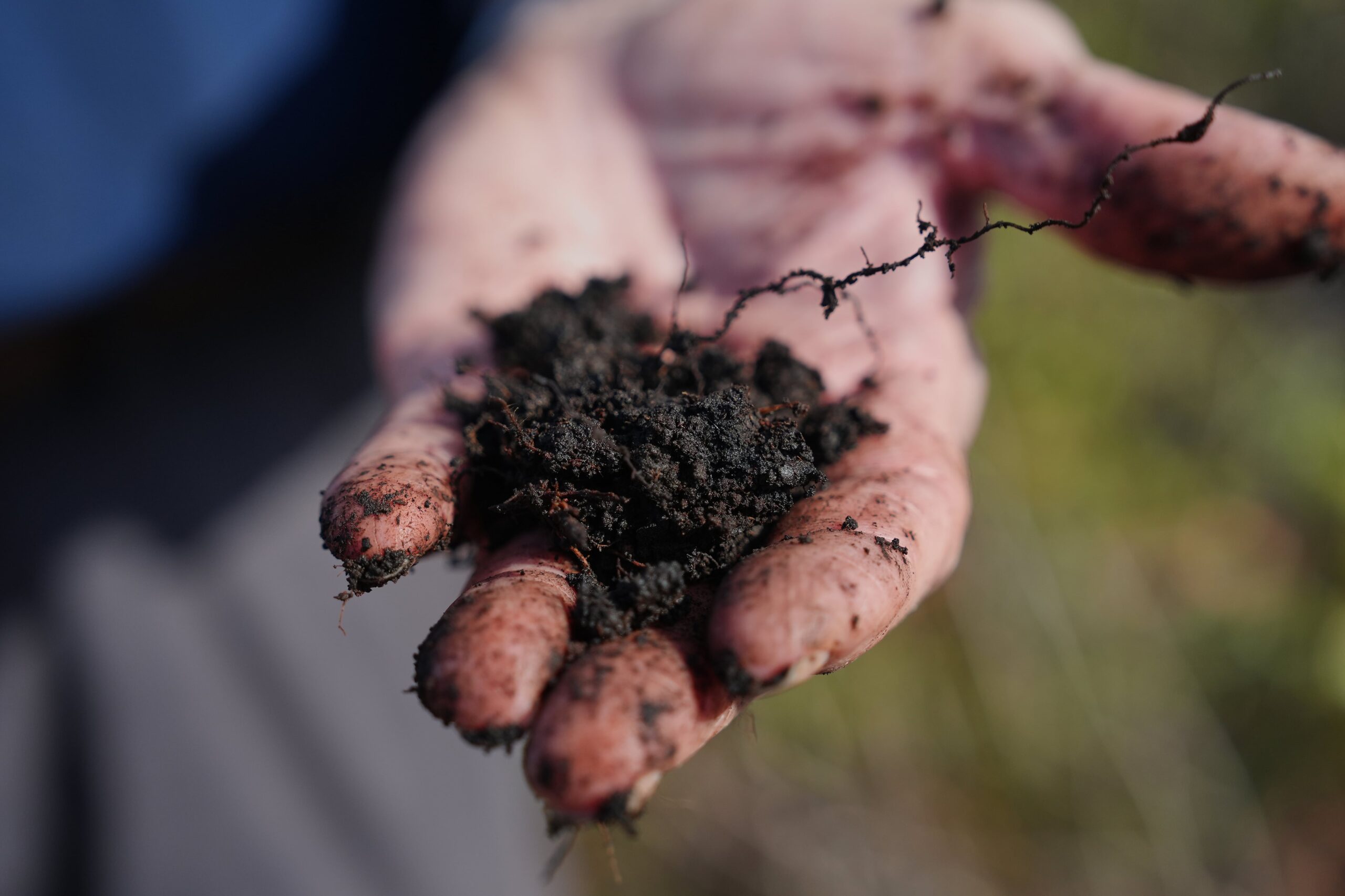
A new book makes the case that the world’s bogs and fens may be the most consequential ecosystems most people have never thought about.
Long before the first environmental protection law was written, peatlands were doing the slow, unglamorous work of holding the planet together. Covering just 3% of Earth’s surface, these waterlogged, oxygen-poor wetlands — known variously as bogs, fens, heaths and muskegs — store more carbon than all the world’s forests combined. When they function, they act as carbon sinks, absorbing atmospheric carbon and locking it into accumulating layers of partially decomposed plant matter. When they are drained, burned or degraded, they flip into sources, releasing stored carbon back into the atmosphere and accelerating the very warming that now threatens them. Understanding that dynamic is, increasingly, a matter of planetary survival.
Jennifer de Mooy’s “Water, Carbon, Time: Exploring Peatlands in a Warming World” (University of Minnesota Press, 2026; 200 pages; $19.95 paperback) arrives at exactly the right moment. A Minnesota-based writer with four decades in conservation and climate policy, de Mooy has produced a book that is part field guide, part ecological history, and part urgent warning — structured around visits to peatlands across North America, with scientists, conservationists and land managers as her companions.
The story she tells begins long before the modern environmental movement, in the deep geological past. Peatlands are largely relics of the last Ice Age, most concentrated at northern latitudes. Russia and Canada together hold two-thirds of the world’s peat. In Alaska alone, more than 7% of the state’s landmass qualifies as peatland — and coring near Homer has measured peat depths ranging from 7 to 25 feet, the product of thousands of years of slow accumulation.
For most of American history, that accumulation meant nothing to policymakers. Wetlands were widely regarded as wastelands — unproductive, mosquito-ridden obstacles to agricultural expansion. Well into the twentieth century, the federal government actively subsidized their destruction, funding drainage projects and wetlands conversions under the banner of flood control and public works. Peat itself was mined commercially, sold as insulation, packaging and poultry litter, and dried bales were burned during World War II in the smelting of artillery shells. The idea that these landscapes were performing irreplaceable ecological functions was simply not part of the political calculus.
By the time that calculus began to shift, the damage was severe. It was not until the 1970s — when the emerging science of ecology gave elected officials something concrete to act on — that wetlands began to receive meaningful legal protection. By then, more than half the wetlands in the contiguous United States had already been destroyed. The Clean Water Act of 1972 finally required that development projects destroying wetlands mitigate the harm they caused, a modest but consequential intervention that marked the first real acknowledgment of what had been lost.
De Mooy traces that policy arc with clarity, and she is careful to show that the science informing it was hard-won. Peatlands support biodiversity in ways that are still being mapped: they provide habitat for plant communities found nowhere else, nesting grounds for birds, and dense insect populations that ripple through broader food webs. They function as natural sponges, absorbing rainfall and releasing it slowly to buffer both floods and droughts. They filter pollutants and protect freshwater quality. In fire-prone regions, healthy, saturated peatlands serve as natural firebreaks — a function that becomes more critical as climate change extends fire seasons and expands their range.
Weeks spent visiting restoration sites give the book much of its texture. In New Jersey’s Pine Barrens, de Mooy describes a large-scale reengineering of a commercial cranberry bog, where heavy equipment resculpted the landscape to restore its natural hydrology. Elsewhere, she documents simpler interventions — filling in drainage ditches and allowing water to pool — that can begin reversing decades of degradation at relatively low cost. The message is not that restoration is easy, but that it is possible, and that the ecological return on investment is substantial.
The book’s most sobering chapter takes de Mooy to Alaska’s Kenai Peninsula, specifically the lowlands of the Kenai National Wildlife Refuge. Her visit was complicated — she and her husband contracted COVID-19 and were unable to meet with local researchers in person — but she corresponded with ecologist Ed Berg and drew on his published work to document what is happening there. Peat cores from the Kenai lowlands show no evidence of trees in the landscape over the past 14,000 years. That is changing now. Warmer temperatures and reduced precipitation are driving a transition from wet peatland to a drier mosaic of woody shrubs, dwarf birch and black spruce — a shift with profound implications for fire risk and for what scientists call carbon flux, the movement of carbon between peat, living plants and the atmosphere. The chapter also highlights Homer’s Drawdown project, a community-based initiative combining scientific education, local stewardship and artistic engagement to protect the region’s peatlands — a model of the kind of ground-level organizing that policy alone cannot replace.
In her epilogue, de Mooy is direct about what she believes is required: coordinated action across conservation, science and policy, pursued with the urgency that the linked crises of climate change and biodiversity collapse demand. She does not pretend that appreciation alone is sufficient. But she builds that appreciation carefully and honestly throughout the book, and by the time she makes her call, readers have earned the context to understand why it matters.
“Water, Carbon, Time” is a model of engaged environmental writing — rigorous enough to respect its subject, accessible enough to reach beyond specialists, and honest about the gap between what we know and what we are actually doing. Peatlands have been absorbing our mistakes for millennia. De Mooy’s book asks, with quiet force, how much longer we expect them to.