
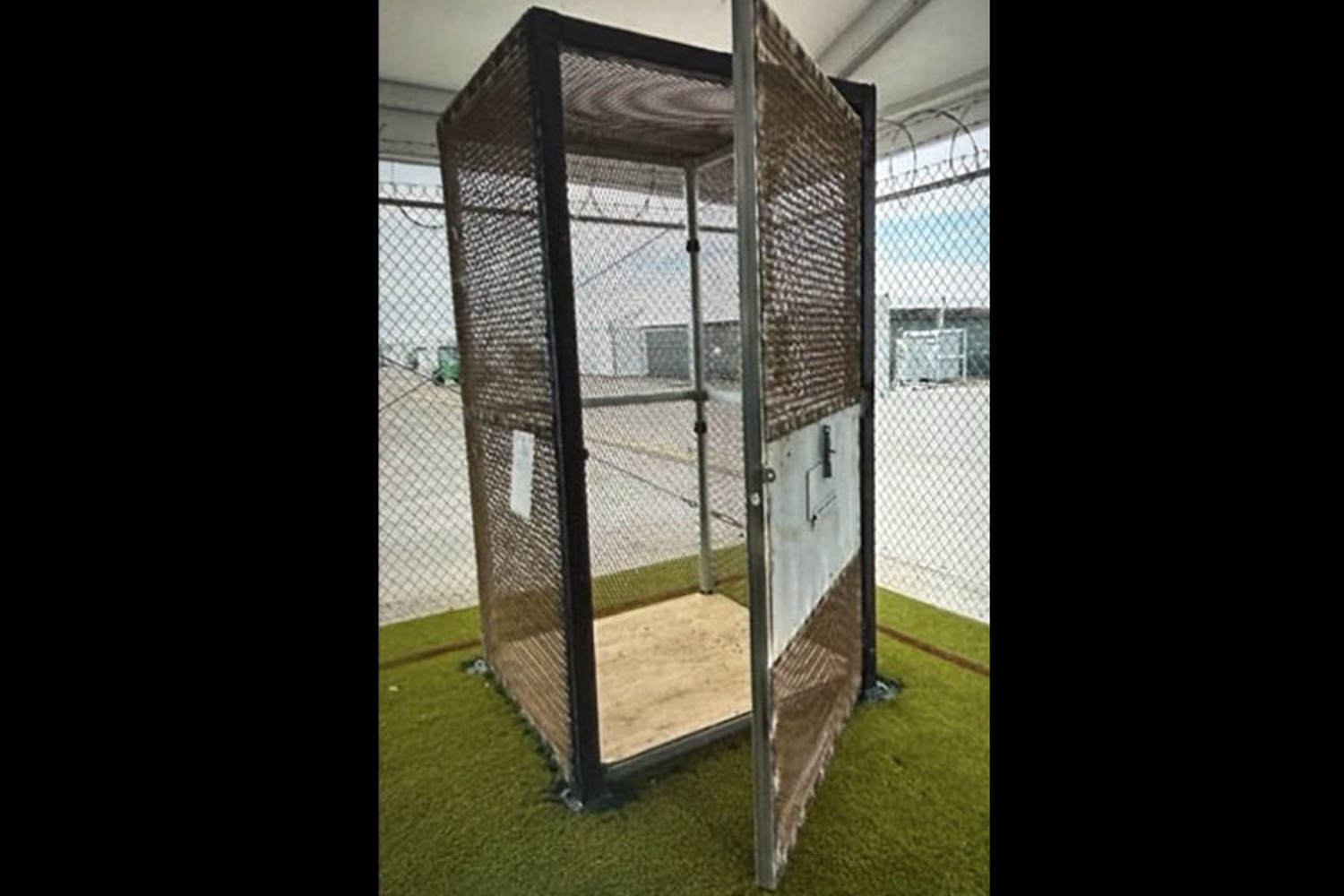
Picture a metal box, roughly four feet by four feet — sixteen square feet of Florida heat, open to the sun, the insects, and the thick Everglades air. Now picture a human being locked inside it.
That is what the Department of Homeland Security’s own inspector general has now confirmed happened at the South Florida Detention Facility, the immigration detention site that Florida Governor Ron DeSantis and the Trump administration christened, with apparent pride, “Alligator Alcatraz.” The watchdog report, published this week, marks the first time a federal agency has officially acknowledged the existence of small outdoor metal enclosures at the facility — cages that Amnesty International, after interviewing detainees and touring the site, had already concluded amounted to torture. The inspector general stopped short of that word, but its own language was damning enough: “the use of such restrictive spaces is highly unconventional and does not align with standards for humane treatment.”
The facility opened in July 2025 in the Everglades, built under DeSantis’s direction and operated through a so-called 287(g) agreement — a mechanism that allows state and local law enforcement to carry out immigration enforcement duties that are otherwise a federal responsibility. ICE, which is supposed to provide oversight under such agreements, had personnel on-site throughout the facility’s operation. Every detainee received an ICE handbook stating that Alligator Alcatraz “is a facility of the United States Immigration and Customs Enforcement.” And yet, when the inspector general’s findings landed, the DHS undersecretary of management and the acting director of ICE responded in writing that ICE held no contract with Florida for the facility and therefore bore no authority over its physical operations. The attempt to disclaim responsibility for conditions inside a facility that bore ICE’s own name is, to put it plainly, a remarkable act of institutional evasion.
The cages themselves — there were outdoor units of roughly 16 square feet and indoor versions of 18 square feet — were described by facility staff as “calming areas” where detainees could “de-escalate and have time alone.” A sign affixed to the outside of the enclosures said they offered detainees “a safe and secure place to reflect on their behavior choices.” ICE told the inspector general that detainees were shackled when escorted to the enclosures but not while inside them, a distinction that carries less weight when the space itself allows almost no movement. For context, ICE’s own guidelines require that single-occupancy rooms in immigration detention facilities measure a minimum of 37 square feet. Solitary confinement cells in federal prisons run to approximately 84 square feet. The cages at Alligator Alcatraz were less than half the size the federal government’s own standards demand for the most restrictive form of individual confinement.
Records reviewed by the inspector general show that 79 detainees were held in these enclosures between July 17, 2025, and January 18, 2026. The average stay was just under an hour; the longest recorded was just over two hours. Staffers told investigators that time was closely monitored and that detainees could leave at any time by request — a claim that sits uneasily alongside the locking mechanisms the inspector general’s team observed on the cages during their visit.
Amnesty International’s account, drawn from interviews with four detainees during a September 2025 tour, painted a considerably grimmer picture of the broader facility: overflowing toilets with fecal matter seeping into sleeping areas, exposure to insects, and lights burning 24 hours a day. On the cages specifically, detainees described being shackled at both hands and feet, unable to sit, forced to stand for hours in direct heat with little water and no protection from the sun. Amnesty’s conclusion was unambiguous — the use of what detainees called “the box” as a form of punishment constitutes torture. The inspector general’s report, constrained by its institutional role, did not adopt that framing, but it did not contradict the underlying facts.
When DeSantis was asked about the report at his daily news conference, he said he hadn’t read it. He then offered that the facility’s goal had been not merely to meet detention standards but to exceed them. The facility has since closed, in June, with DeSantis describing it as always having been intended as a temporary measure. Detainees were either deported or transferred to other federal facilities.
What remains is the bill. The Florida facility cost the state more than one billion dollars in taxpayer money, according to state records made public through litigation. The Federal Emergency Management Agency has provided Florida $608 million toward its operation. Internal government spreadsheets, reviewed by NBC News after appearing in court filings, show the facility cost more than one million dollars per day to run. A standard ICE detention bed costs less than $200 per day; a bed at Alligator Alcatraz cost in excess of $3,000. The Trump administration and DeSantis presented the facility as a bold and necessary instrument of mass deportation. What it delivered, by the government’s own accounting, was a grotesquely expensive, constitutionally dubious operation that confined human beings in spaces smaller than a parking space and left a federal paper trail nobody in authority now wants to own.
The inspector general’s report is a rare moment of institutional accountability in an administration that has fired at least 18 inspectors general since January 2025 — officials whose entire mandate is to conduct objective audits and investigate waste, fraud, and abuse. Joseph Cuffari, DHS’s inspector general, is among the few Cabinet-level watchdogs who survived that purge. His office’s findings will not undo what happened inside those metal cages. But they make it considerably harder to pretend it didn’t happen at all.