
A Recruit Without a Camera, a Man With a Bullet in His Back
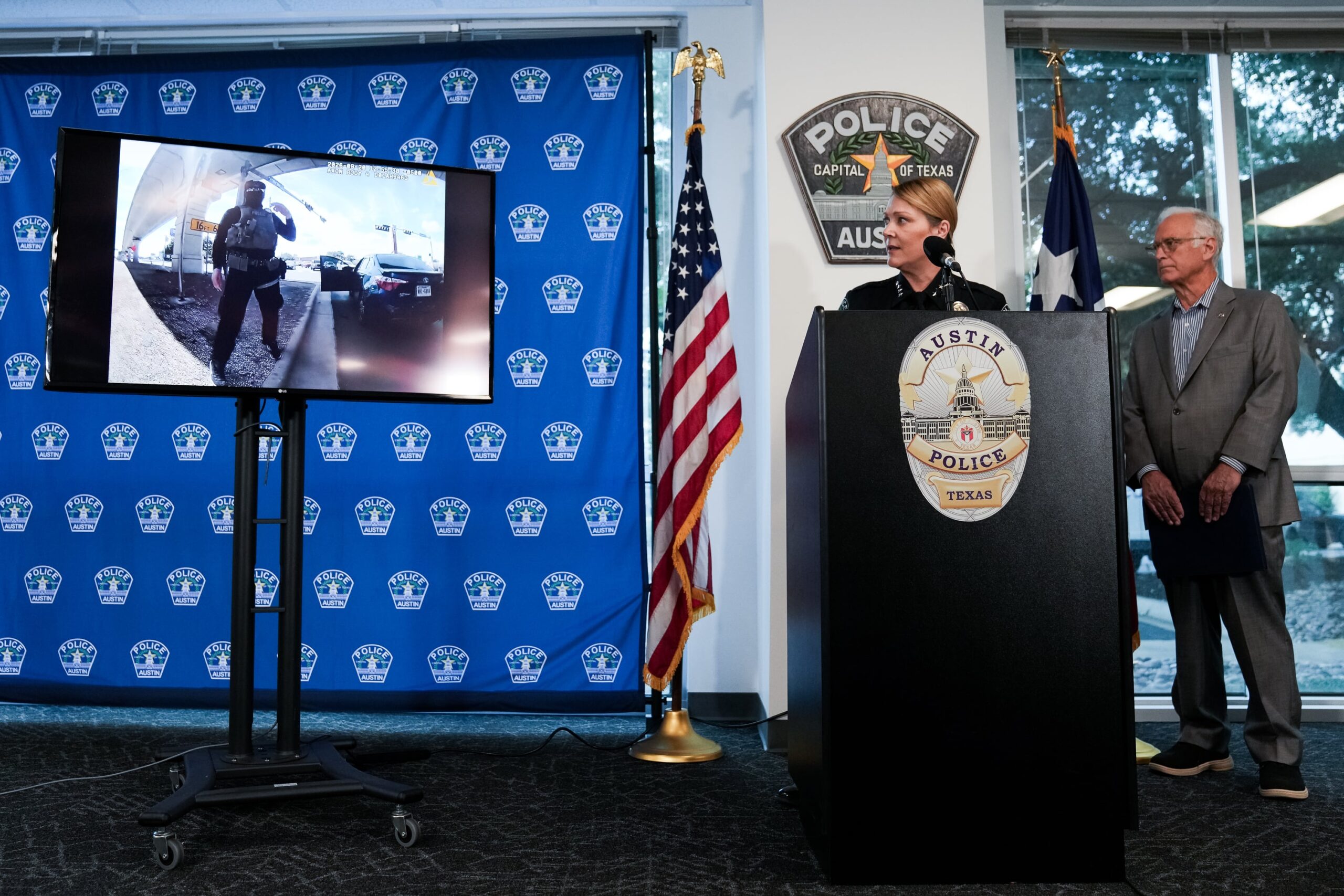
The ICE officer who shot Venezuelan asylum seeker Wilber Garcés Pérez in Austin on Sunday was a newer recruit who had been issued a body camera but was not using it when he fired his weapon, according to two former Department of Homeland Security officials briefed on the matter. The officer had previously worked at another federal law enforcement agency before joining ICE during the agency’s aggressive hiring surge last year — a surge that former officials say prioritized speed over scrutiny. DHS did not respond to questions about the officer’s background, training, or why he failed to activate his camera during an arrest. The Atlantic first reported the officer’s recruit status.
Garcés, 28, is a DoorDash delivery driver who entered the United States legally to seek asylum. He was shot after ICE officers in an unmarked black SUV attempted a traffic stop. His attorney, Kate Lincoln-Goldfinch, says ICE sideswiped his car and struck it again as Garcés attempted a U-turn to find a safe place to pull over — a reasonable response, she argues, given that the vehicle pursuing him bore no visible law enforcement markings. Bystander video shows an officer exiting the SUV and approaching Garcés’s vehicle before shots ring out. The footage raises serious questions about DHS’s official characterization of the encounter as a “dangerous attempt to evade arrest.”
Garcés now sits in immigration detention with a bullet lodged near his spine — too close to safely remove, according to his doctors — a fractured clavicle, and reported episodes of partial paralysis on his left side. He spent his first night in the Pearsall, Texas detention facility sleeping on the floor, according to his attorney, though DHS disputes this account. His case has become a focal point in the escalating debate over ICE’s use of force, the adequacy of its officer training, and the administration’s systematic failure to implement its own body camera policy.
A Hiring Surge That Outpaced Vetting
The Austin shooting did not occur in a vacuum. It is the latest in a string of incidents that former DHS officials trace directly to the administration’s decision to rapidly expand ICE’s ranks without ensuring adequate background checks or training. DHS has been quietly terminating some of these recruits in recent months — over poor performance or red flags that, critics say, should have disqualified them before they ever reached the streets. The fact that these problems are being identified after deployment rather than before it reflects a structural failure in how the agency has managed its hiring spree.
The officer who shot Garcés had prior federal law enforcement experience, which may have contributed to his placement in the field. But experience at another agency does not substitute for ICE-specific training, particularly as the agency has dramatically expanded the scope and aggression of its enforcement operations. Former officials who spoke to The Washington Post on condition of anonymity to discuss internal matters described a culture in which urgency overrode due diligence — and where the consequences of that trade-off are now becoming impossible to ignore.
The Body Camera Rollout: A Study in Institutional Evasion
Promises Made, Promises Delayed
The body camera program’s troubled history is itself a story of institutional dysfunction, political interference, and shifting accountability. Following the January shooting deaths of U.S. citizens Renée Good and Alex Pretti in Minneapolis — incidents in which officers also lacked active cameras — then-DHS Secretary Kristi Noem announced that all 22,000 ICE officers and agents would be equipped with body cameras. ICE acting director David Venturella subsequently promised that cameras would be distributed to every officer by the end of August. An agency spokesman told The Washington Post in late August that DHS had enough cameras to equip the entire force nationwide.
Then the goalposts moved. In early September, Homeland Security Secretary Markwayne Mullin said at a news conference that cameras had not yet been fully distributed and that only officers assigned to make field arrests would receive them. This narrowing of scope — announced quietly, weeks after the original deadline had passed — effectively left a significant portion of the agency’s workforce without the accountability tools that officials had publicly promised. The White House, it emerged, had initially sought to eliminate the body camera program entirely, a detail that casts Mullin’s expressed support for the initiative in a more complicated light.
A Reminder Memo That Arrived Too Late
Following the Austin shooting, ICE sent an email to all officers on Tuesday reminding them that they “must activate” their cameras “to capture footage of Enforcement Activities” and instructing them to turn on devices before a traffic stop begins, or immediately afterward if circumstances prevent prior activation. Officers who fail to comply must submit a written explanation. The memo’s timing — issued after another unarmed man was shot by an officer without a recording — underscores how reactive rather than preventive the agency’s approach to accountability has been. It also raises the question of why such a reminder was necessary at all if the policy had been clearly communicated and enforced from the start.
A Pattern of Shootings, a Pattern of Silence
The Austin incident fits a disturbing pattern. In July, ICE officers shot and killed Lorenzo Salgado Araujo, a Mexican national and longtime Houston resident. Days later, another officer shot and killed Johan Sebastián Durán Guerrero, a Colombian immigrant in Maine. In both cases, as in Austin, officers fired at drivers seated in their vehicles. After the Maine shooting, ICE temporarily suspended traffic-stop arrests in most circumstances — a pause that lasted only until President Trump publicly praised the tactic as an essential enforcement tool, at which point the agency reversed course.
The Justice Department has taken few visible steps to investigate the dozens of documented shootings connected to the administration’s immigration enforcement campaign. In several of these incidents, bystander footage has directly contradicted the department’s official narrative, yet no meaningful federal accountability mechanism has been triggered. The absence of body camera footage in the Austin case means that, once again, the public is left to weigh ICE’s account against limited external evidence — a situation that the agency’s own policy failures have created and that its leadership has so far declined to address with any urgency.
DHS’s statement Tuesday characterized Garcés’s shooting as the result of dangerous behavior on his part, and Mullin’s office noted that his work permit had expired. “This person is an illegal alien who has no legal status to be here and has been given some of the best medical care he’s ever received in his life,” Mullin said — a statement that his attorney and advocates called callous and factually contested. The framing is telling: rather than acknowledge the accountability gap created by a recruit without an active camera, the department’s first instinct was to litigate the immigration status of the man who was shot.
Who Is Wilber Garcés Pérez?
Garcés entered the United States legally to seek asylum. An immigration judge ultimately issued a removal order after he missed a court hearing — but his attorney says officials mailed the notice of his court date to an old address, meaning he may never have received it. He is the primary financial provider for his family and has a young son with a disability whose medical costs he covers. Before Sunday, he was working as a DoorDash delivery driver. These are not the details that appear in DHS press statements, but they are the details that matter if one is trying to understand what actually happened and why.
Lincoln-Goldfinch has filed a federal lawsuit in Texas seeking Garcés’s release and a halt to his potential deportation to Venezuela. U.S. District Judge Orlando L. Garcia has scheduled an in-person hearing for September 30 and ordered that Garcés be present. As of Monday evening, Garcés had been transferred to a second hospital after reporting paralysis on his left side. “We still do not have clarity about the cause or extent of the loss of movement he experienced,” Lincoln-Goldfinch wrote on social media — a sentence that, in its clinical precision, captures the profound uncertainty surrounding a man who was shot by an agent of the U.S. government and then taken into custody four hours later.
What Accountability Requires
The Austin shooting exposes several overlapping failures that demand direct answers. First, why was a newer recruit placed in an enforcement role — conducting traffic stops — without an active body camera, in direct violation of stated policy? Second, why has the body camera rollout been so inconsistently implemented, and who bears responsibility for the gap between the promises made in August and the reality on the ground in September? Third, why has the Justice Department failed to open visible investigations into a pattern of shootings by federal immigration agents that has now claimed multiple lives and seriously injured others?
The answers to these questions will not emerge from DHS press statements, which have so far functioned primarily as political defense rather than factual accounting. They require congressional oversight, independent investigation, and a press corps willing to treat the absence of accountability as the story — not merely the backdrop. Lincoln-Goldfinch’s challenge to Mullin was direct: “You need to answer why your agents are not turning their body cams on.” That question deserves a direct answer, and the public deserves more than a reminder memo issued after another man has already been shot.