
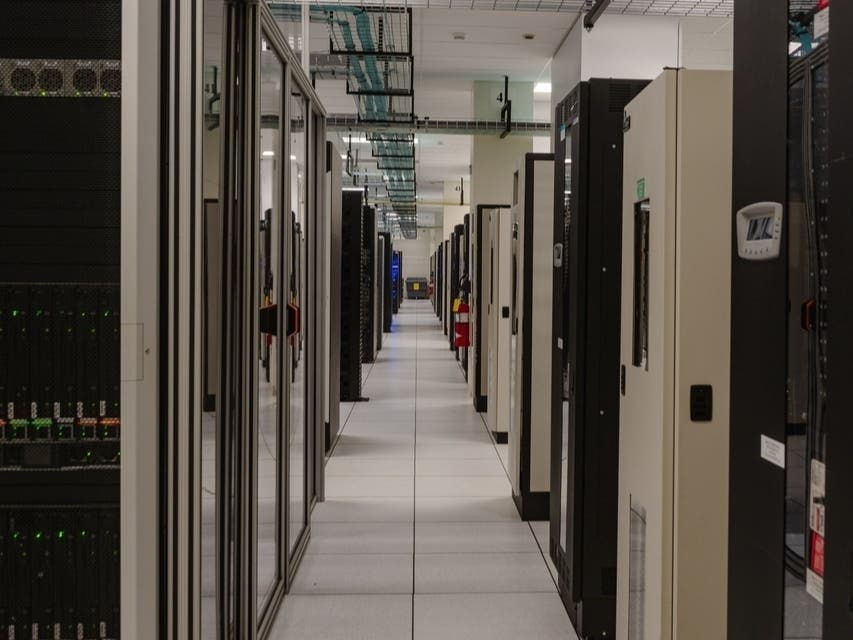
New Jersey’s environmental regulators have levied a record-breaking fine of more than $1 million against a data center in Vineland, penalizing the facility for operating dozens of unpermitted natural-gas generators in violation of the state’s Air Pollution Control Act — a landmark enforcement action that arrives as communities across the state mobilize to ban such facilities outright.
The New Jersey Department of Environmental Protection announced the $1,072,000 penalty against DataOne, whose Vineland facility was found, following a July 29 inspection, to have installed and operated 62 large stationary generators — each rated at 1,982 kilowatts — without obtaining the required preconstruction permits or appropriate operating certificates. NJDEP Commissioner Ed Potosnak confirmed it is the largest enforcement action of its kind ever taken against such a facility in New Jersey’s history. The generators were no longer present when inspectors returned to the site in December 2025, according to the Administrative Order and Notice of Civil Penalty Assessment.
The scale of the violation is not incidental. Natural-gas generators of this class emit carbon dioxide, nitrogen oxides, and carbon monoxide at industrial volumes; state regulations require permits for any generator producing 37 kilowatts or more, a threshold that the DataOne units exceeded by a factor of more than fifty. By contrast, a standard portable home generator produces between 5 and 15 kilowatts. DataOne has been ordered to either immediately apply for and secure the mandatory permits or cease operations.
The Vineland facility has become the defining symbol of a fast-moving grassroots campaign against AI-driven data centers in New Jersey. The Climate Revolution Action Network, which has been advocating for municipal bans, reports that more than 30 towns had prohibited data centers outright as of mid-August, among them Jersey City, Bayonne, Howell, Warren, Madison, East Brunswick, and Stafford Township, with Brick Township introducing a ban ordinance on September 8. Bridgewater took a more cautious path, approving regulatory restrictions at its September 8 council meeting rather than an outright ban, citing concerns about potential litigation — a fear that is not unfounded, given that Montgomery’s ban is already being challenged in court by developer E. Kahn Development Corp.
The anxiety driving these local actions is tangible and, in at least one case, literally physical. During a Manchester Township council meeting at which residents urged an outright ban, a woman who had been visiting family in Vineland testified that she could feel vibrations from the DataOne center at a home located more than a mile away.
The broader context is one of rapid and largely unregulated industrial expansion in service of artificial intelligence infrastructure. The Climate Revolution Action Network argues that while data centers have existed since the 1950s and were “generally harmless,” the energy and resource demands of AI workloads have fundamentally changed their impact on surrounding communities, ratepayers, and the environment. Supporters of the industry counter that these facilities are essential to keeping New Jersey competitive in the AI economy.
Governor Mikie Sherrill’s administration has declined to impose the statewide moratorium that opponents have demanded, but it has moved on two significant regulatory fronts: Sherrill signed legislation requiring data centers to source their own clean energy and establishing a separate utility rate class to shield residential customers from the grid costs these facilities impose, and as of August 27, data center operators must submit regular reports to the New Jersey Board of Public Utilities detailing their water and energy consumption.
Commissioner Potosnak framed the Vineland penalty in explicitly deterrent terms. “The enforcement action sends a clear message that these facilities will not be constructed or operated with impunity in this state,” he said, adding that the Sherrill administration “demands accountability and corporate responsibility in the construction and operation of data centers and is committed to putting in place legal and regulatory guardrails that protect ratepayers, communities and the environment.” Whether a single fine, however record-setting, will prove sufficient to discipline an industry expanding at the pace of AI investment remains the central question for the communities still fighting for stronger protections.