
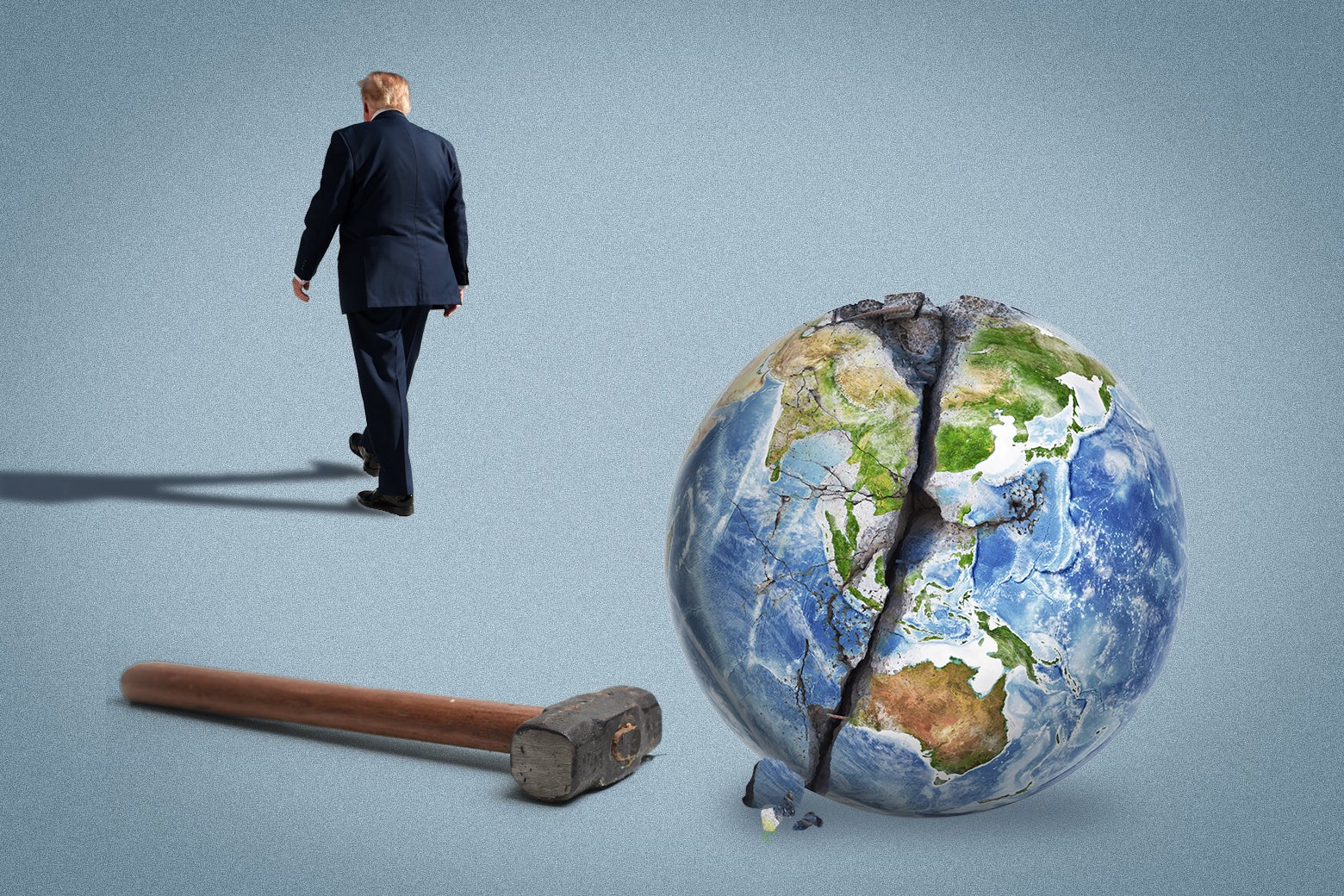
Picture the scene at the United Nations General Assembly last month: world leaders assembled in formal rows, diplomats in pressed suits, the full theater of international order on display — and then Donald Trump at the podium, declaring that Venezuela’s oil reserves now belong to the United States by right of conquest. “To the victor belong the spoils,” he told the delegates, with the casual menace of a man who has never once doubted his own impunity. The room did not erupt in applause. It absorbed the statement the way a body absorbs a blow — with visible effort and no small amount of dread.
That moment crystallized something that veteran diplomats and foreign-policy analysts have been wrestling with since Trump returned to the White House: the question is no longer whether his second term is damaging America’s global standing — it plainly is — but whether the damage is the kind that heals once he’s gone, or the kind that scars permanently. The distinction matters enormously, both for the architecture of Western alliances and for the progressive values of democratic solidarity, multilateral cooperation, and rules-based international order that those alliances, however imperfectly, were built to protect.
We’ve Heard This Before — And Then Things Recovered
The chorus of alarm surrounding Trump’s foreign policy is, in one sense, a rerun. During his first term, the Guardian warned that NATO allies were questioning whether America would honor its Article 5 commitments. CNN catalogued governments across Europe, Asia, and the Middle East quietly seeking alternative sources of leadership. A veteran of both the George W. Bush and Obama administrations declared, with the gravity of an epitaph, “This is how the liberal international order dies.” And yet it didn’t die. Trump lost in 2020, Biden took office, and the alliances snapped back with surprising vigor. NATO expanded to include Finland and Sweden. Western nations rallied around Ukraine with weapons, sanctions, and solidarity. The AUKUS pact between the United States, United Kingdom, and Australia took shape. The Quad — linking the US, Japan, Australia, and India — drew tighter. The rebuke to pessimism seemed almost embarrassingly complete.
That history informs a notably optimistic Foreign Affairs essay published last August by Kurt M. Campbell and Rush Doshi, both veterans of Biden’s National Security Council. Their argument is structurally compelling: America’s alliances have survived not just difficult presidents but genuine civilizational shocks — the Vietnam catastrophe, the Iraq debacle, the 2008 financial crisis, the energy crises of the 1970s. “The lesson of history,” they write, “is that alliance systems often prove more resilient in retrospect than contemporary observers expect at the time.” The underlying logic, they contend, is not sentiment but interest. America’s partners are not friends in the schoolyard sense; they are strategic partners bound by shared threats, and those threats — Russian military aggression, Chinese economic expansionism — are more acute now than they have been in decades. Interdependence in trade, technology, and military infrastructure gives allied governments powerful incentives to repair whatever Trump breaks, once someone else holds the keys.
It is a sophisticated and carefully argued case. It is also, on close inspection, riddled with holes large enough to sail an aircraft carrier through.
Trump’s Worldview Is No Longer Just His
The most fundamental problem with the Campbell-Doshi optimism is the assumption that Trumpism is essentially a personality disorder — a quirk of one man that will recede when the man does. The evidence cuts hard against that reading. Trump has spent a decade systematically remaking the Republican Party in his image, purging officials who resisted his “America First” doctrine and rewarding those who bent the knee. Marco Rubio, once a hawkish internationalist who successfully co-sponsored legislation preventing any president from unilaterally withdrawing from NATO, now sits as Secretary of State and executes Trump’s wishes with apparent enthusiasm. After accusing several allies of blocking US military access to their bases during the Iran conflict, Rubio went on Fox News and asked, with apparent sincerity, “If we can’t use our base when we have a contingency, what’s the point of having the base and, frankly, the point of the alliance?” The man who once defended NATO’s existence is now publicly questioning it on behalf of a president who treats it as an obstacle.
The GOP’s congressional wing still contains members who privately support NATO and view Russia with suspicion, but the voters who send them to Washington are thoroughly Trumpified, and those voters are not going anywhere. Trump was deeply unpopular at the end of his first term and still managed to win a second. His grip on the Republican base shows no sign of loosening, and there is little reason to believe he will quietly relinquish his role as kingmaker once he leaves office. The next Republican presidential nominee is far more likely to inherit his hostility to multilateral commitments than to resurrect the pro-alliance, anti-Russia posture of the pre-Trump GOP. For America’s partners, one Trump term was an aberration they could explain away; two terms is a pattern they have to plan around, and the prospect of a Trumpist holding the presidency roughly half the time for the foreseeable future makes rebuilding trust a structurally precarious project.
Meanwhile, Trump’s return has also reshaped the Democratic Party’s foreign-policy instincts in ways that complicate the optimistic scenario. Biden’s attempt to rehabilitate America’s global standing — his repeated assurance that “America is back,” met by world leaders who reportedly responded, “But for how long?” — now looks prophetic in its fragility. The ambitious Democrats positioning themselves for 2028 are focused on domestic reconstruction: economic investment, institutional reform, a Supreme Court badly warped by years of Republican manipulation. Many progressives, understandably exhausted by decades of military adventurism sold as democracy promotion, are skeptical of projecting American power abroad and have sometimes framed confrontation with Russia and China as reflexive jingoism or a gift to defense contractors. That skepticism, however understandable in origin, risks letting alliances atrophy regardless of which party wins the next election.
Not Every Ally Wants the Old Order Back
A second, darker complication in the optimistic picture is that some of America’s nominal allies are not actually suffering under Trump’s new dispensation — they are thriving in it. Autocratic partners like Saudi Arabia and Qatar have turned his transactional approach to geopolitics, and his family’s well-documented susceptibility to financial entanglement, into a competitive advantage. More troublingly, within democratic allied nations, right-wing political movements that share Trump’s xenophobic and isolationist instincts are gaining ground with alarming speed. The far-right Alternative for Germany party recently won a closely watched state election in a landslide. Reform UK, led by Trump’s ideological ally Nigel Farage, has led national polling for much of the past year. Marine Le Pen’s National Rally is ahead in surveys ahead of France’s next presidential contest. In Brazil, Flávio Bolsonaro — son of a former president who attempted a coup in the mold of January 6th — topped the first round of this week’s presidential election and is favored to win the runoff.
This is the scenario that Campbell and Doshi’s framework struggles to accommodate: Trump does not need to turn the United States into an outright pariah for Western alliances to lose their character and purpose. He could instead transform them from the inside, populating them with governments that share his contempt for democratic norms, his hostility to multilateral rules, and his comfort with authoritarian power. An alliance of Trumpists, Farage disciples, and Le Pen sympathizers is not a Western alliance in any meaningful sense — it is something closer to the illiberal bloc it was built to oppose.
The damage to America’s concrete economic credibility compounds the political damage. Even friendly nations are reducing their holdings of US Treasury bonds as yields soar and confidence wavers. The dollar’s share of global currency reserves, already declining, dropped further after Trump retook office. His attempts to politically pressure Federal Reserve officials and weaponize the legal system against opponents have raised genuine questions about whether the United States remains a safe destination for investment. A Pew Research Center survey conducted this year found that people in Australia, Canada, France, Germany, Greece, Italy, the Netherlands, Spain, and Sweden — all formal US allies — now view China more favorably than they view the United States. That is a remarkable reversal, and it happened faster than Trump’s first term ever managed to produce.
Self-Interest Is Not Self-Executing
The deepest flaw in Campbell and Doshi’s argument is philosophical rather than empirical. Their case rests on the assumption that rational self-interest will ultimately reassert itself — that allied governments will set aside their grievances with Trump because confronting China together is simply too obviously necessary to abandon. It is a logical argument. It is also an argument that assumes logic governs political behavior more reliably than it does. If the benefits of strong alliances were self-evident to American voters, or to Trump himself, the current crisis would not exist. The history of international relations is littered with moments when the rational course of action was perfectly clear and perfectly ignored.
What seems more likely, at least in the near term, is not a clean restoration of the old order but a messy global improvisation. Canada’s Prime Minister Mark Carney traveled to Beijing earlier this year to inaugurate what he called a “new strategic partnership,” exchanging lower Canadian tariffs on Chinese electric vehicles for reduced Chinese tariffs on Canadian agricultural goods. He has simultaneously sought “associate membership” in the European Union, a status without precedent, as a hedge against American unreliability. He is not alone in this hedging. Governments that cannot count on Washington as a stable counterweight to Beijing may find that managed coexistence with China is preferable to confrontation — even knowing that China poses a deeper long-term threat to democratic governance and open markets than Trump does. The logic of detente, once it takes hold, is hard to reverse.
Finnish President Alexander Stubb, whose country joined NATO during the Biden administration, is reportedly betting that the alliance will adapt and endure. His optimism is partly grounded in a personal friendship with Trump built around a shared love of golf, and partly in a “good relationship” with Jared Kushner, which he hopes will help broker an end to Russia’s war in Ukraine. That the fate of European security might hinge on golf diplomacy and Kushner’s goodwill is itself a measure of how far the situation has deteriorated. And even Stubb’s optimism comes wrapped in a candid acknowledgment that Europe must forge new partnerships in “a world of disorder” — which is not the language of a man who believes the old order is intact.
The Stakes Are Too High for Wishful Thinking
Campbell and Doshi are right that America’s alliances have survived serious crises before. The bonds forged after World War II have proven more durable than skeptics repeatedly predicted, and the underlying logic of collective security against shared threats has not disappeared. But those bonds were built and maintained in an era when the United States could be counted on, even in its worst moments, to remain fundamentally committed to the rules-based order it helped design. What Trump’s second term is testing is something different: whether alliances can survive not just a difficult president but a political movement that has decided the rules-based order is the enemy.
The answer to that question will not be written by Trump alone. It will be written by whoever comes after him — in both parties, in allied capitals, and in the streets of countries where voters are choosing between democratic solidarity and the seductive simplicity of nationalist grievance. The ship of state is seeking safety in a storm, as one European leader put it. The storm, unfortunately, shows no sign of passing on its own.