
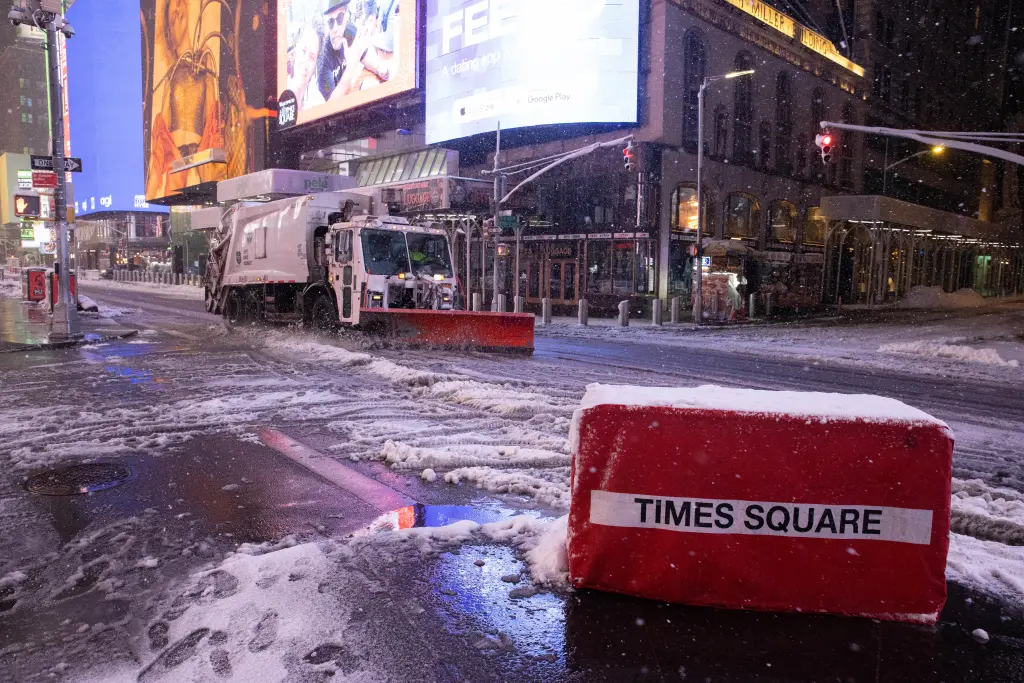

New York City slowed to a near standstill on Monday, February 23, 2026. A powerful winter storm brought intense snowfall and strong winds across the metro area. Early reports showed double-digit totals in several neighborhoods. Forecasters warned that travel could become “nearly impossible” in parts of the region.
What “bomb cyclone” means in plain terms
A bomb cyclone is a storm that intensifies very quickly as air pressure drops fast. That rapid strengthening can boost winds and intensify precipitation. In winter, that mix can create blizzard conditions and sudden whiteouts.
Double-digit snow totals reported across the city
Snow kept falling before dawn. Staten Island reported more than 13 inches. Mott Haven in the Bronx reached about a foot. Flatbush and Washington Heights also topped 11 inches, based on National Weather Service updates cited in reports.
Snowfall rates surged during the morning
The storm produced bursts of very heavy snow. Reports cited rates near 2 to 3 inches per hour early Monday from New York toward Massachusetts. Strong winds lowered visibility and made plowing harder. As a result, conditions changed quickly from block to block.
Winds, outages, and emergency declarations
Wind gusts reached around 60 mph in parts of the region, according to reports. Power outages spread across the East Coast, including large impacts in New Jersey. New York Governor Kathy Hochul declared a state of emergency covering all five boroughs, Long Island, and other counties. New Jersey also placed the entire state under a state of emergency.
Roads emptied as travel bans took effect
City streets turned quiet overnight. A travel ban was pushed to residents through a loud cell phone alert Sunday evening. Reports said the restriction began at 9 p.m. Sunday and was set to run through noon Monday. Snowplows became the main vehicles on many routes.
Transit disruptions spread across the region
Public transportation also took a hit. NJ Transit suspended service, according to agency statements cited in reports. The Long Island Rail Road and New York City subways reported cancellations, delays, and service changes. Commuters faced limited options as the storm intensified.
Flight cancellations climbed into the thousands
Air travel disruptions expanded beyond the Northeast. Flight tracking data cited in reports showed more than 5,500 U.S. flights canceled on Monday, with thousands more delayed. Airports in New York City and Boston accounted for many of the disruptions.
Schools close as the storm continues
New York City schools closed for the day. Mayor Zohran Mamdani described it as the first “old-school snow day” since 2019, according to reports. Forecasters expected the storm to keep dumping snow through much of Monday, with higher totals still possible before conditions improved.