
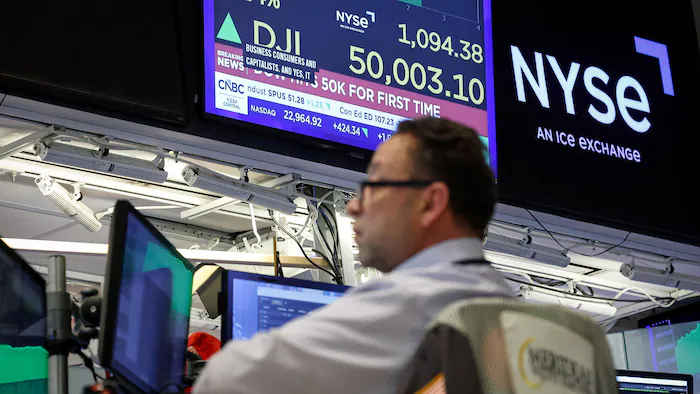

President Donald Trump has again predicted the Dow Jones Industrial Average could reach 100,000 before he leaves office, after the blue-chip index closed above 50,000 for the first time in early February.
The Dow finished above 50,000 on Feb. 6, 2026, a milestone that followed a broad market rally led by technology stocks and expectations that interest rates could fall later this year.
Dow 100,000 claim draws attention to long-term market gains
The renewed forecast has prompted fresh discussion about how far U.S. equities have climbed since the early 1980s. The Dow fell below 800 in 1982 during a prolonged downturn tied to recession and high interest rates, including a close at about 795 on March 8 of that year.
While the Dow is a price-weighted index of 30 large U.S. companies, other measures point to a broader surge in the value of publicly traded American firms. The total market capitalization of U.S.-listed companies was about $69 trillion as of Jan. 1, 2026, according to Siblis Research.
How the US compares with other major markets
Recent estimates put China’s stock market capitalization at roughly $16.3 trillion in January 2026, according to CEIC data.
Japan’s equity market is widely cited as being close to $8 trillion, based on industry commentary that pegged it at about $7.9 trillion.
For Europe, one recent estimate put the combined market capitalization of European stock markets at about €22.7 trillion in 2025.
Tax and inflation shifts are central to the political argument
Supporters of lower taxes and deregulation often argue that policy changes since the 1980s helped fuel corporate profitability and investment. The top federal individual income tax rate for 2026 is 37%, according to the IRS, compared with the 70% top marginal rate in place before the Reagan-era tax cuts began to take effect.
The statutory federal corporate income tax rate remains 21%, a level set by the 2017 Tax Cuts and Jobs Act.
Debate also continues over who bears the federal income tax burden. USAFacts, citing IRS data, reports that the top 1% of earners paid about 40% of federal income taxes in 2022.
Local tax debates add to the national spotlight
Tax policy has also become a point of emphasis in major U.S. cities and states. Zohran Mamdani was sworn in as New York City’s mayor on Jan. 1, 2026, after campaigning on a platform that included tax increases on higher earners, according to the city’s mayoral office profile.
Trump has not detailed a specific pathway for the Dow to reach 100,000, and market strategists note that future performance will depend on factors including interest rates, corporate earnings, inflation, and global growth. The Dow’s move above 50,000 has nonetheless intensified the political and economic debate over which policies have mattered most in the market’s decades-long rise.