
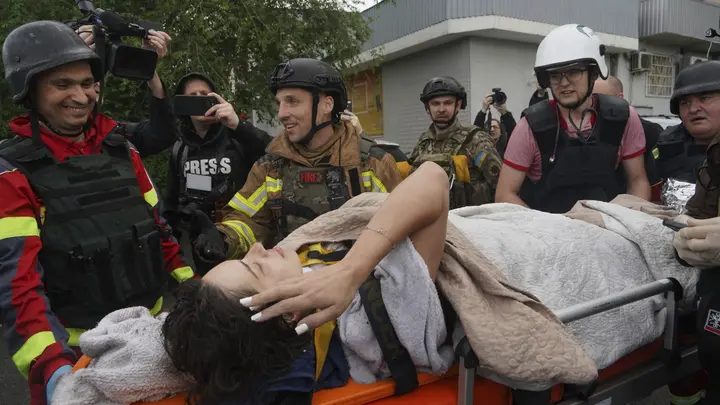

Four years after Russia launched its full-scale invasion, the war in Ukraine has hardened into an attritional fight. Attrition means both sides trade losses for small gains, day after day. Russia still holds about one-fifth of Ukraine, while Kyiv reports limited recaptures in recent pushes.
At the same time, diplomacy has accelerated. Washington has hosted repeated contacts with Kyiv, and U.S.-brokered talks have continued in the Middle East and Europe. The result is a conflict shaped by two tracks: battlefield pressure and negotiations that still lack a clear breakthrough.
A front line that barely moves, at a very high cost
The map has changed slowly since 2022, but the human toll has grown. Public casualty estimates vary widely and remain hard to verify during wartime. Some assessments put Russian casualties as high as about 1.25 million, while others cite lower totals for both sides. Many independent trackers warn that any single number carries uncertainty.
What is clear is the scale of loss. Ukraine and Russia both rely on mass artillery, drones, and fortified positions. They also rotate units under strain. That dynamic makes big advances rare, and it makes each kilometer costly.
Ukraine peace talks have moved from capitals to neutral venues
Negotiations have continued even as fighting persists. U.S. President Donald Trump met Russian President Vladimir Putin in Anchorage, Alaska, in August 2025, in talks focused on possible pathways toward a settlement.
Since then, U.S.-mediated contacts have expanded. Delegations met in Abu Dhabi in January and early February 2026. They then held talks in Geneva on February 17–18, with U.S. envoy Steve Witkoff involved in the discussions. The talks produced limited public detail, but they kept a channel open and signaled sustained U.S. engagement.
Stalemate remains the default outcome
Many former officials describe the most likely near-term path as continuation. Neither side has delivered a decisive strategic break. Russia’s territorial grip has held in broad terms. Ukraine has kept its state intact and its army cohesive.
Retired U.S. Air Force Gen. Philip Breedlove, a former NATO supreme allied commander in Europe, has argued that Russia has not achieved a victory despite its occupation. That view reflects a wider Western assessment: Russia has failed to meet its maximal aims, while Ukraine has not yet forced a full rollback.
This scenario keeps pressure on both economies and societies. It also rewards endurance, logistics, and external support more than single operations.
Momentum could still shift the negotiating balance
A second scenario depends on Ukraine sustaining battlefield gains. In early 2026, Ukraine and its partners moved to restrict Russian use of Starlink terminals. Starlink is a satellite internet system that supports communications in areas with damaged infrastructure. Ukraine says the restriction disrupted Russian connectivity in some sectors, though Russian officials have downplayed the impact.
Ukraine has also leaned heavily on drones. FPV drones, or “first-person view” drones, send live video to an operator who pilots them like a fast remote aircraft. They have become central to strikes on vehicles, trenches, and supply routes.
If Ukraine holds momentum, Kyiv could arrive at talks with more leverage. However, military swings can prove temporary, especially in a war dominated by reserves and replenishment.
The risk of escalation and the risk of fatigue
A third scenario concerns Western staying power. Analysts warn that uneven support can extend the war and widen pressure on Ukraine. They also warn that Russia may test limits through wider strikes, covert action, or pressure on supply routes.
Support levels matter because Ukraine depends on outside air defenses, ammunition, and financing. Russia also faces constraints, yet it can still mobilize large resources and sustain strikes.
In this scenario, diplomacy continues, but it runs against mistrust and competing red lines. The war then becomes a referendum on long-term commitment, not a quick negotiation.
The war’s fifth year begins with no decisive settlement in place. Russia still occupies large areas, and Ukraine still fights to regain them. Meanwhile, talks in Geneva and earlier rounds in Abu Dhabi show that diplomacy has not stopped. The next phase will likely follow one of three tracks: a grinding stalemate, a shift driven by Ukrainian gains, or a test of Western resolve that reshapes the battlefield and the bargaining table.