
China Dominates Humanoid Robot Production — But the Real Challenge Is Finding Buyers
Chinese humanoid robots can do backflips, direct traffic, and brew coffee. The country now accounts for roughly 85% of global humanoid robot shipments and has more than 140 manufacturers producing over 330 models. But despite Beijing’s massive industrial ambitions and state support, experts warn that demand is struggling to keep pace with production capacity — and the economics remain deeply challenging.
Robot makers in China report thousands of orders from government agencies and private businesses, with applications ranging from sorting parcels to staffing hotel lobbies. Yet analysts and venture capital investors say most humanoid robots are still more performative than functional, and true mass-market deployment could be years away.
Morgan Stanley estimates the global humanoid robot market could eventually be worth $5 trillion. China and the United States currently dominate research and development, but they lead in different ways: the U.S. holds an edge in the artificial intelligence powering robots’ high-level computing, while China leads in manufacturing capacity, hardware supply chains, and data collection for robot training.
What Chinese Robots Can — and Can’t — Do
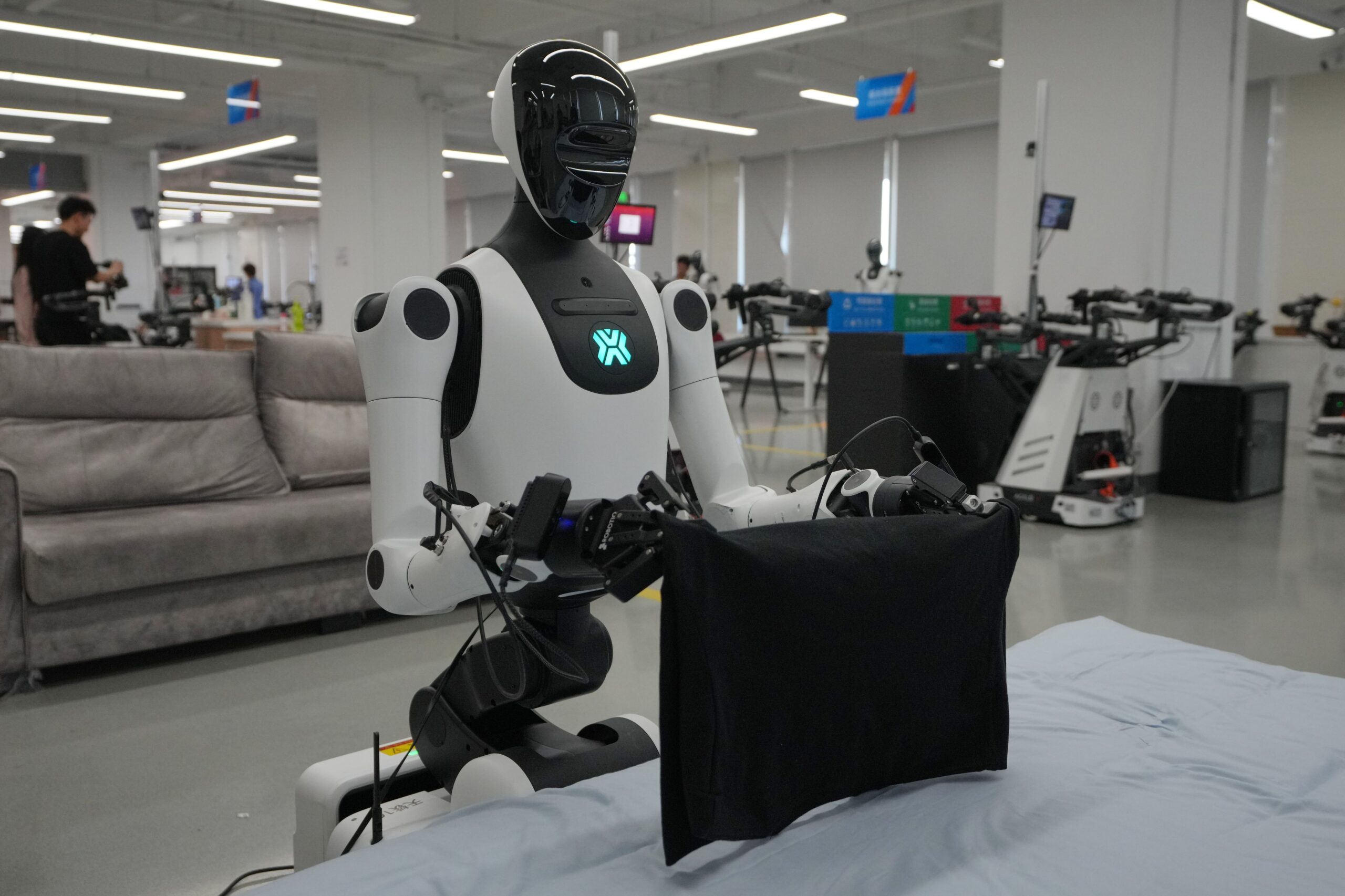
Shanghai-based startup Matrix Robotics has drawn attention with its flagship “MATRIX-3,” a nearly 5.6-foot humanoid priced at around $99,000 per unit. The company says it has received roughly 1,000 orders from coffee chains and hotels, though it has so far delivered only a few hundred units. It claims it could ship 5,000 units this year if orders materialize.
Shenzhen-based EngineAI offers a basic humanoid for 180,000 yuan (approximately $26,600), targeting roles like security guard and museum guide. The company also markets its robots for entertainment — dancing and boxing demonstrations.
But real-world performance tells a more complicated story. In Beijing, freelance content creator Yang Ning recently tested a cleaning robot that could organize shoes, fold clothes, and change garbage bags — but only with a human cleaner present. She described watching it sort shoes as “amazing,” yet found it inefficient and “a bit too big and difficult to move around in a small house.”
The Demand Gap Is Real
Samm Sacks, a senior fellow at the New America think tank focused on Chinese technology, said most humanoid robots are “still performative rather than functional,” unable to reliably operate in messy, unpredictable environments.
“The use cases of these robots are still so limited,” said Chibo Tang of venture capital firm Gobi Partners. “Without the demand and without that scale from the market, these companies are not able to really go into mass production.”
China’s own government has acknowledged the risk. Last year, Beijing publicly warned of a potential bubble in the humanoid robot industry, citing lagging commercialization. The country had more than 140 manufacturers by 2025, according to the Ministry of Industry and Information Technology.
Of the more than 2 billion yuan ($295 million) worth of orders placed in 2025, Morgan Stanley notes that many came from state-owned enterprises deploying robots in power plants, data centers, and entertainment venues — not exactly the broad commercial market manufacturers are hoping to capture.
China Still Leads the World by a Wide Margin
Despite the demand challenges, China’s production numbers dwarf those of its competitors. Of the more than 13,000 humanoid robots shipped globally in 2025, Chinese companies AGIBOT and Unitree each shipped over 5,000 units. By contrast, U.S. rivals Figure AI and Tesla each shipped a few hundred or fewer, according to technology research group Omdia.
Unitree reported 1.7 billion yuan (around $250 million) in revenue last year, with profit exceeding 278 million yuan ($41 million) — a rare sign of financial health in a sector still burning through investment capital.
Morgan Stanley expects China’s humanoid robot sales to more than double this year to around 28,000 units, with Omdia forecasting annual shipments of advanced robots could surpass 1 million units by the early 2030s.
Chinese robots also benefit from a significant cost advantage. Using locally sourced components has made Chinese humanoids on average 20% or more cheaper than foreign models, Morgan Stanley said. The average price could fall from $46,000 today to around $21,000 by 2050 — and some Chinese models are already priced below $6,000.
State Support Gives China a Structural Advantage
Chinese humanoid robot startups benefit from substantial government backing, aligned with the ruling Communist Party’s 2026–2030 five-year plan, which targets humanoid robotics as a strategic technology frontier. This state support — in the form of subsidies, procurement contracts, and research funding — gives Chinese manufacturers a structural advantage that private-sector competitors in the U.S. and Japan do not enjoy.
Japan and the United States face similar commercialization struggles, with humanoid startups in both countries also finding it difficult to secure buyers in industrial and workplace settings.
Yet deployment in China is accelerating. Ye Tian, an ex-Apple engineer and founder of Chinese startup RoboScience, said Chinese consumers and industries are relatively accustomed to rapid technological change — a cultural and market factor that may ease adoption.
The Remaining Obstacles: Cost, Fragility, and Data
Even with falling prices, the Mercator Institute for China Studies concluded that Chinese humanoid robots remain “far too expensive for widespread deployment.” Sacks put it bluntly: “The economics are tough — humanoid robots remain expensive to produce, fragile in operation, and dependent on highly structured environments to function.”
A deeper technical challenge involves data. For humanoid robots to perform complex, varied tasks — rather than single repetitive ones — they need training data drawn from a wide range of real-world environments. That data collection is still in its early stages.
Eric Guo, founder and CEO of Shenzhen-based AI² Robotics, said accumulating that data “could take years to massively scale up.” His assessment was blunt: “The mass production capability in the robotic area is still at the very early stage.”
The most realistic near-term commercial path, analysts say, runs through industrial and logistics settings — warehouses, factories, and ports — where humanoids could handle heavy lifting and dangerous tasks. A broader household market, which Matrix Robotics CEO Allen Zhang believes could eventually span hundreds of millions of Chinese homes, remains a longer-term prospect.