
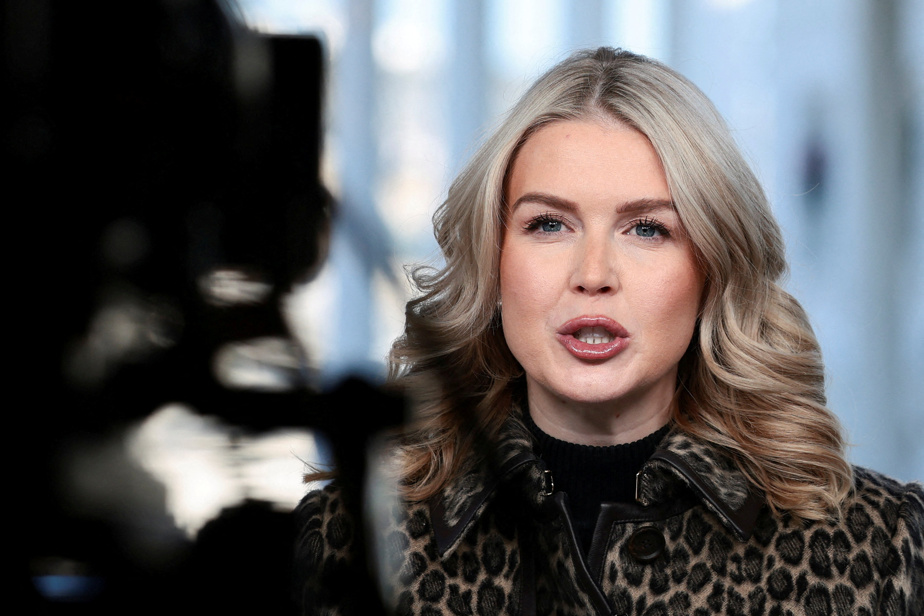
When White House Press Secretary Karoline Leavitt stepped before reporters Thursday to defend the Trump administration’s civilian nuclear deal with Saudi Arabia, she reached for a familiar refrain — “America first” — and in doing so, ignited a wave of furious, historically grounded pushback that exposed just how strained that framing has become. Leavitt argued that the agreement “gives priority access for American companies and the Saudi nuclear energy program, which will ultimately benefit American industry workers and supply chain,” framing a geopolitically fraught arrangement as little more than a jobs initiative. But critics across the progressive left were quick to point out that the history between the United States and the Kingdom of Saudi Arabia is not so easily laundered through the language of supply chains and industrial benefit.
The most immediate and pointed challenge Leavitt faced was a question reporters pressed her on directly: why does Saudi Arabia qualify for a civilian nuclear deal when Iran does not? Her answer — that American companies would gain preferential access — sidestepped the strategic and moral dimensions of the question entirely, offering an economic justification where a security argument was plainly required. That evasion did not go unnoticed. Corbin Trent, a Democratic strategist and former communications director for Representative Alexandria Ocasio-Cortez, captured the sentiment with biting sarcasm: “Remind me again of which government was known and found to have been associated with the 9/11 attacks? Oh! That’s right, Saudi Arabia. But yep it’s about ‘Murica 1st!” Trent, who also worked on Senator Bernie Sanders’ presidential campaign and now runs the Super PAC A Fight Worth Having, was giving voice to a grievance that stretches back more than two decades and has never been adequately resolved by any administration, Democratic or Republican.
Progressive commentator Sarah Larchmont sharpened the historical record further, noting that fifteen of the nineteen hijackers responsible for the September 11 attacks were Saudi nationals, as was Osama bin Laden, the architect of the deadliest terrorist attack ever carried out on American soil. These are not contested facts, not matters of partisan interpretation — they are documented history, and they sit uncomfortably alongside any arrangement that grants the Saudi state privileged access to American nuclear technology and expertise. Writer and political commentator Jim Stewartson brought the timeline forward, invoking the 2018 murder of Washington Post journalist Jamal Khashoggi, who was killed and dismembered by Saudi operatives on the direct orders of Crown Prince Mohammed bin Salman, according to U.S. intelligence assessments. “Saudi Arabia flew planes into American buildings on 9/11 and chopped up a journalist they didn’t like,” Stewartson wrote, in a formulation that was deliberately blunt and impossible to dismiss as hyperbole.
Political scientist Natascha Dea Burdeinei cut to what many observers see as the deal’s most troubling subtext: the reported existence of a billion-dollar Trump-branded complex in Saudi Arabia, which raises unavoidable questions about whether the administration’s foreign policy is being shaped by the president’s private financial interests. “A $1B Trump complex is not putting America first,” she wrote on X, adding that “anything that prioritizes a Trump or billionaire pocket over the security and wellbeing of the American people is not America first.” This is not a fringe concern. The entanglement of Trump’s business empire with his foreign policy decisions has been a consistent and legitimate source of scrutiny throughout both his terms, and the Saudi nuclear deal does nothing to allay those concerns — it amplifies them.
What makes Leavitt’s defence particularly difficult to sustain is not just the weight of the historical record, but the internal contradiction at the heart of the administration’s own rhetoric. For years, the “America first” framework has been deployed to justify withdrawal from multilateral agreements, the imposition of tariffs on allies, and deep skepticism toward international institutions — all on the grounds that American interests must come before foreign entanglements. Yet here is the same administration extending a civilian nuclear partnership to a monarchy with documented ties to the worst terrorist attack in American history, a government that murders journalists, and a royal family with deep financial ties to the president himself. The selective application of “America first” is not a policy — it is a performance, and an increasingly threadbare one.
The backlash to Leavitt’s remarks is a reminder that the American public’s memory of September 11 remains sharp, and that invoking patriotic language does not automatically neutralize legitimate security and ethical concerns. Deals of this magnitude — transferring civilian nuclear knowledge and infrastructure to a volatile regional power — demand rigorous public scrutiny, honest accounting of the risks, and a press secretary willing to engage with hard questions rather than retreat into slogans. What the country got on Thursday was something considerably less than that, and the response from commentators, strategists, and ordinary citizens suggests that the gap between the administration’s words and its actions is not going unnoticed.