
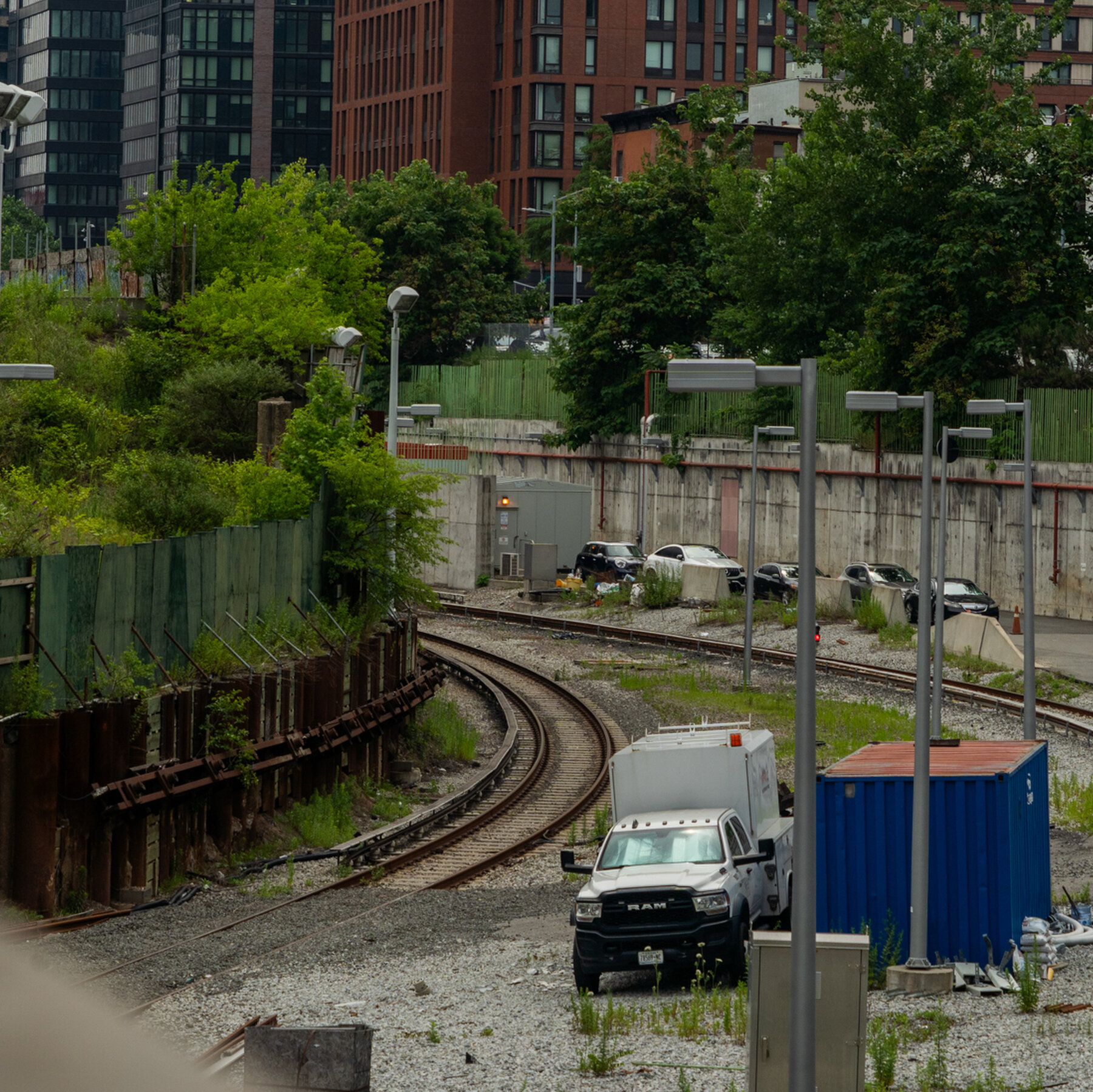
More than two decades after its announcement generated enormous fanfare — starchitect Frank Gehry sketching towers, Jay-Z lending his Brooklyn credibility, and Governor-era officials promising a transformative affordable housing future — Atlantic Yards remains unfinished. On Monday, New York State economic development officials unveiled a $5 billion plan to finally complete the long-stalled megaproject, now branded Pacific Park, in the Prospect Heights neighborhood of Brooklyn. The announcement is significant. So is the skepticism it deserves.
The plan, released by the Atlantic Yards Community Development Corporation, calls for six new high-rises containing 5,600 units, roughly 1,242 of which would be designated affordable. It would deck over the Vanderbilt Yard rail tracks running along Atlantic Avenue, add more than eight acres of open space, and include an intergenerational community center in the first building constructed. New York State would contribute approximately $700 million toward building platforms over the rail lines, with union pension funds expected to finance the bulk of construction through developer loans.
Governor Kathy Hochul framed the announcement in the language of progress. “Atlantic Yards is one of New York’s most significant unfinished affordable housing developments, and we are finally moving it toward completion,” she said, citing the state’s broader $25 billion housing investment. That framing is not wrong, exactly — but it papers over a history of failure that demands scrutiny before celebration.
When developer Bruce Ratner first announced the project in 2003, the price tag was $2.5 billion. The original vision promised 2,250 affordable units for low- and middle-income tenants. Over the following twenty-plus years, developers completed the Barclays Center — now home to the Brooklyn Nets and New York Liberty — and built roughly 3,200 mostly market-rate apartments across eight towers. Of those promised 2,250 affordable units, only 1,374 were ever built. A 2014 community agreement set a deadline of May 2025 for the remainder, backed by $2,000 monthly fines per missing apartment. State officials later waived those fines entirely, handing developers a consequence-free pass for their failure to deliver.
That history matters enormously as New York evaluates what this new plan actually promises. Assemblymember Jo Anne Simon, whose district includes the development site, has already raised a pointed concern: the plan’s emphasis on “moderate-income” affordable units does not adequately address the neighborhood’s acute need for genuinely low-income housing. It is a distinction that progressives — as opposed to those who treat any below-market unit as a victory regardless of income targeting — must insist upon. Affordable housing that only pencils out for households earning 80 or 100 percent of area median income does not serve the families most at risk of displacement in a rapidly gentrifying Brooklyn.
The newly approved development team, Brooklyn Ascending Land Co., is led by Cirrus Real Estate Partners and LCOR. The team has committed to contributing $4.5 million to an affordable housing trust fund within 30 days, with another $7.5 million to follow over two years — modest sums against a $5 billion project. Groundbreaking is targeted for 2028, a full quarter-century after city and state officials first approved the development. The lead developer has suggested the entire project could be completed by the late 2030s, meaning New Yorkers may wait until roughly 2038 to see a project announced during the Bloomberg administration reach its conclusion.
The road to this latest announcement was itself littered with dysfunction. Chinese developer Greenland Holdings invested $1 billion to lay a foundation for the platform and secured permits that could accelerate future construction — then defaulted on its debt, throwing the project into further disarray. That default is not a minor footnote; it is evidence that mega-developments of this scale and complexity, reliant on private developers with their own financial vulnerabilities, carry structural risks that state oversight must actively manage rather than simply hope away.
None of this means the project should be abandoned. Brooklyn’s housing crisis is real and worsening. The decking of the Vanderbilt Yard, the addition of open space, and the construction of thousands of new units — even imperfectly targeted ones — represent genuine public goods. State investment in the platform infrastructure is exactly the kind of role government should play: absorbing costs that the market won’t, enabling development that otherwise stalls. The question is not whether to build, but whether the state is demanding enough in return for its $700 million.
A two-year environmental review is expected to begin following the plan agreement, with a formal vote by the Empire State Development board anticipated in the summer of 2028. That timeline gives advocates, local elected officials, and community organizations a meaningful window to push for stronger affordability commitments, deeper income targeting, and enforceable accountability mechanisms — the kind that cannot simply be waived when a developer falls behind. The fines that evaporated in 2025 should be a lesson, not a precedent.
Atlantic Yards has spent two decades as a symbol of what happens when ambitious public-private deals prioritize developer flexibility over community obligation. This new chapter could be different — but only if the state treats its $700 million as leverage, not a gift, and holds Brooklyn Ascending Land Co. to standards that earlier developers were permitted to ignore. The families who were promised affordable homes in 2003 are still waiting. New York cannot afford to make them wait another twenty years.