
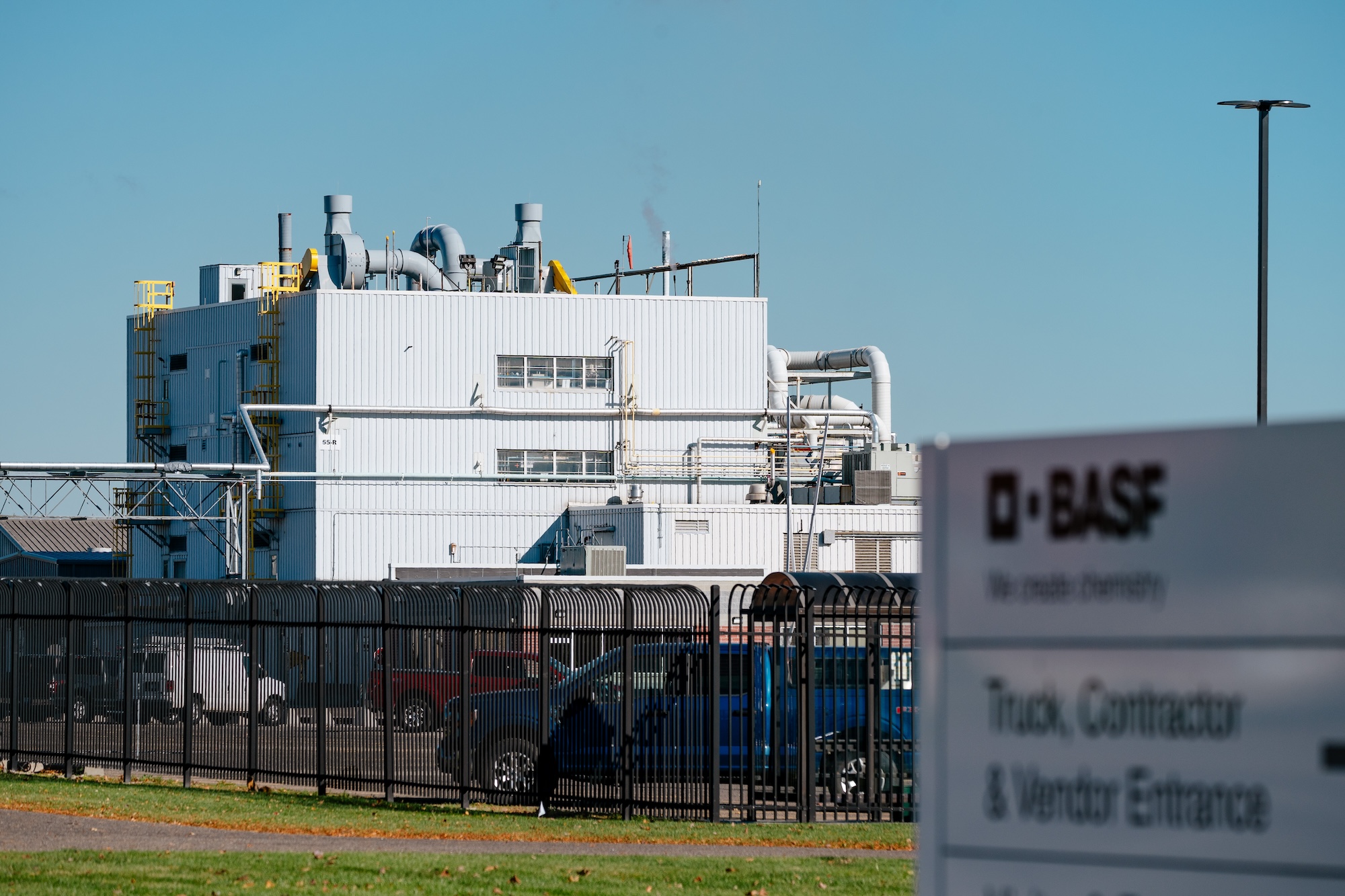
Nearly four decades after signing a consent decree with the state of Michigan, chemical manufacturing giant BASF is still struggling to contain contaminated groundwater at its 230-acre Wyandotte plant — and the remediation plan it has now put forward may not be nearly enough. That is the central problem with the company’s newly approved workplan: it proposes incremental, experimental adjustments to a system that an independent expert says has already been failing in plain sight, while a more aggressive solution sits unused.
The 1986 consent decree between BASF and the state required the company to maintain an inward hydraulic “gradient” at its North Works site on Biddle Avenue — essentially ensuring that groundwater flows into extraction wells rather than out toward the Detroit River. To achieve that, regulators at the Michigan Department of Environment, Great Lakes, and Energy (EGLE) determined that extraction wells must pull between 10 and 90 gallons per minute. What EGLE found in 2025 was starkly different: wells were drawing fewer than 2 gallons per minute, while up to 60 gallons per minute were flowing directly toward the river — the very outcome the decree was designed to prevent. The river in question runs just north of the Wyandotte municipal water intake, serving a community that has already borne disproportionate industrial burden for generations.
The soil beneath the North Works site, former marshland drained and filled with chemical waste as far back as the 1880s, is contaminated with mercury, PFAS, PFOS, and other volatile compounds. That toxic fill dirt is not inert: groundwater percolates through it continuously, carrying contaminants toward the river. BASF operates 15 extraction wells across three wellfields — four in Wellfield A, nine in Wellfield B, and two in Wellfield C — but the system has clearly been underperforming its legal mandate for years.
The workplan that EGLE approved in March, following negotiations with BASF, outlines two sequential phases. In the first, the company will temporarily shut down Wellfield C to determine whether doing so improves the vacuum extraction performance in the other two wellfields. If that change proves insufficient, a second phase would involve cleaning the well screens, which have become clogged with sediment over time and are hampering pumping capacity. BASF frames this as methodical, single-variable testing. The company has also argued, based on sampling data showing mostly non-detectable contaminant levels between 2015 and 2018, that it should be permitted to shut down Wellfield C permanently.
Brian O’Mara, a Metro Detroit-based hydrogeologist with extensive experience in industrial waste cleanups, is unconvinced. He describes the workplan as “window dressing” — a phrase that should give regulators and the surrounding community pause. O’Mara argues that installing larger, more powerful wells and pumps capable of more aggressively capturing contaminated groundwater would be a far more effective interim remedy, and one that could be sustained indefinitely. “They could run that interim remedy for decades,” he said. “What they’re proposing with this work plan, when it comes to looking at the mass of how much contamination is going offsite, this is like a drop in the bucket.”
That assessment matters. When a company subject to a decades-old consent decree is still negotiating incremental adjustments rather than deploying the most effective available technology, the question of regulatory leverage becomes unavoidable. EGLE has approved this workplan, but approval of a plan is not the same as confidence that it will work — and the agency’s own 2025 findings demonstrate that BASF’s prior approach failed to meet the legal standard.
A Permanent Fix on a Long Horizon
The workplan is explicitly described as a temporary measure, a bridge to what regulators and the company call the real solution: permanent perimeter barriers around the site, combined with a groundwater collection and extraction system and an on-site treatment facility. The Environmental Protection Agency granted full approval for that permanent plan at the end of June, with construction scheduled to run from 2027 to 2029. BASF spokesperson Chris Kozak called the submission of the final design to the EPA “an important milestone,” and the company pledged continued coordination with both the EPA and EGLE.
Those commitments are welcome, but 2027 is still years away, and the contamination is not waiting. Every month that the extraction system underperforms its legal mandate is another month that mercury, PFAS, and volatile compounds have a pathway to a river that millions of people in the Great Lakes region depend on. The gap between what BASF is legally obligated to do and what it has actually delivered — a gap that persisted long enough for EGLE to formally flag it in 2025 — is not merely a technical compliance matter. It is a public health and environmental justice concern that demands more than incremental tinkering.
The deeper implication is this: consent decrees and regulatory frameworks are only as strong as the enforcement behind them. When a corporation of BASF’s scale can operate for years at a fraction of its required extraction rate, and then respond with a workplan that an independent expert dismisses as inadequate, the burden falls on regulators to demand more — not to negotiate down to what the company finds convenient. The permanent fix, if it arrives on schedule and performs as designed, will be meaningful progress. But the distance between that promise and today’s reality is measured in contaminants flowing toward a public waterway.