
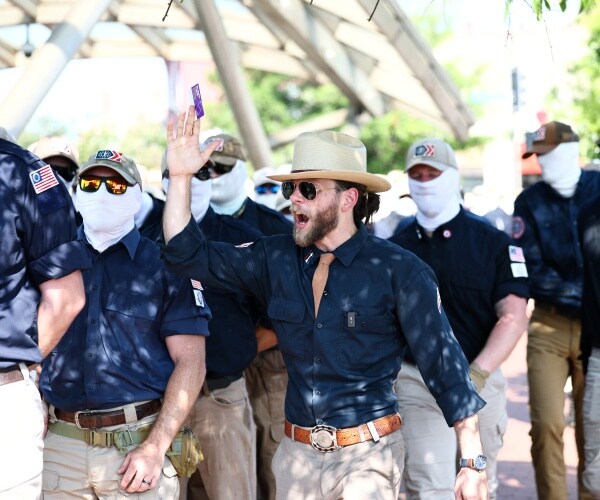
What actually happened on July 4th in Washington?
Hundreds of masked members of Patriot Front, a white supremacist organization, marched through the nation’s capital on Independence Day. They moved in formation to the beat of drummers near the U.S. Capitol and Union Station before boarding Metro trains to a Washington suburb. The march was organized, coordinated, and unmistakably ideological. It was not a spontaneous gathering of concerned citizens — it was a disciplined display by a group whose own published manifesto declares that “democracy has failed this once great nation” and calls for a “hard reset” to return to the traditions of European settlers.
Interior Secretary Doug Burgum appeared on CNN’s “State of the Union” the following morning and was asked to account for the federal government’s response. His answer was clear: officials had no reason to intervene. The marchers broke no laws, he argued, and therefore the government’s hands were tied. That legal framing is not wrong on its face. But it is far from the whole story.
Is Burgum right that this is protected free speech?
Technically, yes — and that distinction matters. The First Amendment does protect the right of even deeply odious groups to assemble and march on public streets, and no serious legal scholar would argue otherwise. Patriot Front members wore masks and marched in formation, but absent evidence of explicit threats or illegal conduct, law enforcement intervention would face significant constitutional obstacles. Free speech protections in the United States are among the broadest in the democratic world, and they do not evaporate simply because the speech in question is repugnant.
But Burgum did not stop at the legal question. He went further, framing the march as simply part of what makes “democracy messy” — a rhetorical move that flattens a meaningful moral distinction. Comparing Patriot Front’s march to anti-Trump protesters on the National Mall, as Burgum did, treats the two as epistemically equivalent. They are not. One group protests government policy within a democratic framework. The other explicitly rejects democracy itself. Calling both sides of that comparison “free speech” is accurate; calling them equivalent is a form of false balance that obscures rather than illuminates.
Why does Burgum’s refusal to condemn the group matter?
This is where the interview became genuinely revealing. Burgum declined to say whether he personally condemned Patriot Front. He also declined to say whether he would recommend that President Trump condemn it. Instead, he downplayed the march as an aberration — a minor blemish on an otherwise celebratory anniversary weekend marking the country’s 250th birthday. That framing is worth sitting with for a moment. A senior Cabinet official, asked directly whether the president should denounce a white supremacist organization that marched through the capital on Independence Day, responded with a shrug.
The refusal is not a neutral act. When public officials decline to condemn white supremacist groups, they send a signal — to those groups, to communities targeted by them, and to the broader public about what the administration considers within the bounds of acceptable politics. Burgum’s “nothing I could possibly agree with” caveat is the verbal equivalent of fine print: technically distancing, functionally meaningless without a clear condemnation. The pattern of this administration treating white nationalist movements with kid gloves while aggressively policing left-wing protest is a documented one, and Burgum’s Sunday appearance fits it precisely.
What else did Burgum address — and why does it matter?
The Interior Secretary also used his Sunday media appearances to defend the Trump administration’s record on Washington’s public spaces, claiming on ABC’s “This Week” that the administration had already repaired dozens of monuments and fountains across the city. The centrepiece of that claim is a $14.7 million renovation of the Lincoln Memorial’s Reflecting Pool — a project awarded through a no-bid contract that drew scrutiny even before its completion. Weeks after the work was finished, the pool showed visible algae growth, peeling surface material, and clear signs of deterioration.
Burgum repeated the administration’s explanation: vandals had used box cutters to slash the pool’s new liner, creating gashes hundreds of feet long. The same company that won the original no-bid contract, he confirmed, will handle the repairs — because, in his words, “they did a fantastic job” with the initial renovation. That claim deserves scrutiny. A project that deteriorates within weeks of completion, attributed to vandalism without publicly verified evidence, repaired by the same contractor under the same arrangement, represents exactly the kind of government spending that demands independent oversight. Whether that oversight materialises remains an open question.
What does this tell us about the administration’s priorities?
Sunday’s interviews offered a compact portrait of an administration’s values in action. A white supremacist group marches through the capital and a Cabinet secretary will not say the president should condemn it. A no-bid contractor produces a pool that fails within weeks and receives the repair contract anyway. These are not unrelated anecdotes — they are data points in a pattern of who gets the benefit of the doubt, who gets protected, and who gets scrutinized. The legal argument for tolerating the Patriot Front march may be sound. The moral and political choice to shrug at it is something else entirely.