
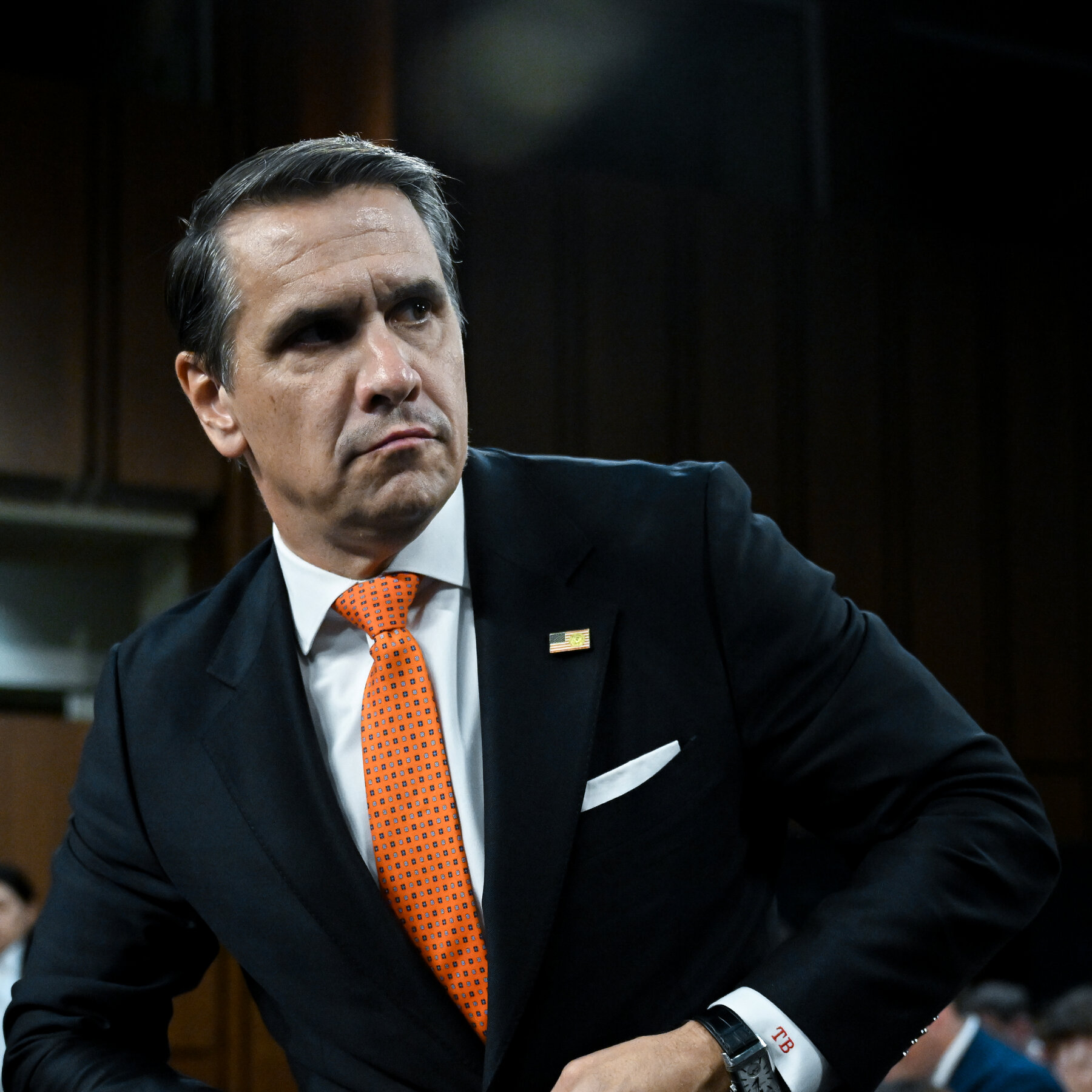
Todd Blanche sat across from Kristen Welker on NBC’s Meet the Press last Sunday and said, plainly, what many had feared: he will not promise to keep the Justice Department independent of the White House. Not hedged. Not buried in qualifications. Just said it out loud.
A Line Crossed in Plain Sight
The statement landed with the weight of its implications. “There’s a big difference between saying we will always do our job and investigate any case and act independently of the White House,” Blanche told Welker. “No, I’m not going to pledge that. And no attorney general should ever pledge that.” It was a remarkable moment — not because it revealed something hidden, but because it confirmed something structural: the firewall between presidential power and prosecutorial authority that Americans have relied on since Watergate is, under this administration, gone.
Blanche is not just any political appointee finding his footing. He is Donald Trump’s former personal defense attorney — the lawyer who sat beside Trump at the defense table during his criminal trial — now confirmed by the Senate to lead the very department that prosecuted his former client. The conflict of interest is not incidental. It is the point.
When pressed on whether the president should have a voice in individual prosecution decisions, Blanche offered a response that was as revealing as it was alarming. “Every American has a voice in prosecutions,” he said, “so whether President Trump should have a, quote, voice, it depends, but yes.” The equivalence between an ordinary citizen and the president of the United States — who commands the department doing the prosecuting — was not a slip. It was a rhetorical strategy designed to normalize something that is not normal.
The Architecture of Erosion
Post-Watergate norms did not emerge from nowhere. They were built in direct response to the catastrophic abuse of executive power that came when a president treated the Justice Department as a personal instrument of political warfare. Richard Nixon’s Saturday Night Massacre — his firing of the special prosecutor investigating him — became the defining lesson: the attorney general must be able to say no to the president. That norm has never been codified in law with sufficient force, and the Trump administration is exploiting that gap with precision.
Blanche attempted to draw a distinction between legitimate presidential direction and improper interference. He cited Trump’s directive to pursue violent criminals as an example of lawful guidance — the kind of broad policy instruction that any president might give. But that framing collapses under scrutiny. The question was never whether a president can set enforcement priorities. The question is whether a president can direct the prosecution or protection of specific individuals for political reasons. Blanche’s answer, functionally, was yes.
The record supports that reading. Under Blanche and his predecessor Pam Bondi, the Justice Department has moved against a series of figures Trump has publicly targeted: New York Attorney General Letitia James, former FBI Director James Comey, and others described by the president as political enemies. These were not cases that emerged organically from career prosecutors. They arrived under direct pressure from the White House. The pattern is not ambiguous.
Confirmation Over Objection
Blanche’s path to confirmation was itself a story about institutional stress. Senators Susan Collins of Maine and Lisa Murkowski of Alaska — the Republican caucus’s nominal moderates — joined every Senate Democrat in opposing his nomination. That opposition reflected genuine alarm about DOJ independence, but it was not enough to block him. The Senate confirmed Blanche, though not before his vote was delayed while he provided proof that he had rescinded an order creating a nearly $1.8 billion compensation fund for alleged victims of wrongful prosecution under the Biden administration. Key Republican senators also extracted written assurances limiting a tax immunity deal for Trump and his family — a detail that speaks volumes about the transactional nature of the confirmation process.
In a separate appearance on Fox News Sunday, Blanche struck a softer tone, insisting he retains the ability to disagree with Trump. “The president loves disagreement,” he said. “He wants to get counsel from all of his leaders that is just that — counsel. It doesn’t mean you’re saying yes to him.” He added that Trump would “expect” him to share his honest feelings. These assurances deserve scrutiny. An attorney general who describes his role as providing “counsel” to the president — rather than independently enforcing the law — has already redefined the job in ways that should concern anyone who values prosecutorial integrity.
Words Against the Record
Blanche has not been short on reassuring language. He told Justice Department employees in his first workforce address that he would “lead this department with integrity” and focus on “upholding the rule of law fairly and impartially.” He told Welker that Trump has never asked him to act unethically or illegally. He dismissed concerns about political interference as “a narrative pushed by the left and pushed by the media.” He promised the department would “act with integrity” and “prosecute without fear or any sort of favor.”
These are words. They exist alongside a documented record of the department pursuing Trump’s political adversaries under presidential pressure, an attorney general who openly says he will factor the president’s views into individual prosecution decisions, and an institutional norm — painstakingly constructed after one of American democracy’s darkest chapters — that is being dismantled in real time, on television, without apology.
The people who depend most on a genuinely independent Justice Department are not Washington insiders. They are ordinary people caught up in federal investigations, immigrants facing deportation proceedings, civil rights plaintiffs pursuing accountability from powerful institutions. When the attorney general signals that the president’s preferences shape prosecutorial choices, the consequences ripple far beyond any single high-profile target. Justice, at every level, becomes conditional. That is not a narrative. That is what Blanche described, in his own words, on Sunday morning.