
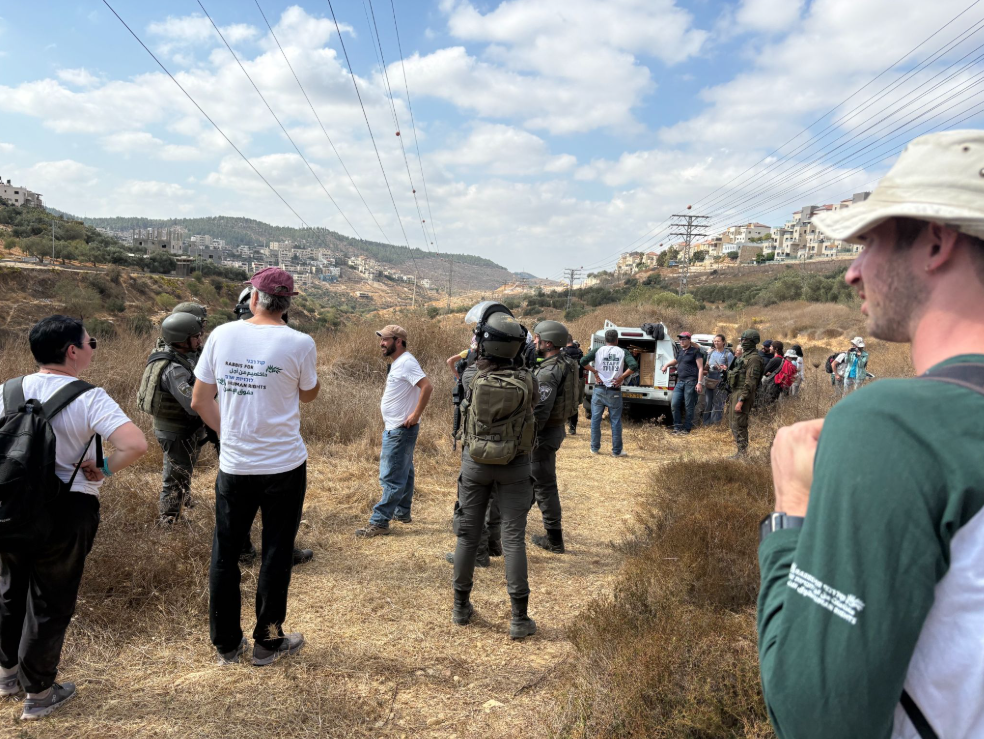
Rabbi Doug Alpert had come to the West Bank to pick olives. He left having spent seven hours in Israeli military detention, facing the threat of deportation, and carrying a firsthand understanding of what Palestinian farmers endure not for a single afternoon but every single day of their lives. Alpert, who leads Congregation Kol Ami in Kansas City and rents worship space at All Souls Unitarian Universalist Church in midtown, is now back home in Missouri, and he is speaking out about what he witnessed and what was done to him and his fellow travelers — not as an act of provocation, but as an act of conscience.
Alpert traveled to the West Bank as part of T’ruah: The Rabbinic Call for Human Rights, a coalition of American and Canadian rabbis and cantors. The group joined Protect the Harvest, an international program designed to accompany Palestinian families during olive harvest season — a form of protective presence that has become necessary precisely because Palestinian farmers can no longer safely access their own land alone. The group numbered roughly 80 people, predominantly rabbis. They were there at the explicit invitation of Palestinian families whose livelihoods depend on the olive groves that Israeli military policy, settler violence, and a labyrinthine checkpoint system have effectively placed out of reach.
For two days, the group harvested olives without incident. Then the Israeli military arrived and declared the area a closed military zone. The declaration came without warning and without apparent legal basis that Alpert or his colleagues recognized as legitimate. The entire group was detained for approximately seven hours. Alpert described the physical conditions of detention as tolerable — they were given food, water, and restroom access — but the psychological weight of the experience was something else entirely. The threat of deportation hung over the group throughout the ordeal, an uncertainty that Alpert acknowledged in his account with characteristic understatement.
What makes Alpert’s testimony particularly striking is not the detention itself, troubling as it is, but the broader context he insists must not be ignored. The olive grove where the group was working, he noted, had been inaccessible to the Palestinian family that owns it since October 7, 2023 — not because of any action taken by that family, but because of Israeli military and settler pressure that has systematically severed Palestinian farmers from their land. Olives are not a peripheral crop in the West Bank; they constitute the backbone of the Palestinian agricultural economy, and the inability to harvest them represents not just an economic blow but a slow erasure of a way of life.
Alpert described the conditions Palestinian farmers face with precision: checkpoints that block access to fields, land seizures that transfer Palestinian territory to illegal Israeli settlements, arrests without charge, and settler violence that operates with what critics — including human rights organizations — describe as effective impunity. These are not contested claims invented by activists. They are documented by groups including the United Nations, Human Rights Watch, and B’Tselem, the Israeli human rights organization. The Israeli government’s settlement expansion in the West Bank has been declared illegal under international law by the International Court of Justice and condemned by the United States government itself, even as Washington continues to supply Israel with military aid.
There is something significant about the fact that it was a group of Jewish rabbis making this stand. Alpert and his colleagues are not outsiders to the conversation about Israel and Jewish identity — they are deeply embedded in it. Their presence in the West Bank was an act of religious witness, grounded in a tradition of prophetic justice that has always insisted the powerful must be held accountable for what they do to the vulnerable. Alpert’s own congregants received a letter from him explaining what happened, a pastoral communication that doubled as a moral reckoning. He did not soften the language. He named what he saw.
Palestinian hospitality, Alpert noted, is something Kansas City residents who have visited Baba’s Pantry will already recognize — a warmth and generosity that is, as he put it, ingrained in Palestinian culture. It is a small but telling detail, the kind that insists on the full humanity of people who are too often reduced, in American political discourse, to abstractions or security variables. The families who invited these rabbis onto their land did so knowing the risks. They did it because the alternative — abandoning their groves entirely — is a form of surrender they are not willing to make.
Alpert’s final reflection is worth sitting with. What he and his colleagues experienced in a single afternoon — the sudden declaration of a military zone, the detention, the uncertainty, the threat of consequences for doing nothing more than picking fruit — is what Palestinian families have absorbed as ordinary life for years, with consequences far graver than a seven-hour wait and a flight home to Kansas City. That asymmetry is not incidental. It is the point. And it is the reason a group of rabbis got on a plane to go pick olives in the first place.