
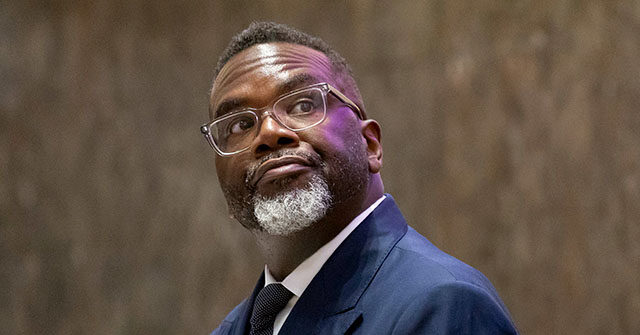
Johnson Makes Re-election Bid Official
Chicago Mayor Brandon Johnson (D) confirmed Sunday that he will seek a second term leading the nation’s third-largest city, telling the New York Times in an interview at his downtown campaign office that he intends to “double down” on his progressive agenda and fight for a city that remains “accessible” to working-class residents. Johnson, 50, is set to formally launch his campaign at the DuSable Black History Museum and Education Center — a symbolically freighted choice for a former labor organizer who built his political identity around racial justice and economic equity. The nonpartisan mayoral election is scheduled for February 2027, with a potential runoff in April if no candidate clears 50 percent of the vote.
“I made a commitment through the lens of working-class leadership that we would take on the billionaires and the corporate interests to prioritize working people to build the safest, most affordable big city in America,” Johnson said. “That’s what we’re doing.” He also posted a “four more years” video to social media on Sunday, highlighting what his administration considers its key accomplishments over his first term.
A City Making Progress — But Still Struggling With Gun Violence
Johnson’s re-election pitch will be tested most sharply on public safety. Chicago recorded 435 homicides in the 12-month period preceding September 4, according to ABC7’s Neighborhood Safety Tracker, which noted that the risk of being murdered in Chicago is “already considerably higher than the risk of dying in a vehicle crash in Illinois.” Gun violence remains concentrated in the city’s South Side neighborhoods, communities that have long been starved of investment and economic opportunity — structural conditions that progressive governance aims to address but has not yet resolved.
There are, however, measurable signs of improvement. The city is currently averaging approximately eight homicides per week, down from ten per week in 2019 and below the yearly average of the past three years. While several American cities post higher homicide rates relative to their populations, Chicago’s absolute numbers remain among the highest in the country — a distinction that fuels both legitimate policy debate and, frequently, bad-faith political attacks that ignore the city’s size and the deep historical roots of its inequalities.
Immigration Policy and the Sanctuary City Debate
Johnson has drawn sustained criticism from the right — and some friction from moderates — over his sanctuary-city posture and his direct resistance to the Trump administration’s immigration enforcement operations. Most notably, he issued an “ICE On Notice” order directing Chicago police to scrutinize the conduct of federal immigration agents operating in the city, a move that reflects a broader progressive conviction that aggressive federal deportation campaigns cause community harm and undermine local public safety by eroding trust between immigrant residents and law enforcement. The policy debate here is substantive, and the evidence on sanctuary cities does not support the claim that they increase violent crime — a claim frequently advanced without empirical grounding by critics of such policies.
City spending records indicate that Chicago allocated close to $640 million over a two-year period toward services for migrants and asylum seekers, a figure that has become a flashpoint in local political debate, particularly given ongoing pressures on the city’s public school system. Johnson’s defenders argue the expenditures reflect a humanitarian obligation and federal failures on immigration policy; his critics contend the funds should have been directed elsewhere. That tension will almost certainly define a significant portion of the 2027 campaign.
A Crowded Field Takes Shape
Johnson will not face an easy path to a second term. Illinois Secretary of State Alexi Giannoulias has emerged as a leading challenger, positioning himself as a more moderate progressive — a distinction that matters in a city where the progressive-versus-liberal fault line is increasingly consequential. U.S. Rep. Mike Quigley (D-IL), representing Chicago’s North Side, has also declared his candidacy, as has state Comptroller Susana Mendoza, giving voters a range of Democratic alternatives before a single Republican has entered the race.
The New York Times described the election as a “formidable test” of Johnson’s “brand of progressive politics” — a characterization that understates the stakes. Johnson won his 2023 race by defeating incumbent Lori Lightfoot and then narrowly besting moderate Democrat Paul Vallas in a runoff, demonstrating that Chicago’s electorate is genuinely divided between a politics of redistribution and structural reform on one side, and a more centrist, law-and-order-inflected approach on the other. How that divide resolves in 2027 will say something significant about the durability of progressive urban governance in one of America’s most scrutinized cities.