
The Trump administration’s campaign to dismantle Biden-era climate investment suffered a significant legal setback on Friday, when a federal judge ordered the Environmental Protection Agency to reinstate the $7 billion Solar for All program — a ruling that exposes just how far the administration overreached when it tried to bury congressionally mandated spending for political reasons.
U.S. District Judge Mary McElroy, herself a Trump appointee, issued a summary judgment finding that the EPA had acted unlawfully when it terminated the program in August 2025. Her ruling is unambiguous: Congress intended the Solar for All grants to continue, and the EPA had no statutory authority to cancel them. The administration did not find a legal loophole. It simply broke the law.
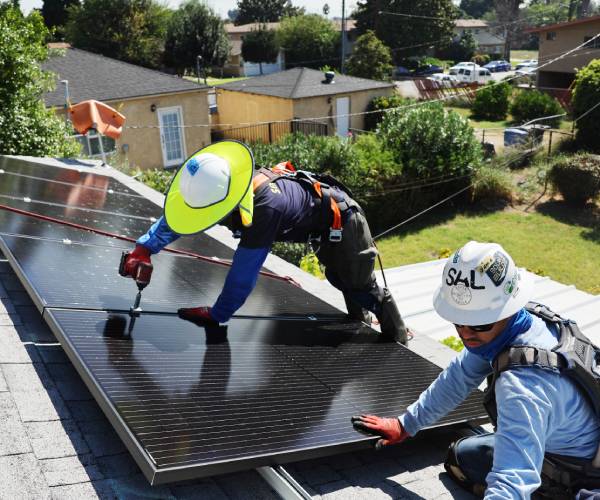
The Solar for All program was created by the Inflation Reduction Act, the landmark 2022 climate law that directed money to states, municipalities, tribal governments, and nonprofits to help more than 900,000 lower-income households install solar energy systems. It formed part of the broader $27 billion Greenhouse Gas Reduction Fund — a green bank designed to channel clean energy investment toward communities that private capital has historically ignored.
The EPA, under Administrator Lee Zeldin, rescinded the Solar for All funds shortly after the One Big Beautiful Bill Act passed in July 2025, with Zeldin dismissing the program as a “boondoggle.” But Judge McElroy rejected that framing with precision. She wrote that the OBBBA “did not convert SFA funding into a lump-sum amount subject to EPA’s discretion” and that the administration had simply pocketed congressionally obligated money without legal justification.
This matters beyond the narrow question of solar panels. The administration’s pattern — canceling programs Congress funded, redirecting or freezing obligated grants, and daring courts to stop it — represents a deliberate assault on the constitutional principle that the executive branch spends what the legislature appropriates, not what a given president prefers. When a Trump-appointed judge finds that pattern unlawful, the conclusion is hard to escape: this was not a policy disagreement but an abuse of executive power.
The case was brought by the Rhode Island AFL-CIO, the Rhode Island Center for Justice, and Solar United Neighbors. Their victory is a reminder that labor and environmental advocates, working together, retain real legal leverage even against an administration that has shown little regard for regulatory norms. The Southern Environmental Law Center put it plainly: “EPA broke the law when it killed the program and pocketed the money.”
A parallel lawsuit, filed by the attorneys general of more than a dozen states over the same canceled funding, was dismissed on jurisdictional grounds by a federal court in Washington in June and is currently on appeal. The legal fight over the remaining $20 billion from the Greenhouse Gas Reduction Fund — also canceled by the Trump administration and earmarked for community development banks and nonprofits combating climate change — continues on a separate track.
The EPA said it is “reviewing the decision and considering options for appeal.” That response, carefully noncommittal, suggests the administration knows the legal ground beneath it is unstable. An appeal would face the same core problem: Congress was explicit, the money was obligated, and no subsequent legislation gave the EPA discretion to eliminate those commitments.
The immediate consequence of Judge McElroy’s order is that the EPA must resume administering Solar for All grants as Congress intended. For the hundreds of thousands of lower-income families who stood to benefit from subsidized solar access — families for whom energy costs consume a disproportionate share of household income — that is not an abstraction. It is the difference between a program that works and one that was quietly strangled before it could deliver.
The broader implication is this: the Trump administration bet that aggressive unilateralism on climate spending would go unchallenged, or at least uncorrected in time to matter. Courts, including courts staffed by the administration’s own appointees, are proving that bet wrong — and the public record of what was attempted grows harder to erase with every ruling like this one.