
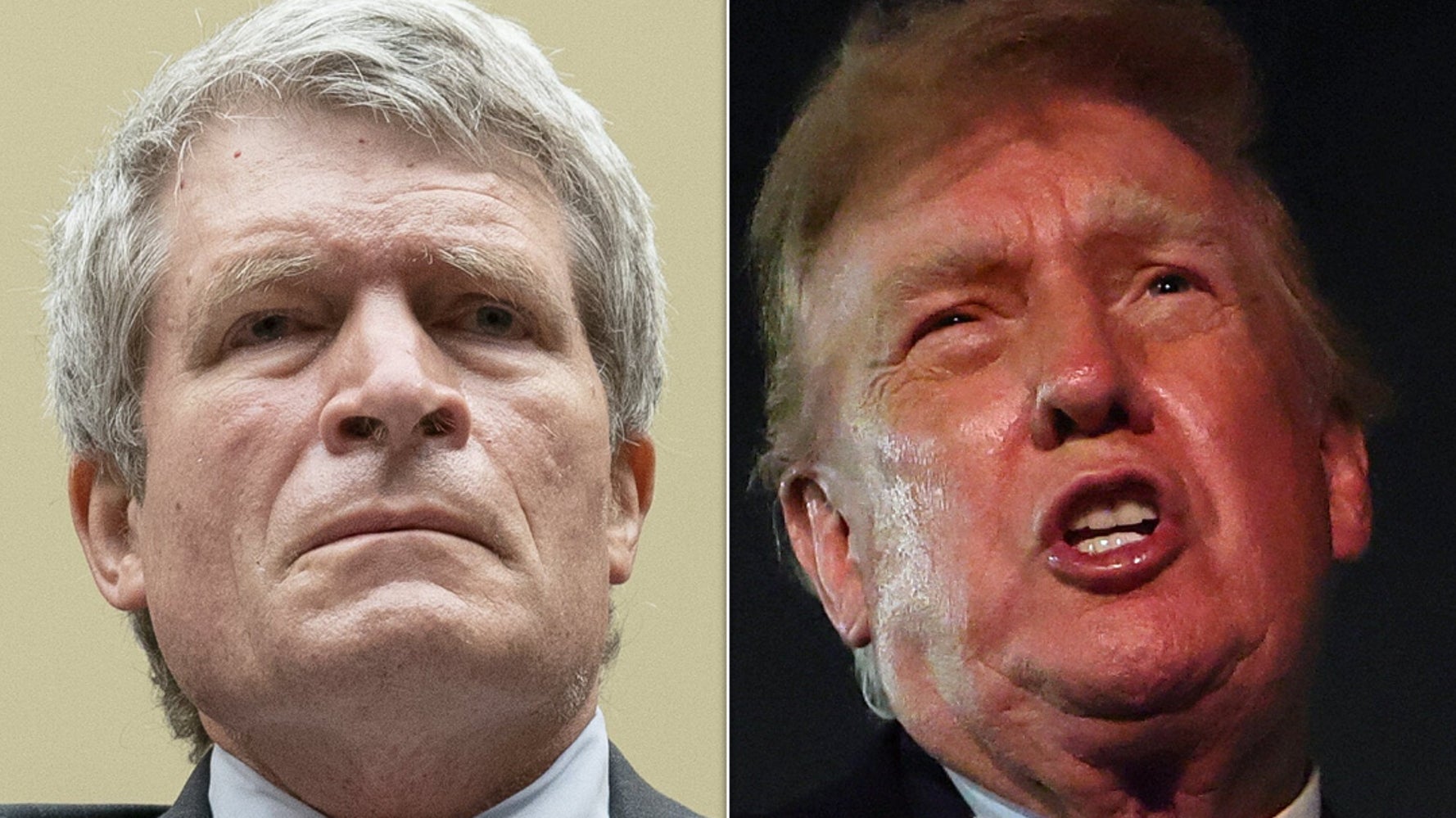
When a sitting president uses taxpayer money to broadcast flattering videos of himself set to the song “Love Me,” the line between governance and propaganda does not blur — it disappears. That is precisely what former White House ethics attorney Richard Painter argued this week when he responded to the Trump administration’s use of public funds to run what can only be described as political advertisements promoting Donald Trump personally. “This could be an impeachable offense,” Painter wrote on X, adding with pointed directness that Trump “has no right to use taxpayer money for campaign ads.” The charge is serious, and it comes from someone with institutional credibility that is difficult to dismiss: Painter served as the ethics chief in the White House of George W. Bush, hardly a bastion of progressive governance.
The administration has produced at least two such videos. The first featured UFC chief Dana White lavishing praise on Trump as “the toughest, most resilient person that I’ve ever met,” all while the Elvis Presley classic “Love Me” played over a montage of the president’s image — a production that would not look out of place in the promotional reel of an authoritarian state. The second was recycled directly from Trump’s 2024 campaign materials, repurposed and redistributed using the machinery and budget of the federal government. The White House has insisted both qualify as public service announcements, a characterization that strains credulity to its breaking point, given that neither promotes any cause, public health initiative, civic awareness campaign, or policy objective that serves the general population.
Painter’s condemnation did not stand alone. Norm Eisen, who served as special counsel for ethics and government reform in the Obama White House, told The New York Times that “the president and his administration have gone from breaking the law to trampling it,” and that the second ad “openly repurposes prior political conduct” in a way that moves the transgression from troubling to flagrant. These are not partisan voices manufacturing outrage; they are specialists in the legal architecture that governs the separation between public office and personal political advancement, and their alarm is grounded in statute. Painter specifically noted that “Congress has expressly prohibited government-sponsored political propaganda, which is dangerous for democracy” — a prohibition that exists precisely because the temptation to exploit the resources of the state for self-promotion is as old as power itself.
Representative Jamie Raskin of Maryland went further still, arguing in a public statement last week that the ads may constitute “felony criminal theft and conversion of government property for political campaign purposes,” citing the relevant federal statute. That a member of Congress would invoke criminal law in this context reflects how far outside accepted norms the administration has traveled, and how rapidly the guardrails of democratic accountability are being tested. What is particularly striking is that even some Republicans who have reliably aligned themselves with Trump found the ads difficult to defend. Senator John Kennedy of Louisiana, speaking on “Face the Nation” on Sunday, said plainly that “no public official, including President Trump or Kristi Noem or John Kennedy, should spend public money on private ads for themselves,” before acknowledging with a kind of weary candor that “there probably is a rule” against it — as indeed there is.
Kennedy’s admission is telling not because it represents meaningful Republican resistance — it does not — but because it reveals the degree to which the administration’s conduct is indefensible even on its own political terms. The rule exists. The law exists. Congress wrote it. And yet the videos ran, the White House defended them, and the apparatus of the federal government was bent, however briefly, toward the task of making one man look magnificent. That is not governance. It is the grammar of autocracy, written in small enough letters that each individual sentence can be explained away, but legible enough in aggregate that those who study such things — ethicists, constitutional lawyers, historians of democratic backsliding — recognize the paragraph for what it is. The question now is whether the institutions designed to enforce the rule Kennedy so casually acknowledged will choose to do so, or whether the precedent will simply calcify into the new normal.