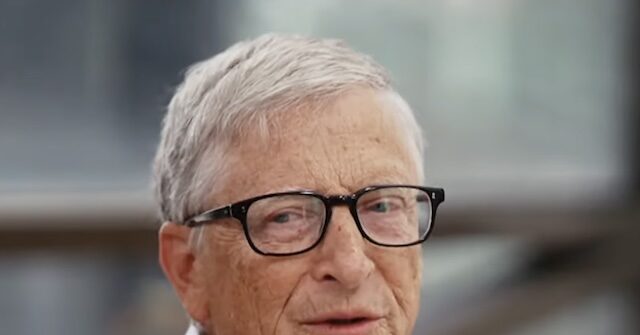
Bill Gates made one of his clearest public statements yet on artificial intelligence governance Sunday, telling NBC’s Meet the Press that self-regulation by the tech industry is simply not enough — and that legislation, law enforcement, and political engagement are all essential to keeping AI from causing serious harm. It was a rare moment of candor from a figure who helped build the modern technology industry, and the urgency in his words was hard to miss.
Speaking with anchor Kristen Welker, Gates described a regulatory landscape that has fallen dangerously behind the technology it is supposed to oversee. Unlike nuclear weapons or rocket systems, where government funding and procurement gave federal agencies deep institutional knowledge, AI has emerged almost entirely from the private sector. That gap in expertise, Gates argued, leaves policymakers poorly equipped to understand the thresholds already crossed — thresholds he named explicitly: bio-attack capability, cyber-attack capability, and others that materialized, in his telling, within this very year.
The implications of that framing deserve to be taken seriously. Gates is not describing theoretical future risks. He is describing dangers that exist now, developed by companies operating largely outside meaningful public oversight, in a policy environment where nationalistic pressure — the “us versus them” logic of a technology race with China — actively discourages anyone from hitting the brakes.
“It’s completely irresponsible not to require every AI to have these safeguards and monitoring capabilities,” Gates said flatly. When Welker pressed him on whether self-regulation could be sufficient, his answer was equally blunt: “No one thinks self-regulation is enough.”
That statement carries real weight coming from a man who spent decades at the helm of one of the world’s most powerful technology corporations. The tech industry has long leaned on the promise of self-governance to fend off regulatory intervention, and Washington has, for the most part, obliged — producing a regulatory vacuum that has allowed AI capabilities to race ahead of any meaningful accountability structure. Gates’s willingness to say plainly that this model has failed is a significant public break from that tradition.
His proposed remedy is straightforward: legislation that mandates safeguards and monitoring for every AI system, enforced through law enforcement and political institutions. He acknowledged this would impose some overhead on the industry but dismissed the concern as minor — “not a dramatic slowing of what they’re doing.” That framing matters, because one of the most persistent arguments against AI regulation is that it would chill innovation and cede ground to less scrupulous international competitors. Gates rejected that trade-off as a false choice.
What Gates is describing is, at its core, a familiar and well-established principle: that when private actors develop technologies capable of broad societal harm, the state has both the right and the obligation to set binding rules. We apply this logic to pharmaceuticals, to aviation, to financial instruments. The question has never really been whether AI warrants the same treatment — it plainly does — but whether the political will exists to act before catastrophic failures force the issue.
The answer to that question remains deeply uncertain. Congress has held hearings, issued statements, and invited tech executives to testify, but has yet to pass comprehensive AI legislation. Meanwhile, the industry continues to advance at a pace that makes each month of inaction more consequential than the last. Gates did not pretend otherwise. His call was not for optimism but for urgency — and for the recognition that the window to build oversight into AI systems, rather than retrofit it after damage is done, is closing faster than Washington seems to understand.