
With the November midterms less than a month away, President Donald Trump is dangling an extraordinary sum of money in front of the American electorate: $5,000 checks for every adult citizen, contingent on Republicans holding Congress. The promise is enormous. The details are essentially nonexistent.
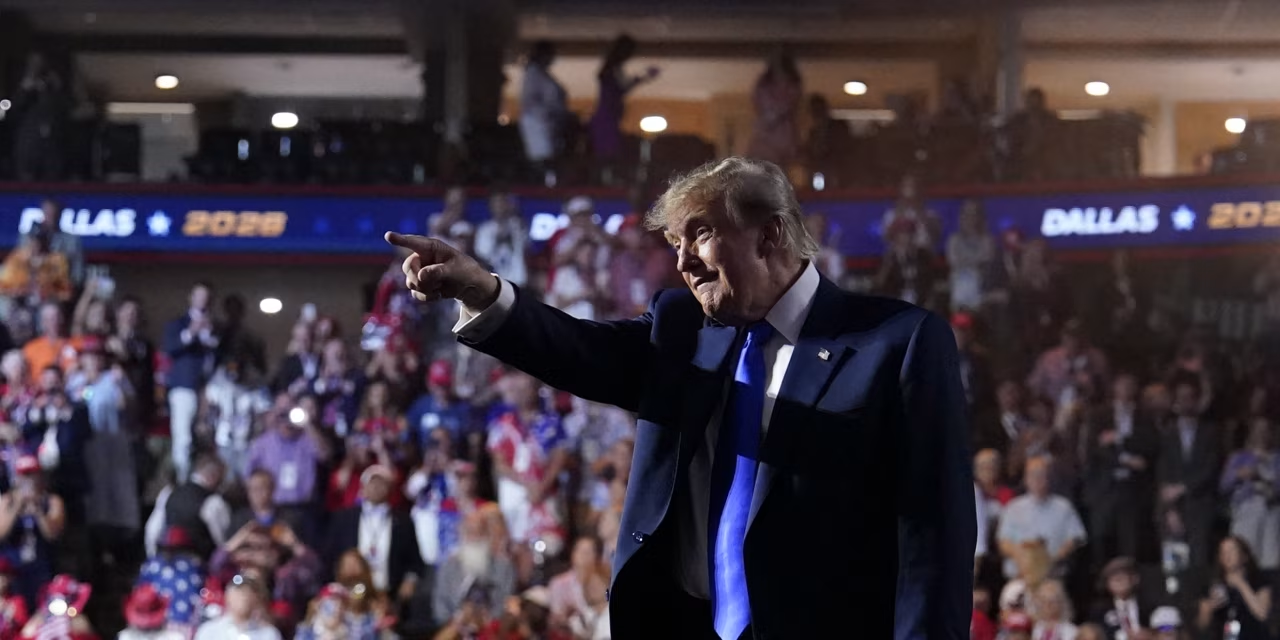
Trump announced the pledge in a Truth Social video post on Saturday, declaring, “If Republicans win the House of Representatives and the Senate in the 2026 Midterm Elections, I’m going to give all Adult Citizens in the United States of America, $5,000.” He had floated a similar proposal just weeks earlier at the Republican National Committee’s first midterm convention in Dallas. What he has not offered, either time, is any coherent explanation of where the money would come from or who would authorize the payments — because sending $5,000 to every adult citizen would cost roughly $1.2 trillion and would require an act of Congress to execute.
The $5,000 pledge arrived alongside two smaller, real cash-payment programs already in motion, lending the broader announcement a veneer of credibility it does not quite earn on its own. On Friday, Trump announced one-time $90 payments to 20.8 million Medicare Part B enrollees, funded through the Medicare Improvement Fund and scheduled to arrive this month. A day before that, roughly 950,000 people who purchased unsubsidized coverage through the federal Obamacare marketplace began receiving $500 “refund” checks — framed by the administration as a return on overpayments, though the program’s rollout has drawn scrutiny for its timing.
That timing is difficult to ignore. A Reuters analysis found that 71% of the Obamacare money — approximately $339 million — is flowing to residents of just 13 states hosting the country’s most competitive Senate and gubernatorial races. Administration officials are careful to note that eligibility is based on insurance status rather than voting registration, and that distinction is technically accurate. But the political geography of the distribution is striking, and the concentration of funds in battleground states weeks before an election warrants more than a passing glance.
What makes the $5,000 promise particularly worth scrutinizing is not its ambition but its familiarity. Trump has made sweeping cash-payment pledges before, and they have a consistent outcome: they do not materialize. In February 2025, the administration floated a $5,000 “DOGE dividend,” claiming the funds would come from savings generated by Elon Musk’s since-disbanded Department of Government Efficiency. Those checks were never issued. In November of that year, Trump proposed a reciprocal tariff-funded dividend of at least $2,000 per person — a plan rendered moot when the Supreme Court struck down the underlying tariffs in February, again producing no payments. And going back further, six weeks before the 2020 election, Trump promised $200 prescription-drug cards to 33 million Medicare beneficiaries “in coming weeks.” Those cards never went out either.
The administration does have genuine direct-payment successes to point to. Congress approved pandemic stimulus payments during Trump’s first term, and the administration delivered a $1,776 “Warrior Dividend” to roughly 1.5 million service members last year. But those programs had clear funding mechanisms and legislative backing. The $5,000 “Trump dividend” has neither, and the White House has offered no timeline for providing either.
Resistance is emerging from within Republican ranks, which is itself telling. Representative David Schweikert of Arizona told Reuters he would “throw everything of my heart and soul” into blocking the proposal, warning it could drive interest rates higher and balloon the deficit. The concern is not ideological squeamishness — it is basic fiscal arithmetic. At $1.2 trillion, the program would represent one of the largest single expenditures in American history, arriving at a moment when the national debt is already at record levels and the Federal Reserve is closely watching for inflationary pressure.
Democrats have been equally sharp. Representative Jamie Raskin of Maryland called the plan a “political bribe” in a CNN interview on September 10th, pointedly reminding viewers that Congress — not the president — controls federal spending. That constitutional reality is precisely why the promise, as structured, cannot be fulfilled by executive action alone, a fact the administration has conspicuously declined to address.
Public opinion, meanwhile, is not breaking cleanly in Trump’s favor. A Rasmussen Reports survey found likely voters essentially split — 47% in favor, 48% opposed — and only 15% said the proposal would actually influence their vote. A Marquette Law School poll in Wisconsin found 70% of respondents opposed to the payments outright. Perhaps most damaging for the political calculus, an Economist/YouGov survey found that 57% of registered voters doubted Trump would deliver the checks even if Republicans did retain Congress — a skepticism that, given the historical record, appears entirely rational.
There is a broader pattern here that deserves to be named plainly. Across multiple election cycles, Trump has deployed the promise of direct cash payments as a campaign instrument, calibrated to generate headlines and voter enthusiasm in the final stretch before votes are cast. Some of those promises have been kept in modified form; most have not. The $90 Medicare payments and the $500 Obamacare checks are real money reaching real people, and that matters. But they also serve as political staging for a far grander promise that carries no funding mechanism, no legislative path, and a track record that should give any voter serious pause. Treating the $5,000 pledge as a credible policy proposal rather than an electoral gambit would require ignoring everything that has come before it — and voters, it seems, are not entirely willing to do that.