
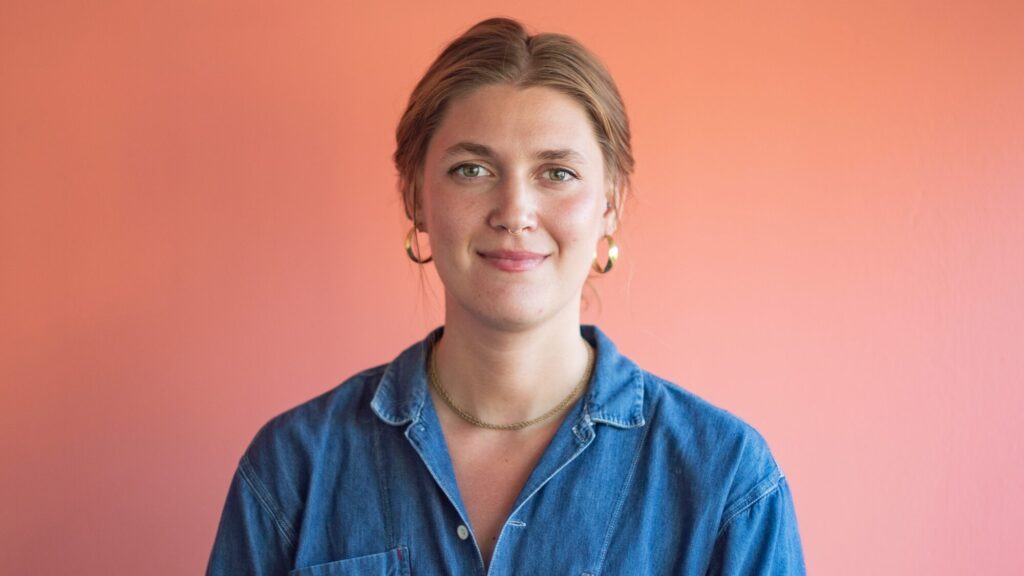
When the Supreme Court stripped away the constitutional right to abortion in June 2022, Betsy Pleasants was already deep in research on how the Covid-19 pandemic had disrupted abortion access. She pivoted fast — and what she built in response has become a rigorous, privacy-conscious model for using artificial intelligence to track reproductive health in real time, at a moment when the stakes could not be higher.
Pleasants, now a postdoctoral research associate at the Center for Women’s Health Research at the University of North Carolina, analyzed more than 7,000 posts from the Reddit forum r/abortion, drawing on natural language processing — a computational method that identifies patterns in human language — alongside careful qualitative reading of individual posts. The dual approach let her team capture both the breadth and the texture of how people were navigating a rapidly shifting legal landscape, surfacing experiences that clinical or practice-based research would almost certainly have missed. Reddit’s relative anonymity meant users spoke with unusual candor about experiences they might never disclose to a provider, a researcher, or even a friend.
The findings confirmed entrenched, well-documented barriers — cost, limited appointment availability, long travel distances — while also illuminating newer and less visible ones that the post-Roe landscape had accelerated.
The research did not stop at cataloguing barriers. Pleasants and her collaborators built explicit ethical guardrails into the methodology, recognizing that reproductive health data carries particular legal and personal risk. Rather than quoting Reddit posts directly — which could expose users to identification and, in some states, prosecution — the team used a “heavy disguise” process, constructing composite quotations that merged and rephrased similar experiences before running them through plagiarism-detection tools to confirm they could not be traced to their sources. That level of care is not standard practice in social media research, and Pleasants’ framework is being watched closely by others in the field.
A framework built for a dangerous moment
Ushma Upadhyay, a professor in the Department of Obstetrics, Gynecology, and Reproductive Sciences at UC San Francisco who mentored Pleasants during her doctorate, described the approach as genuinely visionary. “At the time, I didn’t know of any other studies using NLP to study online discourse on abortion,” Upadhyay said. “Most researchers will just take a random sample of a manageable number that they can analyze, and so this approach was really great because Betsy was able to get a more complete picture.” Danny Valdez, associate professor of public health at Indiana University’s School of Public Health-Bloomington, who has used NLP to study vaccine misinformation and addiction recovery, put it plainly: computational tools give researchers “a 1,000-foot overview of how people communicate when they need help,” and they can reveal the pulse of public experience in ways that inform where policy is headed — or where it needs to go.
Pleasants grew up in North Carolina receiving abstinence-only sex education even in Durham, a progressive university city, and that early encounter with unequal health knowledge shaped everything that followed. She entered college intending to become a physician but was pulled toward medical anthropology and the structural questions underneath clinical practice — who gets accurate information, who gets care, and who bears the cost when both are withheld. That trajectory led her from UNC to UC Berkeley and back to UNC, and it runs as a continuous thread through research that has now expanded to include contraception access and the spread of health misinformation online. With reproductive rights under sustained legislative assault at the state and federal level, Pleasants is clear-eyed about what her work is for. “The importance of the research doesn’t lessen just because policies make the work harder,” she said. “Rather, the opposite seems true right now.”