
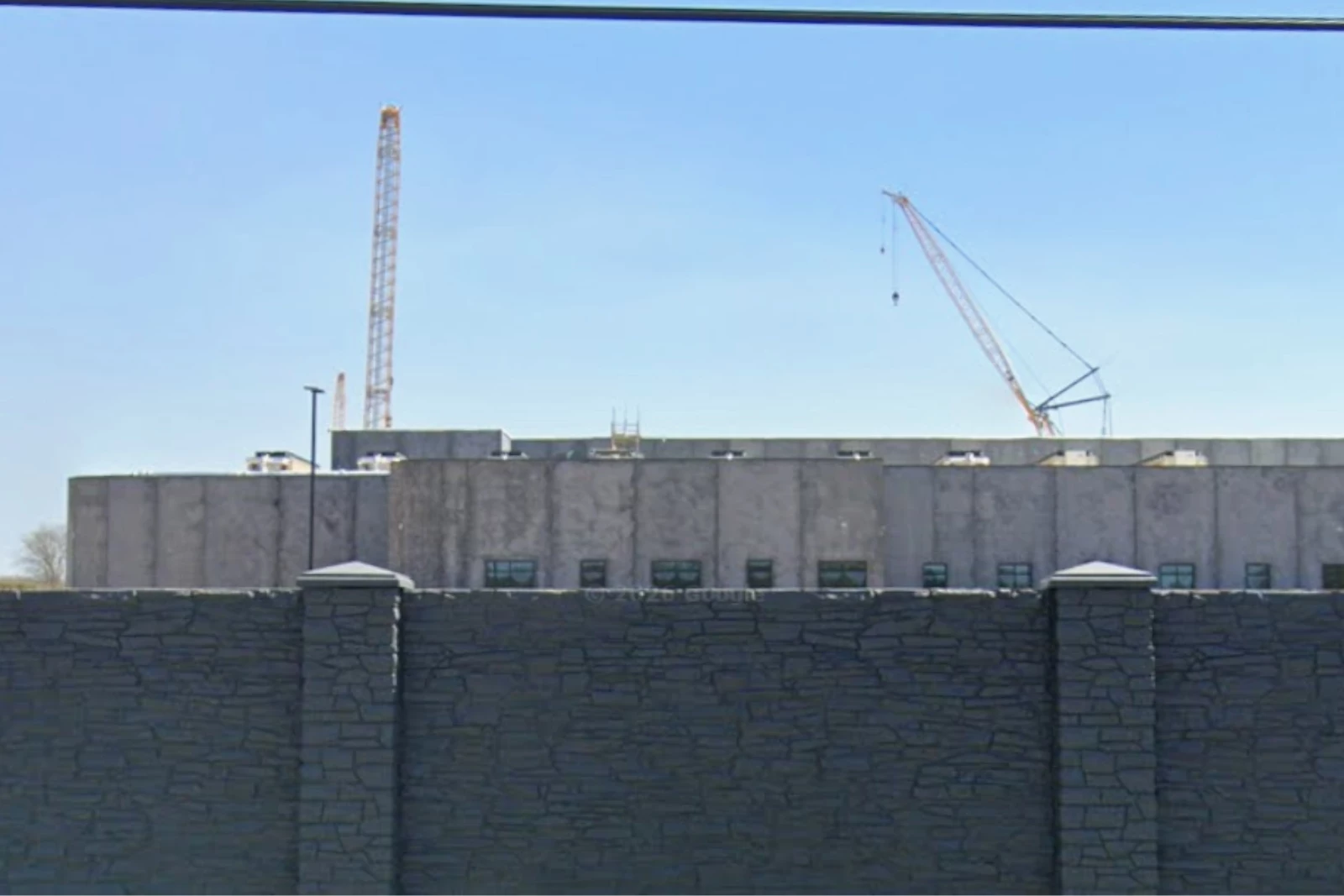
More than a year ago, Monroe Township in Gloucester County quietly amended its local redevelopment plan to include data centers as a principal permitted use. Online municipal records show the town adopted a “Hexa Builders Redevelopment Plan” that explicitly opened the door for the Princeton-based development company to build on a 172-acre parcel of vacant farmland at 3043 South Black Horse Pike. At the time, few residents paid close attention. That would soon change.
It was not until early 2025 that public awareness caught up with what a modern AI data center actually demands — enormous quantities of electricity drawn from regional grids, and vast volumes of water consumed for cooling. Starting in January, crowds began filling Monroe Township public meetings, raising sharp questions about a project that had initially been described in planning documents as a “warehouse and distribution center.” Environmental advocates from the Pinelands Alliance and NJ Food & Water Watch were among those who showed up to push back, and Mayor Greg Wolfe acknowledged their input as a driving force in the council’s subsequent deliberations.
By March, Monroe officials moved to reverse course. Following a new recommendation from town leadership, the council began crafting restrictions explicitly designed to exclude data centers from the township — making Monroe one of the first municipalities in New Jersey to pursue an outright ban through local ordinance. The move reflected a growing pattern across the state, as communities scrambled to respond to the sudden surge in hyperscale data center proposals driven by the AI industry’s insatiable appetite for computing power.
On April 8, Hexa Builders filed an application to amend its site plan, formally proposing to convert its planned warehouse into a million-square-foot data center. The revised plans included a closed-loop cooling system designed to eliminate continuous groundwater withdrawal, along with on-site electrical infrastructure — modifications the company says demonstrated a good-faith effort to address community concerns. A facility of that scale would qualify as a high-capacity, hyperscale data center, the kind that has become extraordinarily lucrative for developers able to lease them to major AI providers.
Monroe Township did not wait. The council pressed forward with its ban, adopting an ordinance that Hexa Builders argues is unconstitutional and was applied in an arbitrary and capricious manner. In June, Hexa filed a complaint in Gloucester County Superior Court challenging the ordinance on multiple legal grounds, including the claim that the ban effectively stripped the company of the use of its property without justification. Township officials acknowledged in a June 9 Facebook statement that the lawsuit “does not come as a surprise,” conceding that the council had been warned an outright ban would invite litigation.
On July 6, the case was moved to federal court in Camden, significantly raising the stakes. A federal ruling on whether a municipality can constitutionally ban an entire category of land use — particularly one tied to emerging technology — could set precedent well beyond Monroe’s borders. The township now faces a $300 million damages claim, a figure that reflects what Hexa contends it has lost in the value and use of its property.
A Pattern Taking Shape Across New Jersey
Monroe is not alone. A nearly identical legal confrontation is unfolding in Andover Township in Sussex County, where a Pennsylvania-based developer, National Land Developers, filed suit on July 10 in Superior Court after the town similarly blocked data center construction following months of vocal public opposition. That complaint uses language strikingly similar to Hexa’s, charging that local officials acted in a manner that was “arbitrary, capricious and unreasonable.” The parallel cases suggest that New Jersey’s wave of municipal data center bans is on a collision course with property rights law — and that the outcomes will matter enormously for how states and localities are permitted to regulate the infrastructure of the AI economy.
Some analysts draw a direct comparison to the legal battles over cell phone towers in the late 2010s, when a wave of town-by-town restrictions attempted to keep towers out of communities concerned about health risks and visual blight. As The New York Times reported in 2019, those local fights largely failed, and the towers proliferated regardless. Years later, as ProPublica documented, federal research into the health effects of cell phone radiation remained essentially nonexistent even as towers grew more powerful and more numerous. The lesson communities drew — that local resistance can be legally fragile and that federal and corporate interests tend to prevail — now looms over every township council weighing a data center ban. Whether Monroe’s residents and their elected officials can hold the line remains an open and genuinely consequential question.