
For roughly four hours on a Friday in 2025, American aviation effectively stood still. A nationwide ground stop, ordered by the Federal Aviation Administration after radar and communications systems showed signs of instability at key facilities, grounded flights across the country and sent officials scrambling to explain what had gone wrong. The answer, when it came, pointed not to sabotage or software gone rogue but to something arguably more troubling: infrastructure so old it predates the Nixon administration.
The episode set off an immediate and politically charged debate in Washington over how much money Congress must spend to drag the nation’s air traffic control network into the twenty-first century, and how quickly the government can actually do it.
How the Ground Stop Unfolded
The trouble began when the FAA detected what Transportation Secretary Sean Duffy described as “inconsistency in the data” flowing from radar and communications systems at certain air route traffic control centers. Those 22 centers, distributed across the country, are responsible for guiding aircraft through long stretches of airspace between departure and arrival, relying on instrument-dependent flight plans that require continuous, reliable data links between pilots and controllers.
Facing what Duffy called “instability” in those systems, the FAA issued a nationwide ground stop out of what he characterized as “an abundance of caution.” The order held for approximately four hours before being lifted. No aircraft were lost. No passengers were harmed. But the disruption was severe enough to trigger mass confusion at airports nationwide and, in the anxious hours before officials spoke publicly, speculation about terror attacks or a malfunction tied to new software the agency had been rolling out.
During a Friday night briefing at the White House, Duffy and Homeland Security Secretary Markwayne Mullin sought to tamp down the wilder theories. Mullin said “we’re not ruling out anything” as a formal matter, but stressed that “the public was never at danger through this process.” The two officials were more forthcoming about the underlying cause: “an incredibly old air traffic control system” that had been subjected to a “patchwork” upgrade process, one that may have overwhelmed the legacy equipment still carrying the bulk of the load.
From $30 Billion to $50 Billion, Overnight
The funding ask escalated almost as fast as the crisis itself. On Thursday, Duffy and Office of Management and Budget Director Russ Vought had sent a formal letter to congressional appropriators requesting $30.1 billion for air traffic modernization. That figure already reflected a White House-backed bill introduced in September by Sen. Eric Schmitt, Republican of Missouri, which called for $10.1 billion in upgrades including $2 billion specifically for cloud computing and national airspace telecommunications. On top of that, a reconciliation law passed in July 2025 had already allocated $12.5 billion, which Duffy and Vought described as a “down-payment.”
Then Friday’s ground stop happened.
By Friday night, Duffy and Mullin had revised the number upward to $50 billion, a jump of $19.1 billion in less than 24 hours. The new figure, which the officials acknowledged they had not yet fully detailed, represented their estimate for what Mullin called a “complete overhaul of the system.” His language was blunt. “Nickel and diming it together does not work,” he said. “We need someone to come in and build the whole system.”
Duffy leaned into the emergency framing with characteristic directness. “This is an emergency,” he told reporters. “I want $50 billion. President Trump is a builder. He’s going to build this network and deliver for the American people. But the president can’t deliver for America unless the Congress delivers the money to make it happen.”
LBJ-Era Infrastructure in a 21st-Century Sky
The Senate Commerce, Science and Transportation Committee’s Republican majority moved quickly to highlight the $1.9 billion already appropriated through the July reconciliation law specifically for upgrading air route traffic control centers, the very facilities the FAA identified as the source of Friday’s problem. But they also acknowledged the scale of the challenge, noting that the last time a new air route traffic control center was built, Lyndon B. Johnson was in the White House. That is not a minor historical footnote. It means the backbone of the system guiding commercial aviation over American skies is, in many respects, a product of the 1960s.
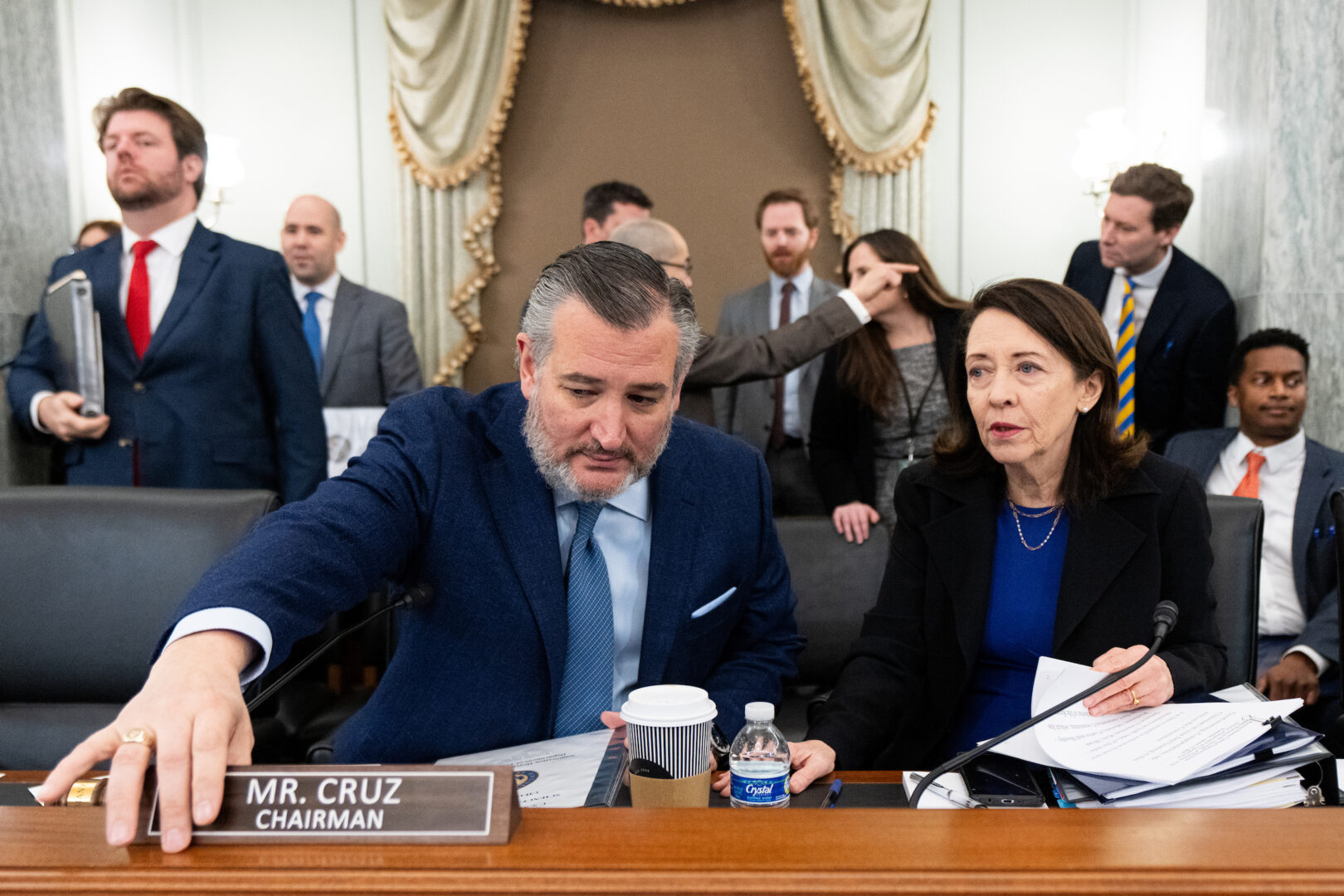
Sen. Maria Cantwell of Washington, the Commerce Committee’s ranking Democrat and its incoming chair when Democrats assume the Senate majority in January, issued a statement Friday night signaling her panel’s intent to investigate. “Technology issues related to how planes communicate through primary frequencies, backup frequencies, and other issues will be something the Commerce Committee will be reviewing,” she said. Her language was measured, but the implication was clear: the oversight process is beginning.
On the House side, Transportation and Infrastructure Committee Chairman Sam Graves, Republican of Missouri, and ranking member Rick Larsen, Democrat of Washington, issued a joint statement calling the communications failures “concerning” and pledging that their committee would “thoroughly review the issues that led to this nationwide ground stop.” The bipartisan framing was notable, even if the underlying policy disagreements over aviation safety remain unresolved.
A Collision’s Long Shadow
Friday’s ground stop did not occur in a vacuum. Both the House and Senate committees have spent months in negotiations over competing aviation safety bills, each responding to the January 2025 midair collision near Ronald Reagan Washington National Airport that killed 67 people. That disaster focused congressional attention on location transmission technology, specifically which systems should be mandated to help aircraft maintain safe separation. Committee leaders have said they hope to reach a deal during the current lame-duck session, though the Friday incident adds new urgency and new political complexity to those talks.
The broader picture is one of a federal infrastructure system that successive administrations, of both parties, allowed to age well past its functional prime. The Trump administration’s sudden enthusiasm for a $50 billion overhaul is, in one sense, a belated acknowledgment of that failure. Whether Congress will actually appropriate the funds, and whether the administration will pursue a coherent modernization plan rather than another round of patchwork fixes, remains the central question hanging over American aviation as the lame-duck session draws to a close.