
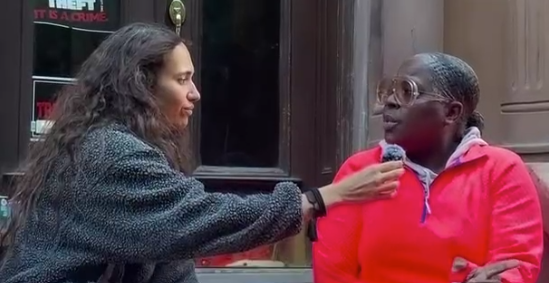
A Brooklyn Democratic district leader with a documented record of amplifying antisemitic conspiracy theories has added a new chapter to that record — blaming “Zionists” for the property dispute that first made her a neighborhood cause célèbre, in a recent interview with an Egyptian social media personality.
Carmella Charrington, elected in June to the unpaid but politically significant role of Democratic district leader in Brooklyn, made the claim during a podcast conversation with Rahma Zein. “They’re Zionists that basically did this,” Charrington said. “Same thing that they’re doing in the West Bank, it’s the same thing. There’s a connection.” The statement drew an explicit parallel between her personal legal situation and Israeli military conduct in the occupied Palestinian territories — a conflation that critics say serves to scapegoat Jewish people rather than engage seriously with either issue.
The role Charrington holds is not ceremonial. District leaders help select the Brooklyn Democratic Party’s influential chairperson and shape judicial nominations — making her views and conduct a matter of genuine consequence for local governance.
A History That Demands Scrutiny
This is not Charrington’s first brush with antisemitic content. Last November, she shared a video on Instagram promoting Henry Ford’s notorious 1920s pamphlet series The International Jew — one of the most widely distributed pieces of antisemitic propaganda in modern history, a text that Adolf Hitler himself praised. The video she amplified blamed Jewish people for slavery, the gay rights movement, the sale of alcohol and drugs, and the 1921 Tulsa Race Massacre. It recycled century-old fantasies about Jewish control of media, banks, and educational institutions. It claimed Jewish people created plastic surgery to “blend in” and are “always changing their names,” variously identifying as Zionists, Communists, and Bolsheviks.
These are not edgy political opinions. They are fabrications with a body count.
Charrington subsequently apologized for the Instagram post in an interview with The New York Times. But apologies issued under pressure carry limited weight when the underlying pattern continues. Her most recent interview suggests the worldview that led her to share that video has not meaningfully shifted.
Elected officials have not stayed silent. State Senators Jabari Brisport and Samantha Huntley condemned the Instagram post. New York City Council Speaker Julie Menin — the first Jewish person to hold that office — also publicly rebuked Charrington’s promotion of antisemitic conspiracy theories. Condemnation has come from across the local political spectrum, including from figures well to Charrington’s left.
The Property Dispute: What the Evidence Actually Shows
Charrington built her public profile around a legal fight over her family’s brownstone in Bedford-Stuyvesant, a rapidly gentrifying neighborhood where the stakes of property ownership are real and the history of predatory real estate practices is well documented. She framed the dispute as deed theft — a serious and legitimate concern in communities of color across New York City. Genuine deed theft does happen. It deserves aggressive legal remedy.
But this case is not that. New York State Attorney General Letitia James’ office — a progressive institution with no incentive to dismiss claims of housing fraud — investigated and determined the situation was an inheritance dispute, not theft. The facts are complicated: Charrington’s father, elderly and infirm, had been taken into custody by the New York City Sheriff’s office in Brooklyn and returned to Georgia, where a court declared him a ward of the state. His estate became the subject of legal proceedings. The home’s sale followed from that process.
Charrington was sent to Rikers Island on a contempt of court charge during the dispute. She reportedly yelled “get your rabbi” at a reporter over the phone and directed sustained animus at the home’s Jewish buyers and at the Jewish judge who issued the contempt order. Framing a civil inheritance proceeding as a Zionist conspiracy does not illuminate structural injustice. It obscures it — and it does real harm to communities that have historically been targeted by exactly these kinds of tropes.
The broader context matters here. Gentrification in Bed-Stuy is a genuine crisis. Black homeowners have faced predatory tactics, legal manipulation, and systemic disinvestment for generations. Those structural wrongs deserve unflinching coverage and political accountability. What they do not deserve is to be instrumentalized in service of antisemitic narratives that have nothing to do with the actual mechanisms of displacement.
Meanwhile, the Brooklyn Democratic Party is navigating its own internal power struggle. Left-leaning forces are pushing to unseat the current centrist chair, Assemblywoman Rodneyse Bichotte. Charrington, as a district leader, sits at the center of that contest — which makes the question of her fitness for the role not merely symbolic but structurally important for the direction of Brooklyn politics.
Progressives who take antisemitism seriously — as a form of racism, as a conspiracy theory that has historically served to protect concentrated power by misdirecting legitimate grievances — cannot treat Charrington’s statements as a side issue. They are the issue.