
The federal government is making it harder for working parents to keep their children in child care — and the consequences are landing hardest on exactly the kinds of families the Republican Party claims to champion.
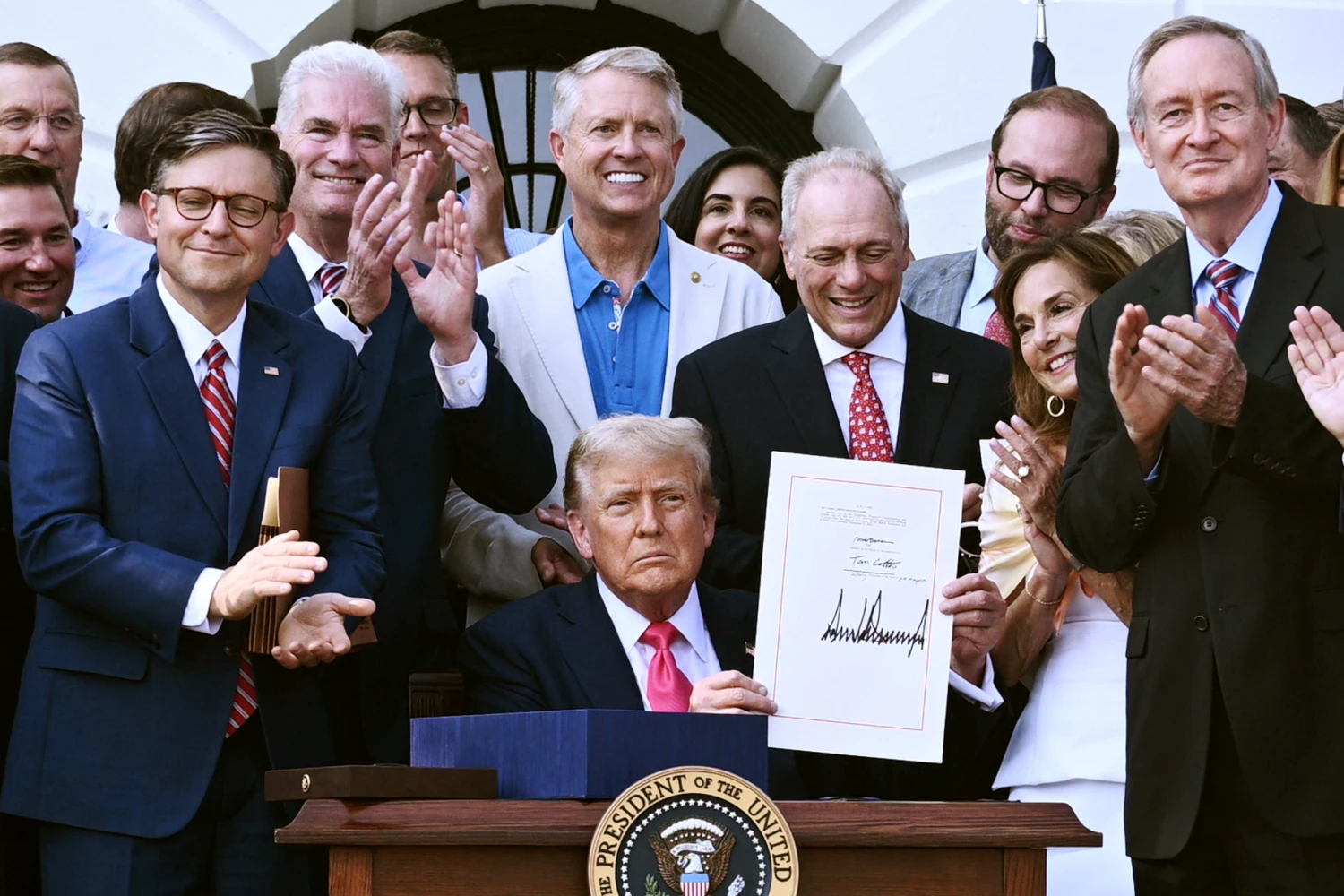
In Nebraska, a state that has voted Republican in every presidential election since 1968, families relying on state child care subsidies are encountering weeks-long delays, unreachable caseworkers, and bureaucratic walls that threaten to knock parents out of the workforce entirely. The cause is not administrative incompetence alone. It is, in significant part, a direct policy consequence of President Donald Trump’s so-called “Big, Beautiful Bill,” signed into law in July 2025 — legislation that has quietly redirected the administrative machinery of state social services away from child care and toward more punishing eligibility verification for food assistance.
This is the real-world cost of conservative governance when its stated values — self-reliance, workforce participation, family stability — collide with its actual policy choices.
What the Policy Actually Does
The mechanism is worth understanding in concrete terms, because it reveals how federal mandates cascade into local disruption. Nebraska’s Department of Health and Human Services has acknowledged a “temporary” surge in processing times for child care subsidy approvals. A department spokesman, Jeff Powell, confirmed that staff resources previously devoted to child care applications have been redirected to satisfy new, more stringent verification requirements for the Supplemental Nutrition Assistance Program — requirements imposed by the Trump administration’s signature domestic legislation. Under the new rules, all states must keep their SNAP error rate below 6 percent or absorb a larger share of benefit costs. Nebraska’s error rate currently sits at 5.9 percent, a razor-thin margin that has nonetheless triggered a significant administrative scramble.
The result is that processing child care subsidy applications — which the state’s own website says may already take up to six weeks — is now stretching to 45 days, two months, and sometimes longer, according to advocates at First Five Nebraska, an early childhood policy organization. Phone calls with state representatives have reportedly consumed more than three hours at a stretch. One Omaha child care director, Tasha McNeil of Brilliant Brains Learning Center, spent three hours and 41 minutes on a single call helping one of her own employees navigate a reauthorization process — a process the worker ultimately completed, but only after submitting additional rounds of documentation.
Powell framed the slowdown as a necessary shift “away from the honor system to verification,” emphasizing fraud prevention and the protection of taxpayer dollars. That framing deserves scrutiny. Nebraska’s SNAP error rate of 5.9 percent — barely below the federal threshold — does not suggest a system riddled with fraud. It suggests a system operating under pressure, where the margin for administrative error is vanishingly small and the cost of missing it has now been raised artificially by federal mandate.
The Human Arithmetic of Bureaucratic Delay
Josh Wigginton and his wife, Amanda, a teacher in the Omaha area, nearly lost their child care arrangement for their 7-year-old daughter Nayeli — a child they adopted out of foster care — because their annual subsidy reauthorization stalled for reasons that turned out to include their caseworker having quietly left state employment without the family being notified. They had begun the reauthorization process more than two months before the crisis point. They called repeatedly, sent emails that bounced back as undeliverable, and at one point Amanda went in person to a state office, only to be referred elsewhere. It was only after a journalist from the Nebraska Examiner contacted the state that the Wiggintons received a resolution call — within hours.
That outcome is telling. A family with the persistence, resources, and sheer luck to have a journalist inquire on their behalf got their problem solved. Families without those advantages do not. As Wigginton himself put it afterward: “I feel bad for people who don’t know the process.”
The stakes of these delays are not abstract. Shannon Burks, who operates Creative Corner Child Care in Grand Island, described a father whose subsidy came up for renewal just as he started a new job. He has two children enrolled full-time. Without timely reauthorization, he faces paying out of pocket at precisely the moment his income is most uncertain — or losing his spot entirely. “He has to pay or I have to hold my breath and hope he gets covered,” Burks said. For providers operating on thin margins, holding their breath is not a sustainable business model. For parents on the edge of workforce participation, a gap in child care is often the difference between keeping a job and losing it.
First Five Nebraska advocates noted that one child care facility in central Nebraska and another in Omaha each had roughly a third of their enrolled families awaiting subsidy approval at any given time. A third. That is not a temporary administrative hiccup — it is a structural failure with compounding consequences for providers, parents, and children alike.
The Ideology Behind the Dysfunction
It would be tempting to attribute all of this to bureaucratic inefficiency, to the ordinary friction of government administration. But that reading lets the policy off the hook. The delays in Nebraska are not incidental to the Trump administration’s legislative agenda — they are a foreseeable consequence of it. When the federal government tightens eligibility verification requirements for one program without providing commensurate administrative resources, it creates a zero-sum competition for staff time within state agencies. Child care subsidies lose that competition because SNAP compliance now carries financial penalties that child care processing does not.
The rhetoric accompanying these choices — fraud prevention, protecting taxpayer dollars, ensuring benefits reach those who “truly need them” — is a familiar conservative register that sounds reasonable in the abstract and operates as a rationing mechanism in practice. The families caught in Nebraska’s processing backlog are not fraudsters. They are adoptive parents, teachers, new hires, and child care workers navigating a system that has been deliberately made more demanding without being made more capable.
Powell said the state has been given the green light to hire additional staff to alleviate the backlog, even amid a broader state hiring freeze prompted by a budget deficit — a deficit that itself reflects the fiscal pressures of a state government operating under Republican leadership. Whether that hiring materializes quickly enough to prevent further family disruptions remains to be seen. The promise of future staffing does not help the father in Grand Island who needs his subsidy renewed today.
What is happening in Nebraska is a case study in what progressive governance critics have long argued: that the systematic underfunding and over-burdening of social service infrastructure does not eliminate need — it just makes the machinery for meeting that need grind slower, punishing the most vulnerable people most. Child care is not a luxury. It is the load-bearing infrastructure of workforce participation, particularly for working-class and lower-income families. When that infrastructure buckles under the weight of federal policy choices, it is not an accident. It is a choice — and its costs are being paid, right now, by families in a state that voted overwhelmingly for the administration imposing them.