
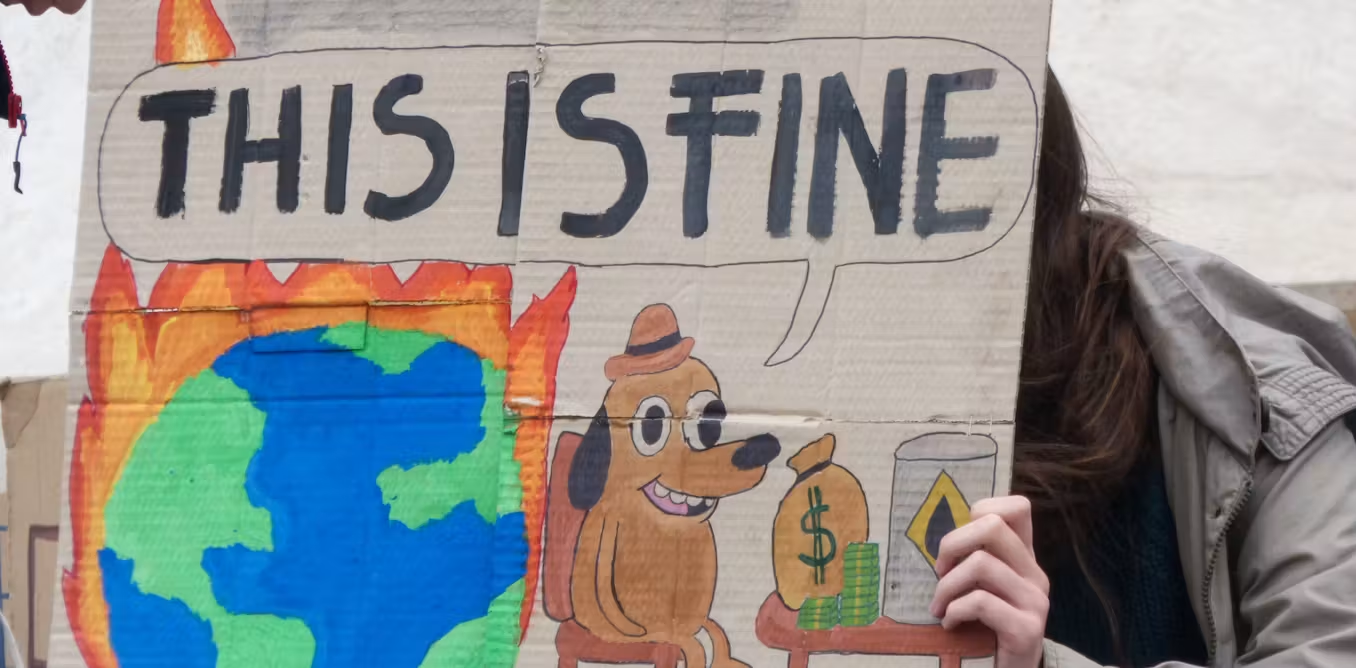
A Crisis That Refuses to Wait
Climate change does not pause for political convenience. It does not negotiate with ideologues, defer to fossil fuel lobbyists, or disappear when a government stops measuring it. The physical reality of a warming planet accelerates regardless of whether policymakers choose to acknowledge it — and the communities bearing the heaviest costs are, overwhelmingly, those with the least power to absorb them.
That is the central, uncomfortable truth that denial politics cannot escape. Ignoring the crisis does not neutralize it. It simply transfers the burden — from today’s decision-makers onto tomorrow’s most vulnerable people.
What the Science Has Settled
The scientific consensus on anthropogenic climate change is not a matter of ongoing debate among credible researchers. It is, at this point, one of the most thoroughly validated conclusions in the history of empirical inquiry. Global average temperatures have risen approximately 1.2 degrees Celsius above pre-industrial levels. The last decade was the hottest on record. Arctic sea ice is retreating at a pace that consistently outstrips even pessimistic projections.
These are measurements. They are not opinions.
The Intergovernmental Panel on Climate Change — drawing on the work of thousands of scientists across more than 195 countries — has made clear that limiting warming to 1.5°C above pre-industrial levels requires rapid, far-reaching, and unprecedented changes across energy, land use, transport, and industry. Every fraction of a degree beyond that threshold translates into measurably worse outcomes: more intense hurricanes, longer droughts, accelerating sea-level rise, and ecosystem collapse at scales that destabilize food and water systems for billions of people.
The Politics of Denial and Who It Serves
Climate denial has never been a grassroots phenomenon. It has been a manufactured product, funded and sustained by fossil fuel interests who understood decades ago — from their own internal research — that continued extraction would destabilize the global climate. Documents made public through litigation and investigative reporting reveal that companies like ExxonMobil were modelling climate trajectories in the 1970s and 1980s with striking accuracy, even as their public communications seeded doubt about the very science their engineers were using.
The political infrastructure that followed was deliberate. Think tanks, front groups, and sympathetic lawmakers amplified uncertainty where little existed, framing a settled empirical question as a “debate” requiring “both sides.” This is not balance. It is the corruption of public epistemology in service of private profit.
Republican climate skepticism, in particular, has hardened from passive doubt into active obstruction. Withdrawing from the Paris Agreement — twice, under two different administrations — gutting the Environmental Protection Agency’s regulatory authority, rolling back methane rules, opening protected lands to drilling: these are not policy disagreements about the best mechanism for decarbonization. They are rejections of the underlying reality that decarbonization is necessary at all. That distinction matters enormously, and treating it as a normal difference of political opinion does a disservice to the public.
The Disproportionate Human Cost
Who Gets Hit First
Climate change is not an abstraction distributed equally across humanity. Its worst effects land hardest on communities that have contributed least to the problem. Low-lying island nations in the Pacific face literal submersion. Sub-Saharan African countries, responsible for a small fraction of cumulative global emissions, are experiencing desertification and crop failure at catastrophic rates. In the United States, it is predominantly low-income communities and communities of color — situated near industrial facilities, in flood-prone areas, in urban heat islands without green infrastructure — that absorb the most acute consequences.
This is an environmental justice crisis. It is inseparable from questions of race, class, and the distribution of political power.
The Economic Argument Against Inaction
Delaying climate action is not fiscally conservative. It is fiscally reckless. The economic costs of unmitigated warming — in disaster relief, infrastructure replacement, agricultural disruption, public health expenditure, and forced migration — dwarf the upfront investment required for a managed energy transition. The Deloitte Economics Institute estimated in 2022 that inaction on climate could cost the global economy $178 trillion over the next 50 years. The Swiss Re Institute has projected that climate change could shrink global GDP by as much as 18 percent by 2050 under high-emission scenarios.
These are not activist projections. They come from financial institutions whose business model depends on accurate risk assessment.
What Genuine Climate Policy Looks Like
The good news — and it is real — is that the tools for a just transition already exist. Renewable energy costs have collapsed over the past decade. Solar and wind are now the cheapest sources of new electricity generation in most of the world. Battery storage technology is advancing rapidly. The question is no longer whether clean energy can power modern economies. It demonstrably can. The question is whether governments will build the regulatory and investment frameworks to accelerate that transition at the necessary pace.
That requires the state to act. It requires public investment in grid modernization, in workforce retraining for communities dependent on fossil fuel employment, in mass transit and building efficiency retrofits, in the protection and restoration of natural carbon sinks. Markets alone will not deliver this at the required speed or with the required equity. The history of every major infrastructure transformation — electrification, the interstate highway system, the internet — confirms that public coordination and public funding are indispensable.
The Inflation Reduction Act, passed in 2022, represented the most significant federal climate investment in American history — imperfect, compromised by the demands of fossil fuel-aligned Democrats, but a genuine structural intervention nonetheless. It proves that legislative action at scale is possible. It also illustrates how much further there is to go.
The Urgency of Now
Carbon dioxide persists in the atmosphere for centuries. Every year of delay in cutting emissions locks in additional warming that future generations cannot undo. The window for limiting the most catastrophic outcomes is not permanently open — it is closing, measurably, with each passing year of insufficient action.
Denial does not close that window more slowly. It accelerates the closing. And the people who will be trapped on the wrong side of it are already among us — in coastal cities, in drought-stricken farmlands, in communities where the air is already thick with the consequences of decades of deferred accountability.
The planet will not wait for a more politically convenient moment. Neither should we.