
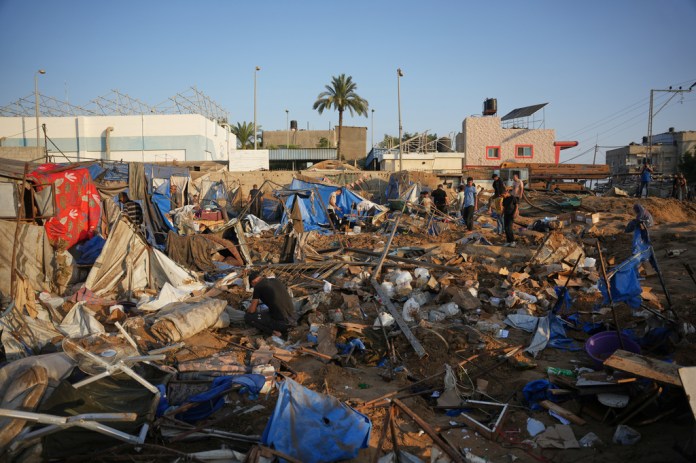
Airstrikes Continue Despite Hamas Agreement and International Pressure
The Board of Peace is confronting open defiance from Israel as its peace framework for Gaza stalls on the ground — with Israeli airstrikes continuing to pound the devastated strip even after Hamas last week agreed to a demilitarization framework, conditional on Israel holding up its own obligations under the deal.
Gaza City sustained repeated strikes on Saturday and Sunday. BOP Director-General Nikolay Mladenov traveled to Jerusalem on Monday to meet directly with Prime Minister Benjamin Netanyahu, urging him to halt the bombardment. Mladenov had already stated publicly that Israeli strikes have “killed civilians and destroyed medical supplies that people depend on.” The human cost of Israel’s continued military campaign is not abstract — it is measured in bodies and broken infrastructure.
The stakes could not be clearer. A functioning peace process exists on paper. Israel is choosing not to follow it.
What the Peace Plan Actually Requires
The framework, announced by President Donald Trump last week, envisions a phased, reciprocal process: Hamas demilitarizes, Israel withdraws its military presence from Gaza, an International Stabilization Force polices the territory during reconstruction, and a secular, technocratic governing body eventually replaces Hamas. It is a serious, if ambitious, roadmap — and both parties formally accepted obligations under it through the Comprehensive Plan and the Sharm El Sheikh deal that secured the release of all remaining hostages.
“Both parties carry obligations under the Comprehensive Plan and the Sharm El Sheikh deal,” Mladenov said Sunday. His message to Netanyahu was unambiguous: compliance is not optional. “My team and I are working around the clock with the parties, the mediators and regional partners to de-escalate and create the space for the full implementation of the plan,” he added. “Achieving a lasting peace is hard but achievable if everyone makes their best efforts.”
Netanyahu’s Cabinet: A Government at War With Itself
Netanyahu’s position is being pulled apart from within. His cabinet last week voted to authorize 200 military personnel from allied nations to enter Gaza as part of the International Stabilization Force — a move that Israeli outlet Channel 12 reported was driven less by genuine commitment than by Netanyahu’s desire to secure a White House meeting with Trump. It was, in other words, a political gesture dressed up as policy.
That gesture is now under direct attack from Netanyahu’s own coalition partners. Finance Minister Bezalel Smotrich and Settlements Minister Orit Strock are demanding that Netanyahu reverse the ISF authorization and instead “adopt a preventative cabinet decision that will block the implementation of the roadmap published by the Board of Peace.” They are not speaking in coded language. They want the peace plan dead.
National Security Minister Itamar Ben Gvir, one of the most extreme voices in the Israeli government, went further. “It was clear from the outset that no international force would do the job for us in Gaza,” he said. “Only the State of Israel can destroy Hamas.” This is not a negotiating position — it is a rejection of the entire diplomatic architecture the Board of Peace has constructed.
Trump and BOP Officials Have Downplayed the Risk — Perhaps Too Quickly
Board of Peace officials, speaking to the Washington Examiner last week, brushed aside concerns about Israeli obstruction. “We’ve gotten strong commitments from Israel,” one official said, adding that Israel is “a vibrant and thriving democracy” with internal disagreements. “I don’t see Israel as a singular problem in isolation that keeps me up at night,” the official concluded.
That confidence looks increasingly difficult to justify. When a government’s finance minister and national security minister are publicly calling for the destruction of a peace framework their own prime minister nominally endorsed, describing that as routine democratic disagreement understates the problem considerably.
Trump, for his part, told reporters he has “an understanding” with Israel — a characteristically vague assurance that provides no enforcement mechanism and no accountability.
One Voice of Support, Surrounded by Opposition
Israeli President Isaac Herzog stands as the rare senior Israeli official willing to speak positively about the BOP’s plan. Addressing a gathering of diplomats on Monday, Herzog said he sees “a lot of positive elements in the efforts” and argued the plan “can bring a certain vision of hope, also to the people of Gaza and to the people of Israel.” He stressed that Hamas must be fully disarmed — a position consistent with the framework’s own requirements.
Herzog’s role, however, is largely ceremonial. Real power rests with Netanyahu and his coalition, where the balance of pressure runs firmly against compliance. The Board of Peace faces a coalition government in which the far-right flank holds genuine leverage — and is using it to obstruct a peace process that the international community, Hamas, and at least some Israelis have formally accepted.
Mladenov and his team are working against a shrinking window. Every airstrike that lands on Gaza City makes the next phase of diplomacy harder to sustain — and every day Netanyahu delays a clear commitment to the plan, his most extreme ministers grow bolder in their campaign to kill it entirely.