
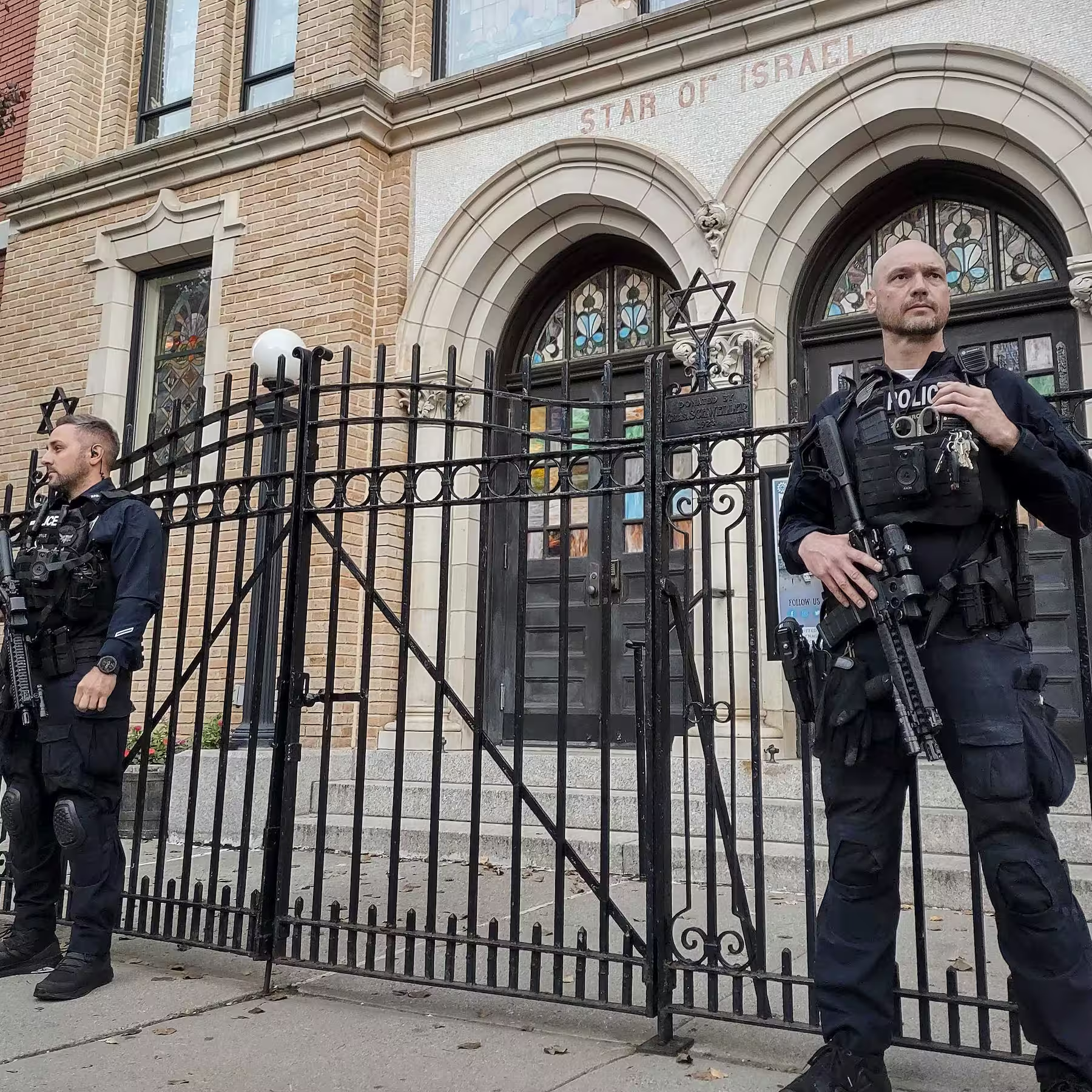
On a September morning outside a synagogue on the Upper West Side, the familiar scene of families gathering for Rosh Hashanah looks much as it always has — children in pressed clothes, elders embracing, the low murmur of anticipation before the new year begins. What has changed, profoundly and expensively, is everything you cannot immediately see.
Plainclothes officers blend into the crowd. Cameras cover the entrances. A security coordinator, hired with grant money that didn’t exist a decade ago, runs a checklist before the doors open. This is what safety looks like for Jewish New Yorkers in 2026, and it costs more than it ever has before.
Ahead of this year’s High Holy Days — Rosh Hashanah and Yom Kippur — falling on the same calendar as the 25th anniversary of September 11, the NYPD has deployed its largest-ever security presence around synagogues, yeshivas, and Jewish cultural institutions across the five boroughs. Commissioner Jessica Tisch confirmed there are no specific credible threats, but cited what she called “the realities of the world that we live in today” as justification for the expanded footprint. Those realities are, by any honest accounting, stark.
Hate crimes in New York City rose nearly 16 percent through the first eight months of 2026. Anti-Jewish hate crimes accounted for more than half of all confirmed hate crimes in the city — 229 incidents compared to 212 during the same period in 2025. Since October 7, 2023, federal and local intelligence officials have tracked a sustained elevation in threats and disrupted alleged plots targeting Jewish institutions, including a Manhattan synagogue and a Jewish center in Brooklyn. The danger is not theoretical.
Mayor Zohran Mamdani declared the safety of Jewish New Yorkers during their sacred days a matter of “the utmost importance” to his administration, and the city’s security architecture reflects that commitment in concrete operational terms. The NYPD’s plan includes additional uniformed foot posts, dedicated house-of-worship patrols, and direct coordination between precinct commanders and clergy — backed by the department’s Intelligence and Counterterrorism Bureau, which is sharing information with federal, state, and international partners.
But the security burden extends far beyond what any police department can absorb on its own. American Jewish institutions spent upwards of $1 billion on security in 2025 — a record high, and a 33 percent increase over prior years, according to a Jewish Federations of North America study. That figure represents an enormous collective tax on communities simply trying to worship, teach, and gather, a cost that falls disproportionately on smaller congregations and institutions without deep endowments.
Government has stepped in to close part of that gap, and the scale of intervention tells its own story. New York State directed a record $70 million through its Securing Communities Against Hate Crimes grant program, offering up to $250,000 per organization to fund physical security upgrades. At the federal level, the Nonprofit Security Grant Program has grown from $10 million in 2004 to $300 million in 2026 — a thirtyfold expansion that nonetheless still falls short of demand. More institutions apply than can be funded, which means that in a landscape defined by genuine risk, eligibility for protection is still partly a matter of luck and capacity to navigate bureaucratic processes.
This is precisely where the argument for robust, well-funded public programs becomes not abstract principle but lived necessity. The communities most vulnerable to hate-motivated violence are often those least equipped to privately finance their own defense. A $250,000 security grant can mean the difference between a congregation that installs reinforced doors and camera systems and one that props open a side entrance and hopes for the best. State and federal investment in this space is not government overreach — it is government doing exactly what it exists to do: protecting people that markets have no incentive to protect.
The NYPD’s deployment this year also carries a symbolic weight that neither officials nor community leaders are ignoring. The convergence of the High Holy Days with the September 11 anniversary concentrates grief and vigilance in the same moment, layering a civic memorial onto a religious one. For many Jewish New Yorkers, the two have long felt connected — not just as calendar coincidence, but as expressions of the same vulnerability that communities targeted by political violence understand in their bones.
Inside the synagogues this week, the liturgy will proceed as it has for centuries. The shofar will sound. Families will sit together and reckon with the year behind them and the one ahead. And outside, largely invisible but entirely present, the apparatus of a city trying to protect its own will hold its position — a reminder that the freedom to observe a holy day in peace is not, in this moment, something that can be taken for granted.