
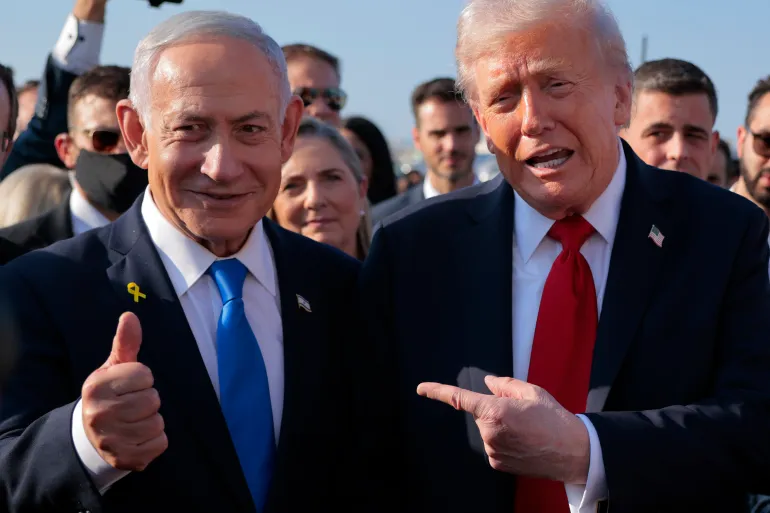
Benjamin Netanyahu publicly and emphatically rejected the Trump-backed 15-point Gaza peace roadmap on Sunday, declaring that Israel “rejects the document” and that its military will not withdraw from Gaza until Hamas is “genuinely disarmed” — meaning every weapon, heavy or light. The rejection is not merely a negotiating posture. It is a deliberate dismantling of a framework the United States spent months constructing, and it exposes a stark and uncomfortable truth: Washington’s leverage over its closest Middle Eastern ally has real limits, especially when Netanyahu’s domestic political survival depends on prolonging the conflict.
The thesis here is straightforward. Netanyahu is not pursuing a security strategy — he is pursuing an electoral one. With Israeli elections scheduled for October 27, less than three months away, polls show his coalition is at genuine risk of losing its parliamentary majority. A negotiated settlement that leaves Hamas structurally intact, even disarmed, would hand his political opponents a potent weapon. Rejecting the American plan, by contrast, lets Netanyahu position himself as the uncompromising guardian of Israeli security, the leader who stands firm “even against our best friends when necessary.” The language is calculated. The audience is domestic.
The plan Netanyahu rejected was not a fringe proposal. Trump’s 15-point roadmap, published July 31 under the auspices of the U.S.-led Board of Peace — a body of roughly 40 countries inaugurated in February 2026, with Trump serving as chair — envisioned a phased process in which Israeli withdrawal and Hamas disarmament would proceed in tandem, rather than requiring full Hamas disarmament as a precondition for any Israeli pullback. Heavy weapons, tunnels, and weapons production sites would be decommissioned under international supervision. Personal firearms would remain subject to Palestinian law and a licensing regime overseen by a U.S.-backed technocratic committee. Hamas, for its part, signaled conditional acceptance, with a senior official reaffirming the group’s commitment to the Board of Peace roadmap on Sunday — attaching conditions around a ceasefire, troop withdrawal to agreed lines, and the eventual establishment of a Palestinian state.
Netanyahu’s counter-demand — that Hamas disarm completely before a single Israeli soldier withdraws — is not a good-faith negotiating position. It is a structural impossibility designed to ensure no deal is reached. No armed non-state actor in modern history has agreed to full disarmament before receiving concrete political guarantees, and Netanyahu has made clear he will grant none: he explicitly ruled out a Palestinian state in either Gaza or the West Bank “as long as I am prime minister.” That formulation is worth sitting with. It means the precondition for disarmament — statehood — is the very outcome Netanyahu has pledged to block. The roadmap is being rejected not because it fails Israel’s security needs, but because it might actually work.
The human cost of this impasse is not abstract. Israel currently controls approximately 70 percent of Gaza, according to Palestinian officials and aid organizations. The population of the territory — overwhelmingly civilian — remains under siege, displacement, and bombardment. Every week the conflict continues without a political horizon is a week of compounded suffering that no security rationale can fully justify. A framework existed. International partners, including Arab states, had signed on. Hamas had not walked away. Netanyahu did.
What this moment reveals about the broader architecture of U.S. foreign policy is also worth confronting honestly. The Board of Peace, whatever its structural flaws — and the exclusion of Palestinian representatives from a body deciding Palestinian futures is a serious one — represented a genuine multilateral effort to move the conflict toward resolution. Trump invested political capital in it. Netanyahu swatted it aside with a three-sentence statement at a cabinet meeting. The fact that this is even possible — that a client state can publicly reject a U.S.-sponsored framework with no apparent consequence — tells us something important about the asymmetry of accountability in American foreign policy. Allies on the right tend to receive deference; pressure tends to fall on those with less leverage. The pattern is not new, but it is worth naming.
The coming weeks will test whether the Biden-era habit of absorbing Israeli defiance without consequence has truly been replaced by something different under the current administration, or whether Netanyahu has correctly calculated that the cost of rejection is zero. If Washington allows this rejection to stand without meaningful response, the Board of Peace roadmap becomes a document — not a process. And the people of Gaza, already living through one of the most prolonged and devastating urban conflicts of recent decades, will pay the price of that failure.