
Five men arrested near a strategically sensitive British air base, a declared national emergency, and a U.S. secretary of state publicly implicating a foreign state — all without a single piece of publicly released evidence. The RAF Fairford incident is serious, and the diplomatic stakes are real. But the gap between what officials are asserting and what has actually been established deserves far more scrutiny than it is currently receiving.
Secretary of State Marco Rubio appeared on Fox News Monday to declare that the suspected terror plot at RAF Fairford in Gloucestershire “clearly involves the hands of a foreign actor.” He called the situation “very serious” and pointedly invoked Iran — noting that Tehran has “openly threatened to attack American interests globally” — while simultaneously acknowledging there was “only so much I can say right now.” That combination of dramatic framing and deliberate vagueness is a pattern worth watching carefully, particularly when it comes from an administration with a documented interest in sustaining public pressure on Iran.
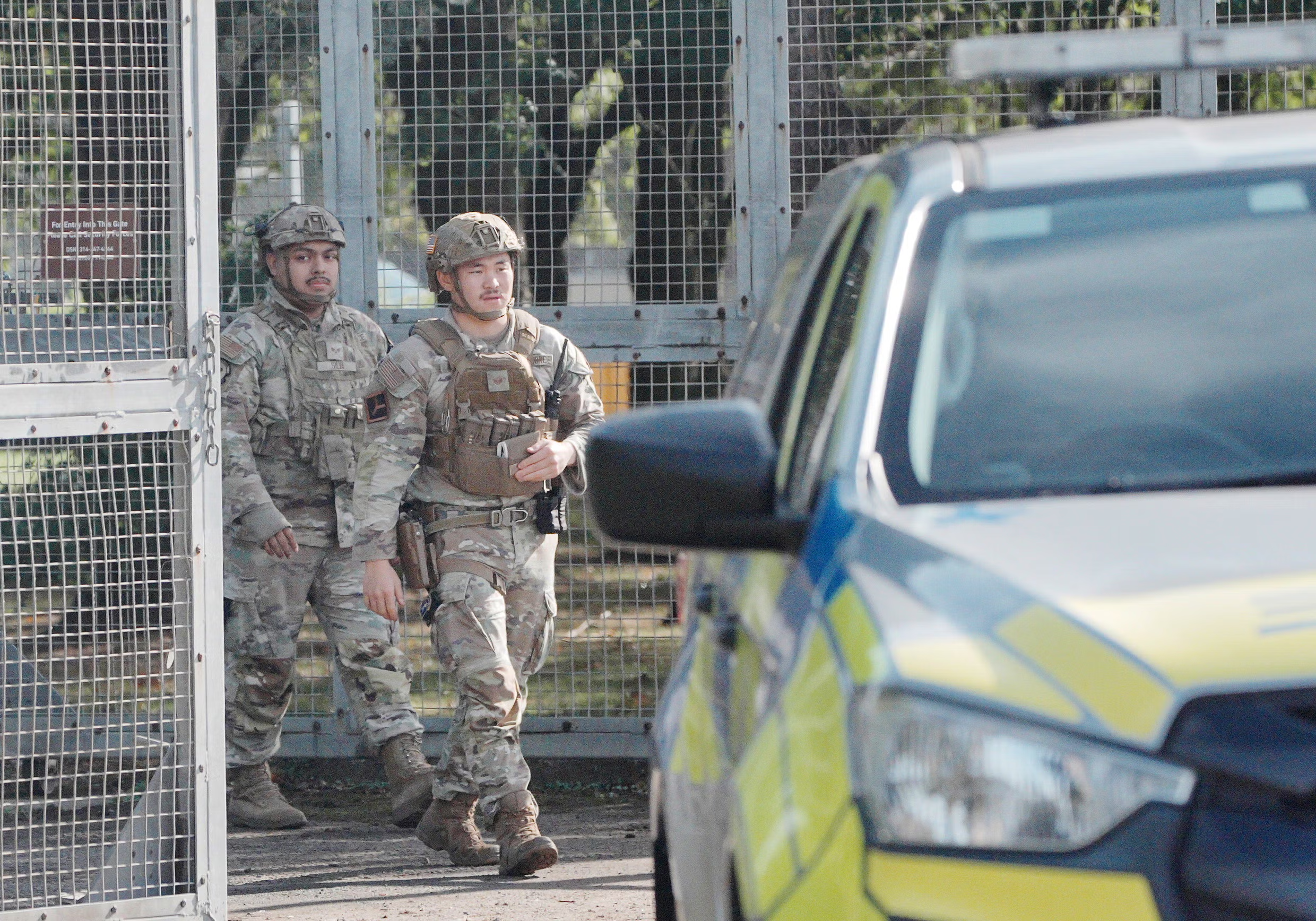
The facts on the ground are considerably more ambiguous. British police arrested five men — all UK nationals in their 20s — on suspicion of terror offences after suspicious vehicles were spotted near the base in the early hours of Sunday morning. Dozens of homes were evacuated as a precaution. By Monday, all five had been released on bail, and a source familiar with the investigation told Reuters that the three large white vans the men appeared to travel in had not contained viable explosives. Critically, the police response had not been intelligence-led, meaning the men were not under active surveillance when stopped — a detail that complicates the narrative of a thwarted, well-organized foreign plot.
A Base at the Center of an Active Conflict
RAF Fairford’s significance to this story cannot be overstated. The base has served as a forward operating location for U.S. Air Force bombers for decades, and in recent months it has been used to launch strikes against Iran — strikes the UK government approved at Washington’s request. In July, Iran’s Islamic Revolutionary Guard Corps explicitly named Fairford, warning that “any base used for aggression against Iranian territory constitutes a legitimate target for our forces.” That statement is a matter of public record, and it lends genuine geopolitical weight to the incident. It also makes it easier for U.S. officials to reach for Iran as the obvious explanation before an investigation has concluded.
Tehran, for its part, flatly denied any involvement. The Iranian embassy in London issued a statement categorically rejecting what it called “unfounded and malicious speculations” linking the country to the arrests. That denial does not exonerate Iran — state actors routinely deny involvement in covert operations — but it is a denial that exists, and responsible reporting requires acknowledging it rather than treating Rubio’s insinuations as settled fact.
President Trump complicated matters further by telling reporters at the White House that the incident “might be” connected to Iran, while also expressing surprise that British authorities had released the suspects on bail. “I wouldn’t have done that,” he said — a remarkable statement from an American president about a sovereign ally’s criminal justice decisions. It is worth noting that on Sunday, Trump had called the original arrests “fantastic,” claiming the U.S. and UK had the men under investigation “for a long time,” a claim that sits uneasily alongside the confirmation that police were not conducting active surveillance when the vehicles were spotted.
British Defence Secretary Wes Streeting offered a measured response, acknowledging that security and intelligence work “takes place often unsung, unreported, for good reason.” That restraint stands in contrast to the rhetorical escalation coming from Washington. Armed police maintained checkpoints around RAF Fairford into Monday, and the UK government convened a national emergency meeting — responses that signal genuine concern without prejudging the investigation’s outcome.
What the Fairford incident ultimately reveals is the volatility of the current moment: a US-Iran conflict now several months old, a British air base serving as a staging ground for American military operations, and a Trump administration that has every political incentive to frame any security incident through the lens of Iranian aggression. None of that means the threat was fabricated or trivial. But it does mean that assertions from Rubio and Trump demand the same evidentiary standard we would apply to any other claim — and right now, that standard has not been met. The investigation is ongoing. The conclusions should wait.