
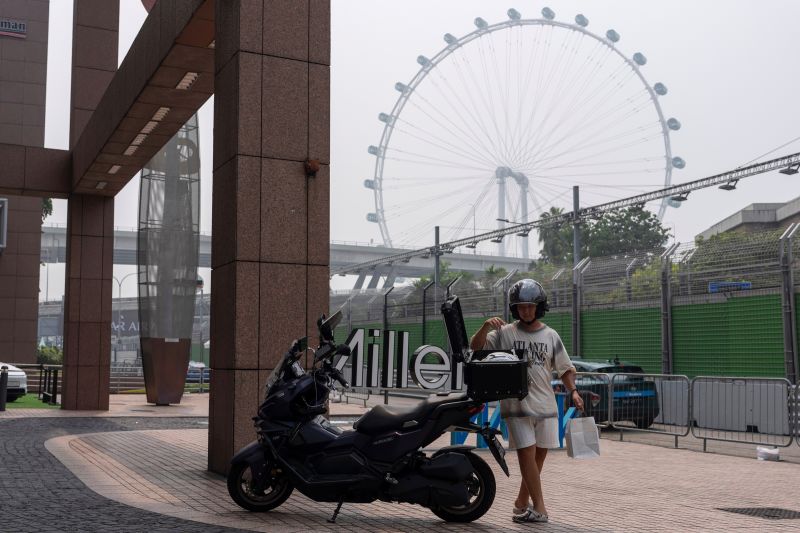
Singapore is suffocating.
One of the wealthiest and most meticulously governed city-states on earth — home to 6.21 million people and an economy generating more than $650 billion annually — has this week earned the grim distinction of being the most polluted city on the planet, its gleaming skyline reduced to faint, ghostly silhouettes by a thick blanket of toxic smog drifting in from neighboring Indonesia. The iconic towers of Marina Bay Sands, symbols of Singapore’s extraordinary prosperity, have all but disappeared behind a haze that no amount of wealth or urban planning can simply engineer away.
According to Swiss air quality monitor IQAir, Singapore’s air quality index reached 216 on Friday morning — firmly in the “very unhealthy” range — placing it at the top of the global pollution rankings, with Kuala Lumpur, suffering from the same source, a close second. The crisis is a stark reminder that environmental degradation does not stop at borders, and that even the most affluent, tightly administered societies remain profoundly vulnerable to the ecological choices made by their neighbors.
The immediate cause is Indonesia’s annual dry-season burning, a practice in which vast stretches of carbon-rich peatland are deliberately cleared and drained to make way for commercial plantations, most notably those producing palm oil — an ingredient embedded in an extraordinary range of everyday products, from instant noodles to toothpaste. These fires are not accidental. They are a predictable, recurring consequence of an agricultural and land-use model that prioritizes short-term commercial extraction over long-term environmental and public health. Singapore and Malaysia have endured this haze almost every year, a regional pattern so entrenched it has its own name and its own bureaucratic response protocols.
What makes 2023 particularly alarming is the arrival of what scientists are describing as a “super” El Niño — a supercharged iteration of the natural climate oscillation that typically brings exceptionally dry conditions to Indonesia. Drier conditions mean fires burn hotter, spread faster, and produce smoke plumes far denser than in ordinary years. Singapore’s National Environment Agency confirmed Thursday that “moderate to dense smoke plumes from southern and central Sumatra and West Kalimantan” were drifting directly toward the city-state under prevailing southeasterly winds, and warned the haze could persist.
The timing is particularly awkward for Singapore’s government and its tourism infrastructure. The city-state is hosting a packed weekend of high-profile events, most visibly the Formula One Singapore Grand Prix night race — one of the sport’s most glamorous fixtures — alongside international conferences and a calendar of entertainment acts including Janet Jackson and The Killers. The FIA, motorsport’s governing body, acknowledged Thursday that outdoor entertainment events at the F1 weekend could be affected, though not the race itself. By Friday, race organizer Singapore GP told CNN it had “no plans to modify” its entertainment schedule, and the Singapore Tourism Board confirmed that “action plans are in place based on the intensity of the haze.” The races of 2015 and 2019 proceeded through similar conditions, and all indications suggest this one will too.
The drivers themselves offered a telling contrast in perspectives. Valtteri Bottas, who cycled more than 400 kilometers from Malaysia to Singapore this week, told Reuters he did not find conditions “that extreme yet,” adding with a shrug that there was not “that much you can do.” Lewis Hamilton said he had “much bigger issues to focus on.” Their relative indifference is understandable — these are elite athletes with resources, medical support, and the luxury of choosing their level of exposure. The millions of ordinary residents of Singapore and Malaysia do not have the same options.
In Malaysia, the consequences have been far less abstract. The education ministry shut schools across several states this week as air quality deteriorated to dangerous levels — a decision that disproportionately affects working families without the means to arrange alternative childcare or remote learning environments. Children, the elderly, and those with respiratory conditions bear the heaviest burden of pollution crises like this one, a burden distributed with the same cruel logic that governs most environmental harm: those least responsible for causing it suffer the most.
The deeper story here is one of regulatory failure at a regional and global scale. The Indonesian fires are not a natural disaster in any meaningful sense — they are the foreseeable product of an agricultural economy that has been allowed, and in many cases incentivized, to externalize its environmental costs onto neighboring countries and onto the atmosphere. Palm oil supply chains connect these burning peatlands to consumers and corporations worldwide, yet accountability remains diffuse and enforcement weak. El Niño intensifies the fires, but it does not create the conditions that make burning the cheapest and most convenient land-clearing option available to plantation operators. Those conditions are political and economic, and they are amenable to political and economic solutions — stricter regulation, meaningful corporate accountability, and regional cooperation with real enforcement teeth.
Singapore’s wealth could not buy its way out of this crisis. That is the point. No city, however prosperous, however well-governed, however technologically sophisticated, can insulate itself from the consequences of environmental destruction happening beyond its jurisdiction. The haze hanging over Marina Bay is not merely an Indonesian problem or a Singaporean inconvenience. It is a concentrated, visible expression of what happens when commercial interests are permitted to override environmental protection, when regulation is inadequate, and when the costs of extraction are allowed to float freely across borders to settle on the lungs of people who had no say in the matter.
The skyscrapers will reappear when the winds shift. The fires will return next year.