
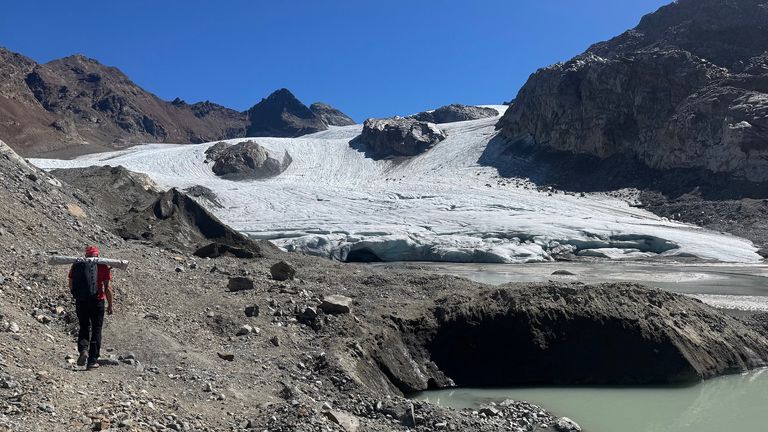
Swiss glaciers shed 5.5% of their total ice volume in 2026, experts announced on September 30, marking the second-largest annual loss ever recorded and continuing a devastating trend driven by summer heat waves and dramatically reduced winter snowfall.
The figures, released in Zurich, underscore the accelerating pace at which the Alpine ice that has defined Switzerland’s landscape for millennia is disappearing. Only 2022 had previously recorded a worse single-year loss, a grim benchmark that scientists had hoped would remain an outlier. It has not.
Heat waves played a central role in this year’s losses, stripping glaciers of ice that cooler, snowier winters might otherwise have partially replenished. When snow accumulation falls short during winter months, glaciers lose the reflective white cover that shields them from summer solar radiation — a feedback loop that compounds melt year over year.
The consequences extend well beyond the visual. Glacial meltwater feeds rivers across Central Europe, supplying drinking water, agricultural irrigation, and hydroelectric power to millions of people. As ice reserves shrink, the long-term reliability of those systems comes under serious pressure.
Scientists monitoring Alpine glaciers have repeatedly warned that without steep and rapid reductions in greenhouse gas emissions, a large share of Switzerland’s remaining glaciers could vanish entirely before the end of the century. The 2026 data offers no reassurance that the trajectory is changing.
The findings arrive as governments across Europe face mounting pressure to strengthen climate adaptation policies and accelerate the transition away from fossil fuels — pressures that market forces and voluntary commitments have, by the evidence of the ice itself, proven insufficient to meet.