
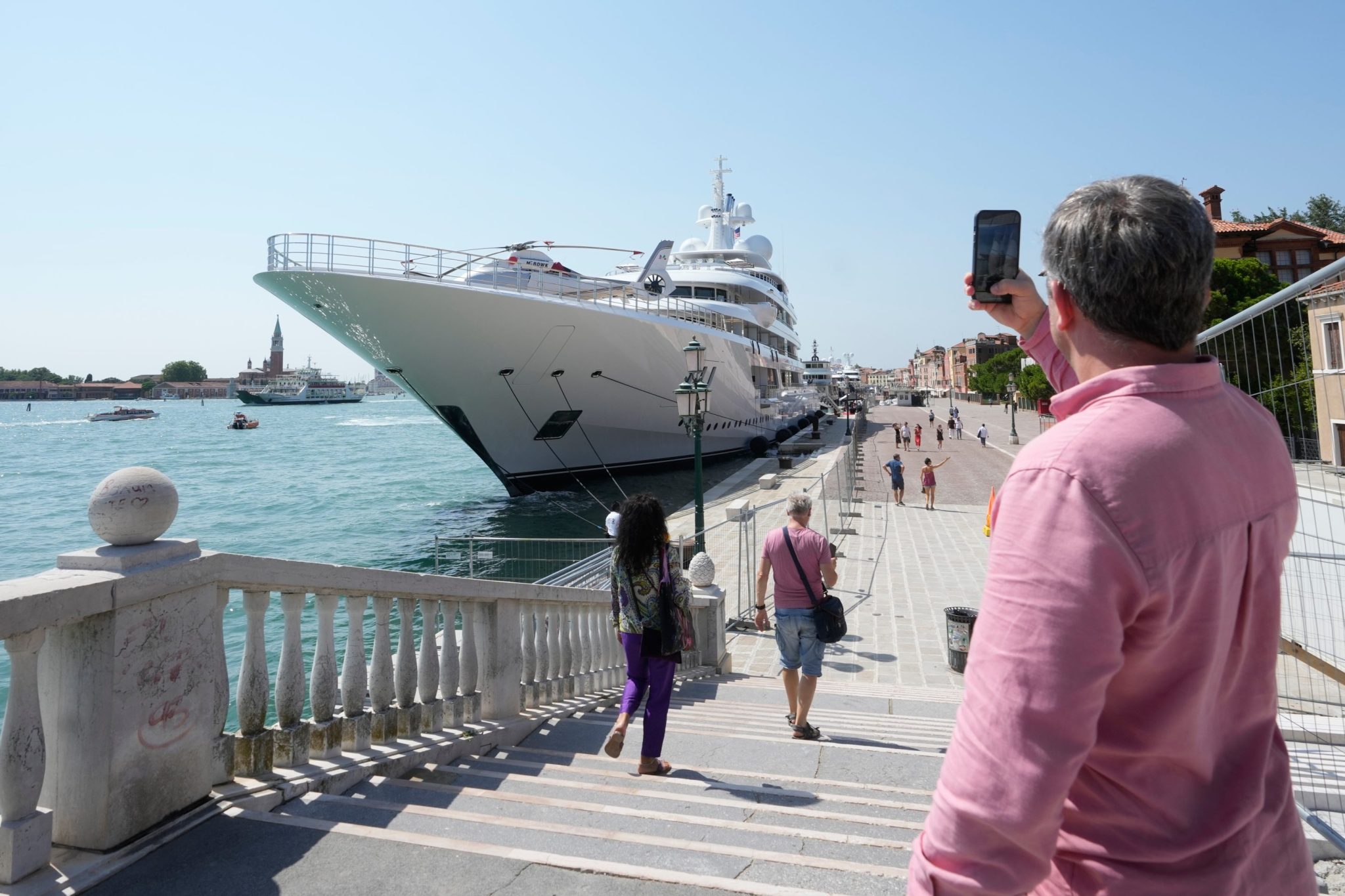
Hundreds of protesters took to Venice’s waterways on Friday to confront a symbol of plutocratic diplomacy: a 384-foot superyacht belonging to Tilman Fertitta, the billionaire restaurateur and casino owner whom Donald Trump appointed U.S. Ambassador to Italy. The demonstration briefly turned physical when riot police blocked marchers from reaching the vessel. The message from the crowd was unambiguous: wealth is not diplomacy, and Venice is not for sale.
The central problem here is not merely aesthetic, though the sight of a six-story yacht dwarfing the centuries-old buildings along St. Mark’s Basin is jarring enough. The deeper issue is what Fertitta’s so-called “Coastal Diplomacy 250” tour reveals about the Trump administration’s understanding of international relations: that personal wealth is a legitimate substitute for institutional diplomacy, and that spectacle can replace substance. When a government sends a man worth $11.3 billion to sail 13 Italian coastal regions on a private superyacht — complete with two helipads, twin swimming pools, and a spa — it is not celebrating shared history. It is performing power.
Protesters understood this instinctively. Many of the same activist groups that demonstrated against Jeff Bezos’s Venice wedding last year mobilized against Fertitta’s arrival, carrying signs reading “Make America Read Again” and “Oligarch in saor” — a sardonic nod to a local Venetian sardine dish. On July 4, organizers unfurled a banner as long as Fertitta’s yacht itself to illustrate what they called “the dimensions of his arrogance.” Organizer Stella Morion connected the dots directly: Venice already buckles under the weight of mass tourism and rising costs, and she tied those pressures explicitly to Trump’s foreign policy, including U.S. strikes on Iran that have driven energy prices higher. “It is the umpteenth slap in the face of a city and all of the people in Venice who struggle to reach the end of the month,” she told the Associated Press. Activist Emanuele Lepore, who spent years fighting to ban cruise ships from the Giudecca Canal, put it more bluntly: “To see such a big ship be able to stay in the lagoon of Venice is a shame.”
Diplomacy as Brand Extension
Fertitta declined an interview but issued a brief statement invoking freedom of speech and America’s founding values — a rhetorical move that managed to be both self-congratulatory and tone-deaf. His framing of the tour as a celebration of “our shared history, our economic partnership, and the cultural bonds that make the U.S.-Italy relationship so special” would carry more weight if it were not delivered from the deck of a vessel that costs more than most Italian towns generate in a year. Political analyst Giovanni Orsina of Rome’s Luiss University acknowledged the approach is “pretty novel,” allowing that it could be read as a sign of personal engagement with Italy. But novelty is not the same as effectiveness, and attention is not the same as respect.
The broader diplomatic context makes Fertitta’s tour look even more strained. The once-warm relationship between Trump and Italian Premier Giorgia Meloni — herself a far-right nationalist whose politics overlap considerably with Trump’s — has cooled sharply. Trump has taken to attacking Meloni on social media, and she conspicuously skipped the U.S. Embassy’s 250th anniversary celebrations. If the superyacht tour was meant to repair that rift or project American soft power, it appears to be failing on both counts. What it has succeeded in doing is galvanizing Venetian civil society and providing a vivid, photogenic illustration of what concentrated private wealth looks like when it dresses itself up as public service.
The Trump administration’s appointment of billionaire loyalists to ambassadorial posts is not incidental — it is structural. It reflects a governing philosophy that conflates personal financial success with fitness for public responsibility, and that treats democratic institutions as venues for personal brand extension. Venice’s protesters, marching with inflatable beach toys and sardine jokes, grasped something that Fertitta’s statement did not: that the right to peaceful protest is not enhanced by being celebrated from the deck of a superyacht. It is, if anything, mocked by it.