
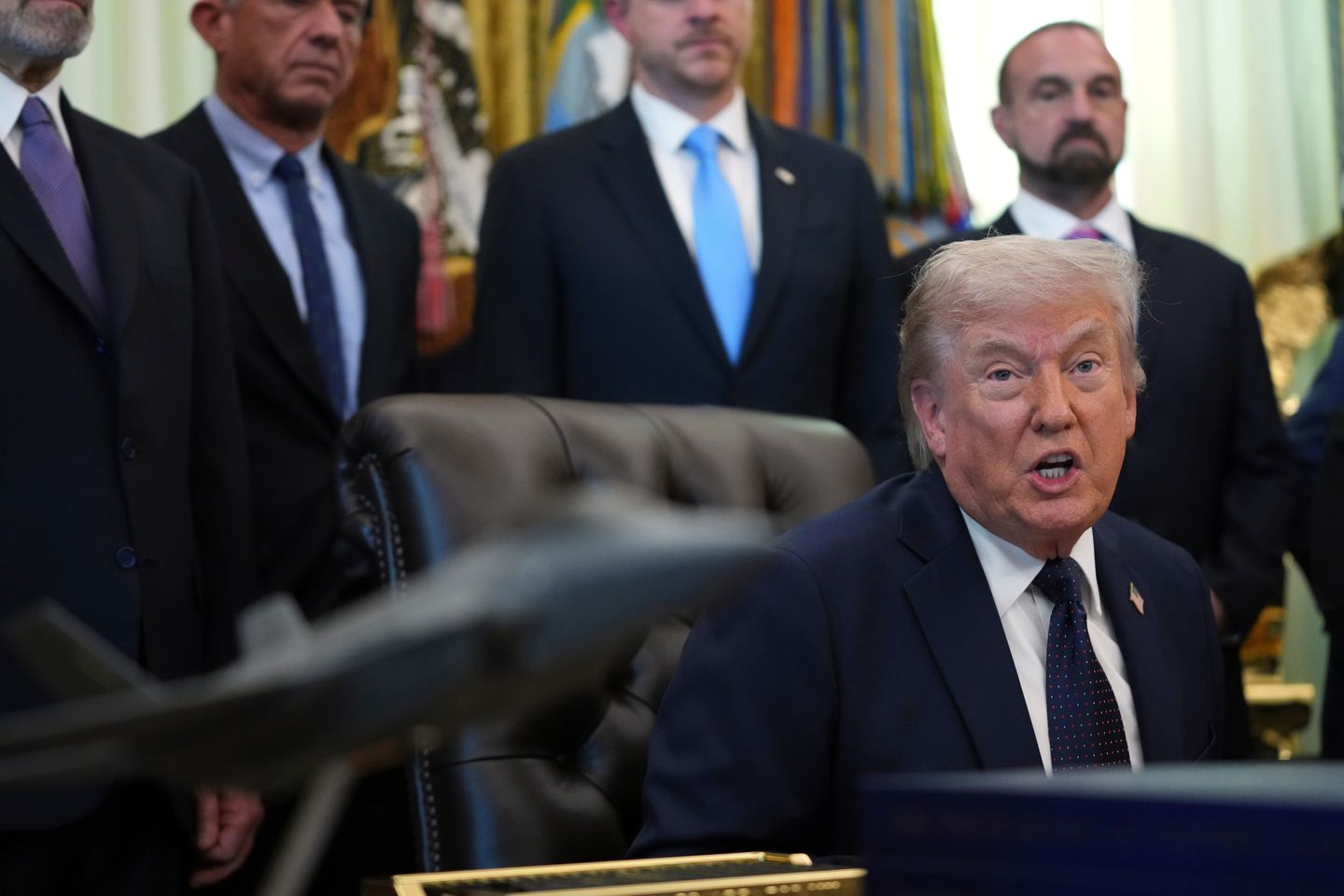
Former President Donald Trump doubled down Thursday on mathematically impossible claims about prescription drug price reductions, defending statements that his administration cut costs by “500%, 600%” during a White House event with drugmaker Regeneron.
Trump acknowledged making the inflated claims but characterized them as simply a “different kind of calculation.” He suggested that while he sometimes cites reductions of “500%, 600%,” his administration also uses more conventional figures like “50%, 60%” or “70, 80 and 90%.”
“People understand that better,” Trump said of the standard percentages, though he maintained both approaches were valid ways of measuring price cuts.
Mathematical Reality vs. Political Claims
A price reduction exceeding 100% is mathematically impossible unless manufacturers drop costs to zero and then pay consumers to use their products. Trump’s repeated use of such figures represents a significant departure from standard economic terminology.
The president’s defense comes as he continues to promote his administration’s efforts on drug pricing during the Regeneron announcement, which detailed a deal to lower costs for certain pharmaceutical products.
Pattern of Inflated Numbers
Trump’s embrace of what he effectively described as “fake math” mirrors his broader approach to statistical claims throughout his presidency. The former president, who popularized the term “fake news,” now appears comfortable defending objectively false mathematical assertions as alternative calculations.
This latest episode underscores ongoing concerns about the accuracy of Trump’s public statements on policy achievements, particularly in areas where precise measurement is crucial for public understanding.