
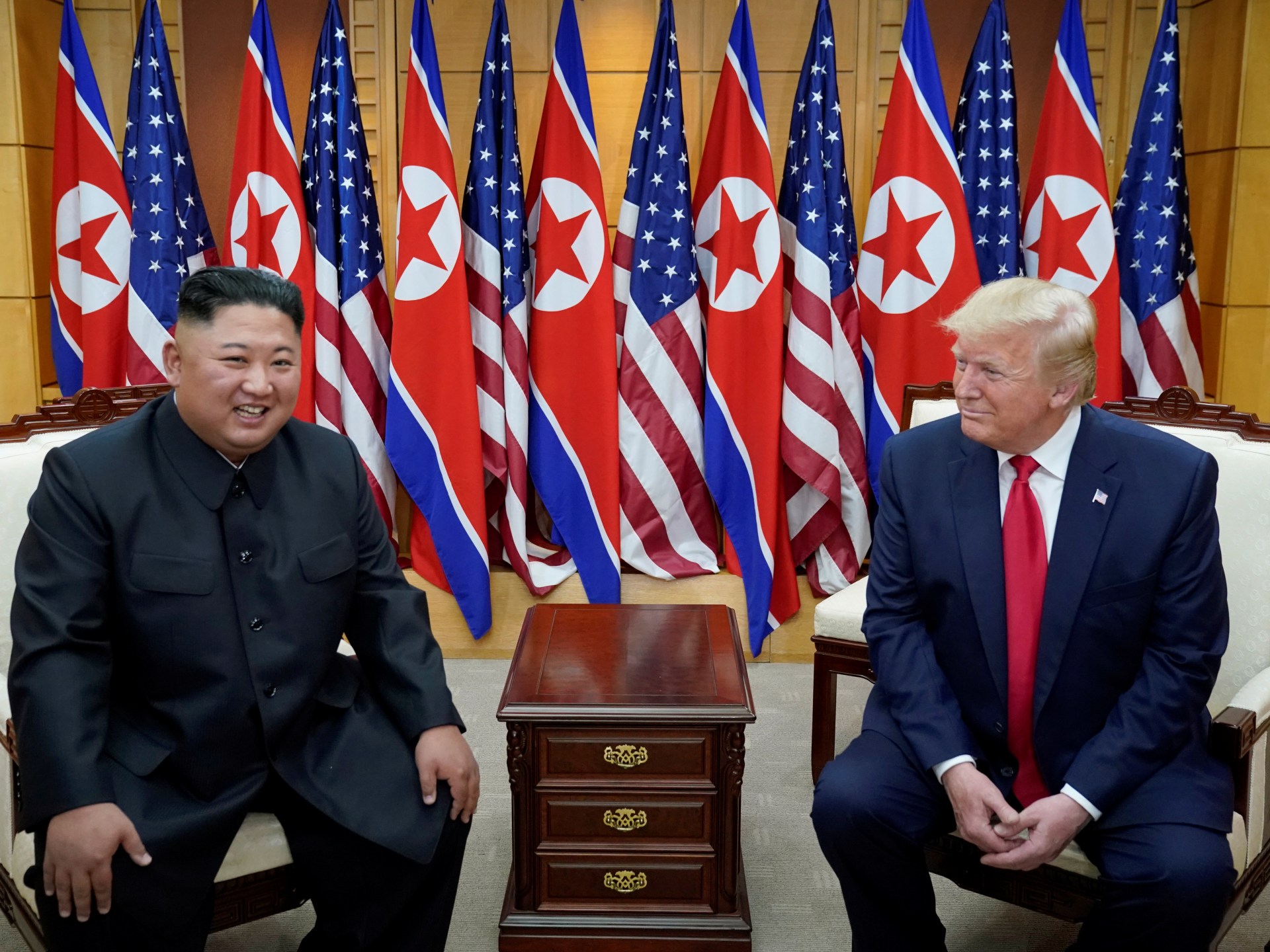
The Oval Office, Monday afternoon. A reporter asks Donald Trump why Kim Jong Un hasn’t responded to his request for a conversation. Trump pauses, then turns the question back: “How do you know he hasn’t responded?” Pressed again, he confirms it simply — “Yeah, he has” — and describes the exchange as “very positive,” offering nothing further. North Korea said nothing at all.
That elliptical exchange encapsulates the strange, unverifiable diplomacy that has come to define Trump’s second-term approach to one of the world’s most dangerous nuclear states. The claim of contact came just one day after Trump ordered the Pentagon to “substantially reduce” joint military exercises with South Korea — a longstanding ally that hosts roughly 39,000 American troops — in a decision that stunned defence officials and regional partners alike and carries real strategic consequences for stability on the Korean Peninsula.
Trump justified the scaling back of the drills on his Truth Social platform, writing that the annual exercises were “not only costly … but send a signal that is totally inappropriate and hostile, to a Country that, as long as Donald J. Trump has been President, has been unthreatening and respectful.” The framing is remarkable in its distortion: North Korea has, during Trump’s presidency, continued to develop and test nuclear weapons, deployed troops to fight alongside Russia in Ukraine, and supplied ballistic missiles used in attacks on Ukrainian civilian infrastructure. Calling Pyongyang “unthreatening” is not a diplomatic nuance — it is a factual misrepresentation, and it should be understood as one.
Trump also linked the decision directly to Seoul’s refusal to join what he has taken to calling the “war on Iran,” a framing that itself deserves scrutiny. The United States and Israel struck Iranian nuclear facilities, and Trump has since pressured allies to retroactively endorse or participate in that operation. South Korea declined. Trump’s response was to question the value of the alliance itself. “We have 39,000 soldiers over there, guarding you from Kim Jong Un, your next-door neighbour,” he said at the Oval Office, “and you’re not going to help us on a very easy military operation in Iran. That’s strange.” The implicit threat — that security guarantees are transactional, contingent on compliance with US military adventurism — is a significant departure from postwar alliance doctrine and one that will not be lost on governments in Seoul, Tokyo, or Warsaw.
South Korean officials moved quickly to reassure their public. Seoul’s presidential office stated that the drills had begun as planned and did not reflect “any intention to attack North Korea or escalate tensions on the Korean peninsula.” President Lee Jae Myung reinforced the point, saying their fundamental purpose is “not to treat a specific entity as an adversary, but to safeguard the safe and peaceful daily lives of the people.” South Korean officials also expressed hope that whatever personal chemistry persists between Trump and Kim might eventually lead both sides back to the negotiating table — a notably optimistic reading of a relationship that collapsed badly in 2019 at the Hanoi summit, when North Korea walked away over disagreements about sanctions relief and denuclearization sequencing.
That collapse is the essential context for evaluating Trump’s current overtures. Since Hanoi, North Korea has dramatically expanded its nuclear arsenal, tested intercontinental ballistic missiles capable of reaching the continental United States, deepened its military partnership with Russia, and watched Kim Yo Jong — the leader’s powerful sister and a key policy voice — publicly dismiss the idea that personal rapport with Trump could ever be leveraged to dismantle Pyongyang’s weapons programme. She said such an effort would only be the subject of “mockery.” That was not a negotiating posture. It was a statement of doctrine.
The North Korea–Russia relationship now constitutes a genuine complication for any American diplomatic effort. North Korean troops have fought in Russia’s war against Ukraine, and Kyiv confirmed last week that North Korean-manufactured missiles were used in a Russian ballistic missile strike on a steel plant in Zaporizhzhia. Trump’s administration has criticised this military cooperation in official statements, yet the president himself said Monday, with apparent warmth, that Kim “has always treated me with great respect. I understand him. He understands me.” The dissonance between the administration’s stated position on North Korea’s role in Ukraine and Trump’s personal affection for Kim is not a minor inconsistency — it reflects a foreign policy built around the president’s ego rather than coherent strategic interests.
Analysts are cautious about what, if anything, the claimed contact signals. Victor Cha, who leads the Korea programme at the Center for Strategic and International Studies in Washington, told Reuters he doubted North Korea would move quickly. “I think they’re going to bide their time and wait a little bit,” he said. Cha also noted that part of Trump’s motivation for elevating the North Korea story appeared to be deflecting attention from his difficulties over the Iran war — a headline management strategy dressed up as diplomacy. Kim, for his part, is in a considerably stronger geopolitical position than he was at their last summit in 2019, with Russian backing, a larger nuclear arsenal, and little obvious incentive to offer concessions.
What remains at stake, beneath the theatre of personal diplomacy and social media declarations, is the security architecture of Northeast Asia — and the lives of millions of people whose safety depends on alliances that Trump treats as leverage. South Koreans living under the shadow of one of the world’s most militarised borders did not choose this uncertainty. They are watching an American president weaken their security guarantees in real time, in apparent exchange for flattery from a nuclear-armed authoritarian who, by all credible accounts, has no intention of giving up the weapons that make him dangerous. That is not diplomacy. It is a performance, and the consequences of mistaking one for the other could be severe.