
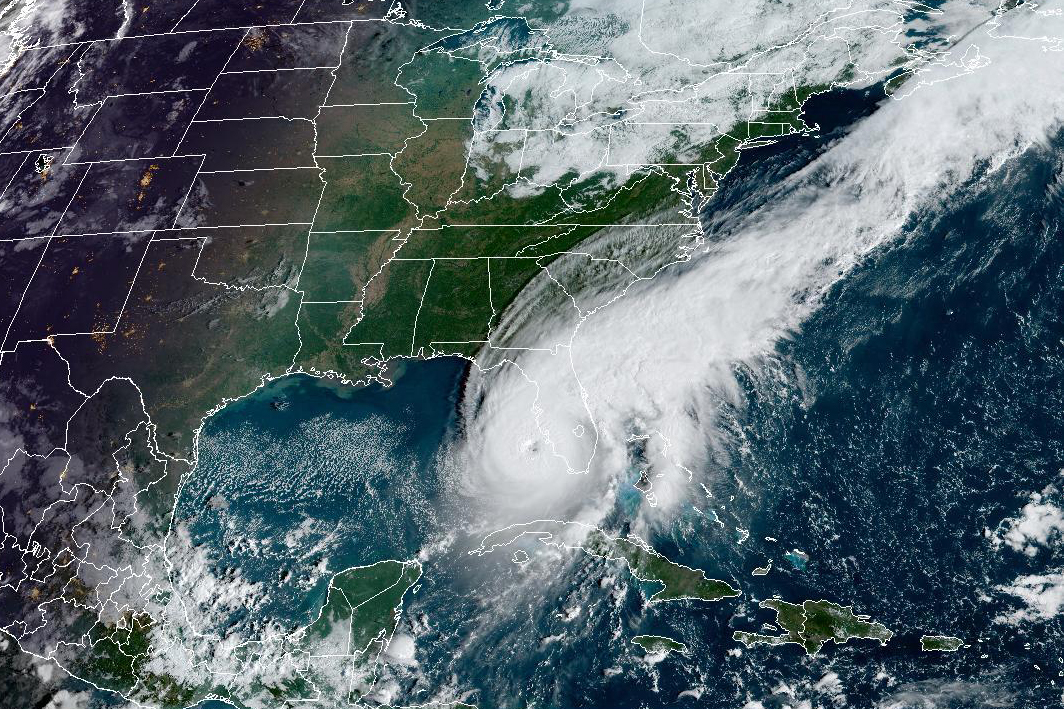
Federal Agency Predicts Quieter Atlantic Season as El Niño Suppresses Activity — With Caveats
The National Oceanic and Atmospheric Administration (NOAA) released its 2026 Atlantic hurricane season forecast Thursday, predicting a below-average year — but meteorologists are urging the public not to let that assessment breed complacency.
NOAA gives a 55 percent probability of a below-average season, forecasting between eight and 14 named storms, three to six hurricanes, and one to three major hurricanes — defined as Category 3 or higher, with sustained winds of at least 111 mph. A typical Atlantic season produces 14 named storms, seven hurricanes, and three major storms.
The agency attributes the quieter outlook primarily to El Niño development, which tends to increase wind shear over the Atlantic and suppress tropical storm formation. Slightly warmer-than-average Atlantic Ocean temperatures and weaker trade winds do push in the opposite direction, creating some uncertainty in the forecast.
Why “Below Average” Is Not the Same as “Safe”
Officials were quick to temper any false sense of security. Ken Graham, director of NOAA’s National Weather Service, said in a statement: “Although El Niño’s impact in the Atlantic Basin can often suppress hurricane development, there is still uncertainty in how each season will unfold. It only takes one storm to make for a very bad season.”
The National Weather Service office in New Orleans echoed that warning on X, pointing to Hurricane Betsy in 1965 — a storm that devastated parts of southeastern Louisiana during what was otherwise a quieter-than-normal year.
NOAA also assigns a 35 percent chance of a near-normal season and a 10 percent chance of an above-normal one, underscoring that the forecast carries meaningful uncertainty.
What the Data Behind the Forecast Shows
Matthew Rosencrans, NOAA’s lead hurricane seasonal forecaster, provided additional context, noting that El Niño years historically average just nine named storms compared to the long-term mean of 14. He also noted that Atlantic Basin sea surface temperatures are nearly identical to last year — running about 0.20°C above average, compared to 0.23°C above average in 2025.
That marginal warmth factored into NOAA’s decision to continue using high-activity era statistics in its modeling, rather than forecasting a record-low level of Accumulated Cyclone Energy. The record low, Rosencrans noted, occurred in 1983 — during a low-activity era when the Atlantic was actually colder than normal.
NOAA’s seasonal outlook is a broad probabilistic tool based on large-scale climate patterns. It does not identify which regions of the United States, if any, face elevated risk of a direct strike.
How Other Major Forecasts Compare
Colorado State University (CSU), which released its outlook earlier in the season, similarly anticipates below-normal activity. CSU projects 13 named storms, six hurricanes, and two major hurricanes, and forecasts a below-average probability of major hurricane landfalls along the U.S. coastline and in the Caribbean. Like NOAA, CSU identifies El Niño-driven wind shear as the dominant suppressing factor.
AccuWeather, which published its forecast in April, offered a slightly wider range: 11 to 16 named storms, four to seven hurricanes, and two to four major storms. AccuWeather also projects three to five direct impacts on the United States this season.
The Bottom Line for Residents in Vulnerable Areas
All three forecasting bodies agree the 2026 season is likely to be quieter than recent years. None of them suggest that residents in hurricane-prone regions — from the Gulf Coast to the Carolinas — should reduce their level of preparedness.
Atlantic hurricane season runs from June 1 through November 30. NOAA and the National Weather Service recommend that households review emergency plans, stock supplies, and monitor forecasts throughout the season regardless of the overall outlook.