
Zelensky Demands European Role in Peace Talks as Russian Drones Strike Nuclear Site and Kill Three
The Ukrainian president met with Starmer, Macron and Merz in London as Russia escalated attacks, hitting a spent nuclear fuel facility near Chernobyl and killing civilians at a bus stop
Ukrainian President Volodymyr Zelensky arrived in London on Sunday demanding that Europe secure a central seat at any peace negotiating table, as Russian drone strikes killed three civilians in southern Ukraine and damaged a nuclear storage facility less than 10 miles from the Chernobyl power plant — an attack the UN’s atomic watchdog called “deeply concerning.”
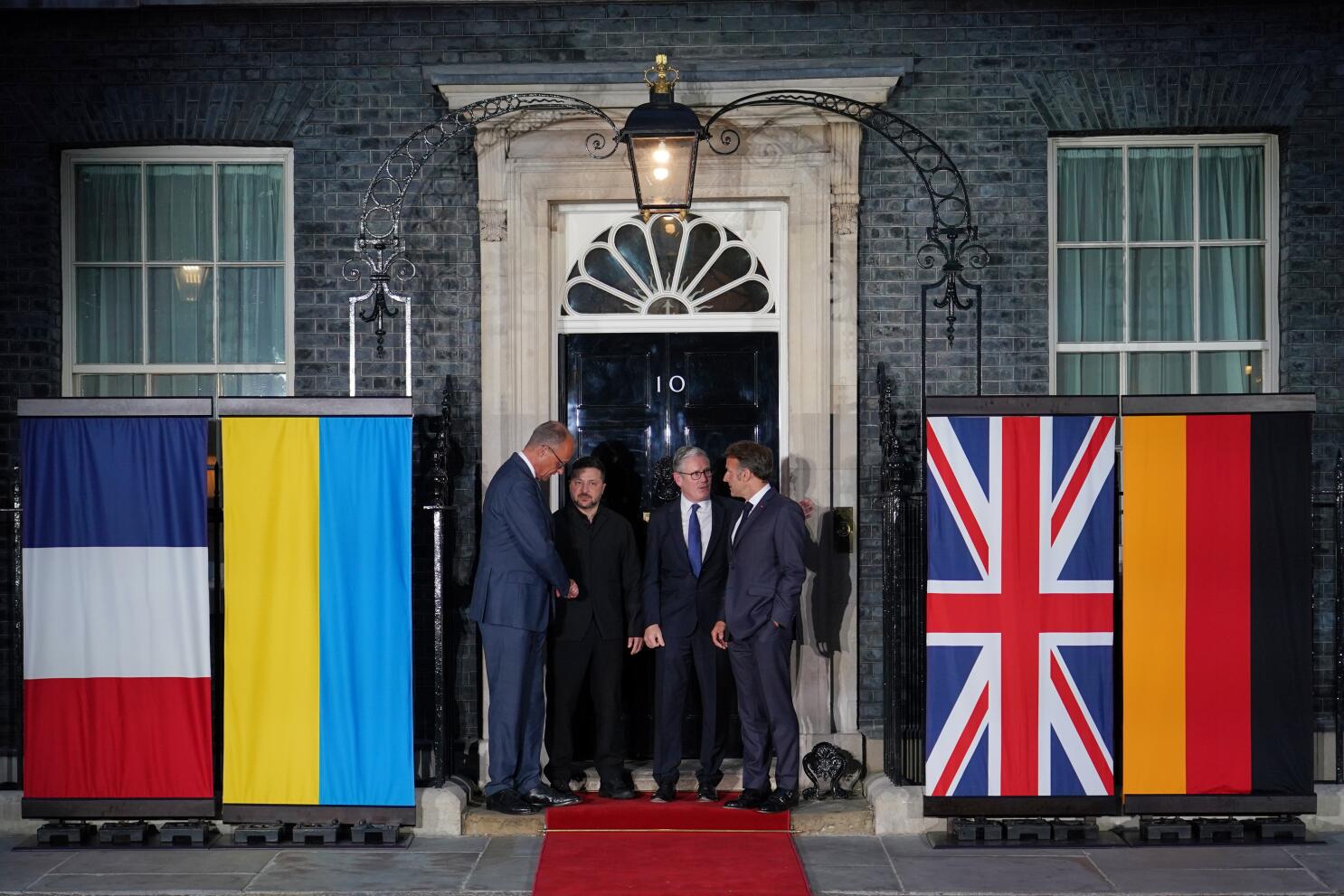
The high-stakes summit at 10 Downing Street, hosted by British Prime Minister Keir Starmer, brought together French President Emmanuel Macron and German Chancellor Friedrich Merz alongside Zelensky. Macron and Merz departed after several hours, with Starmer continuing bilateral talks with the Ukrainian leader.
“Europe must be part of the negotiations and must be strong,” Zelensky wrote on X ahead of the meeting, signaling Kyiv’s determination not to be sidelined in any diplomatic process.
Nuclear Strike Raises International Alarm
A Russian drone struck a spent nuclear fuel storage facility in Ukraine’s Kyiv region, igniting a fire that took under an hour to extinguish. Ukrainian officials said radiation levels remained within safe parameters, but the proximity to the decommissioned Chernobyl plant — just nine miles away — alarmed international observers.
Rafael Mariano Grossi, Director General of the International Atomic Energy Agency (IAEA), described the strike as “deeply concerning,” citing the large volumes of nuclear material stored at the site. Grossi said the IAEA would dispatch inspectors to assess the damage.
The attack represents a significant escalation in Russia’s targeting strategy and a direct challenge to nuclear safety norms that the international community has repeatedly warned must not be crossed.
Civilians Killed at Bus Stop in Zaporizhzhia
Separately, a Russian drone strike killed three people waiting at a bus stop in Balabyne, a village in Ukraine’s southern Zaporizhzhia region. A fourth person was wounded. The regional military administration chief, Ivan Fedorov, confirmed the casualties via Telegram.
The strikes on civilian infrastructure — a bus stop, a nuclear storage site — underscore the indiscriminate nature of Russia’s drone campaign, now well into its fourth year since Moscow’s full-scale invasion began in February 2022.
Europe’s Security Role at the Center of Talks
The London summit reflects the growing weight of the E3 group — the UK, France and Germany — in shaping Ukraine’s future security architecture. The UK and France jointly lead the “coalition of the willing,” an initiative to provide concrete security guarantees for Ukraine as part of any eventual peace framework.
The talks focused heavily on air defense support for Ukraine, an increasingly urgent priority as Russian drone swarms continue to impede frontline advances and terrorize civilian populations. With the front lines largely static, both sides have turned to long-range strikes to gain strategic leverage.
Ukraine Strikes Deep Into Russia
The weekend’s violence was not one-sided. A large-scale Ukrainian drone attack on St. Petersburg — Russia’s second-largest city — struck less than 24 hours after the conclusion of President Vladimir Putin’s flagship economic forum in the city. The attack demonstrated Kyiv’s expanding capacity to reach deep inside Russian territory.
A Ukrainian strike also killed one person and wounded another in Russia’s Kursk region, according to regional governor Alexander Khinshtein.
The St. Petersburg strike punctured Putin’s carefully maintained domestic narrative — that the war is a distant operation with little impact on Russian civilian life. That claim is becoming harder to sustain as Ukrainian long-range capabilities grow.
More than four years since Russia’s invasion, with no ceasefire in sight and nuclear safety now directly implicated, the pressure on European leaders to act — and to act coherently — has rarely been greater.