
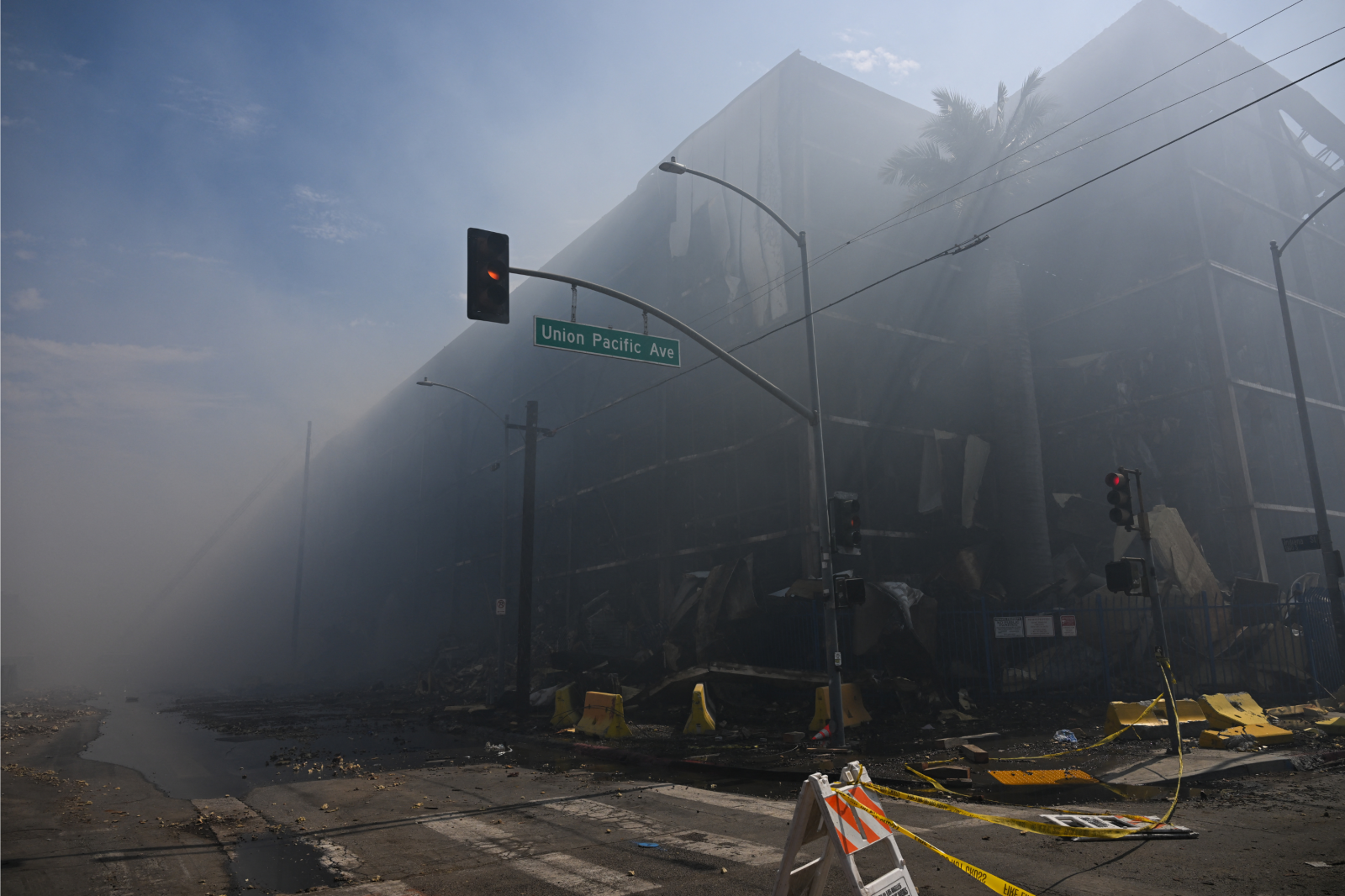
Air Quality Crisis Grips Los Angeles as Warehouse Fire Enters Second Week
A massive warehouse fire in the Boyle Heights neighborhood of Los Angeles has blanketed surrounding communities in toxic smoke for more than six days, triggering a state of emergency and sending air quality readings to more than twice the federal “hazardous” threshold. Officials warn conditions may persist through at least midweek.
The blaze broke out on Wednesday, June 17, at a nearly 500,000-square-foot cold-storage facility on Los Palos Street operated by Lineage, one of the world’s largest cold-chain logistics companies. The fire continues to smolder, defying efforts to fully extinguish it due to the building’s scale, structural challenges, and the presence of hazardous materials on site.
On Saturday, California Governor Gavin Newsom declared a State of Emergency for Los Angeles County, citing the fire’s threat to public health and the strain on local emergency resources.
What Caused the Fire
No official cause has been confirmed, but Lineage has pointed to rooftop solar panel testing as the likely ignition point. The company said in a statement: “We believe the fire started on the roof when the owner of the solar array, Altus Power, was doing tests.”
Altus Power disputed that characterization, telling Newsweek that the cause “has yet to be determined” and that the company is “cooperating fully with the authorities as they investigate.” The company said it deployed resources into the community immediately after being notified and has reached out to local leaders to offer assistance.
No injuries have been reported. Fire officials have described the incident as “very complex,” with hazardous materials and structural instability slowing containment efforts.
Pollution Readings Exceeded Hazardous Levels
Air quality monitoring near the fire site recorded an Air Quality Index (AQI) reading of 621 on Monday night — more than double the EPA’s “hazardous” threshold of 300, according to ABC News. The AQI scale tops out at 500 under standard measurements, making the reading an extreme outlier.
By Tuesday, levels at the same sensor location had fallen back to the moderate range. However, EPA monitoring across surrounding areas continued to show conditions ranging from “moderate” to “unhealthy” at the time of publication.
The National Weather Service (NWS) has issued air quality alerts warning of “harmful” conditions, in effect until at least noon Wednesday.
Which Communities Are Most Affected
The NWS identifies the following areas as most heavily impacted by poor air quality:
Officials caution that smoke levels can shift rapidly depending on wind direction and time of day, meaning conditions may deteriorate suddenly in areas not currently under alert.
Who Is Most at Risk
Fine particulate matter — the primary pollutant released by smoke — is among the most dangerous forms of air pollution, according to the EPA. These microscopic particles penetrate deep into the lungs and can enter the bloodstream, elevating the risk of serious cardiovascular and respiratory harm.
Populations at greatest risk include:
Health experts warn that symptoms can occur even when smoke is not visible, particularly for those in sensitive groups. Potential health effects include breathing difficulties, asthma attacks, increased risk of heart attacks, eye and throat irritation, and reduced lung function.
What Residents Should Do Now
Governor Newsom’s emergency declaration and the NWS are urging residents in affected areas to take the following precautions:
The California Department of Public Health advises anyone who must go outside to wear an N95 mask. Sensitive individuals should take particular care to limit outdoor exposure entirely.
Weather Conditions Will Slow Recovery
The NWS forecast offers little immediate relief. Light winds are expected through Wednesday, slowing the dispersal of smoke across the Los Angeles basin. Morning and overnight fog could trap polluted air near ground level, compounding the health risk.
Conditions are expected to gradually improve later in the week as cooler temperatures arrive and winds pick up slightly, helping to clear lingering smoke from affected neighborhoods.
Updated June 24, 2026, 10:00 a.m. ET: This article was updated to include a statement from Altus Power.