
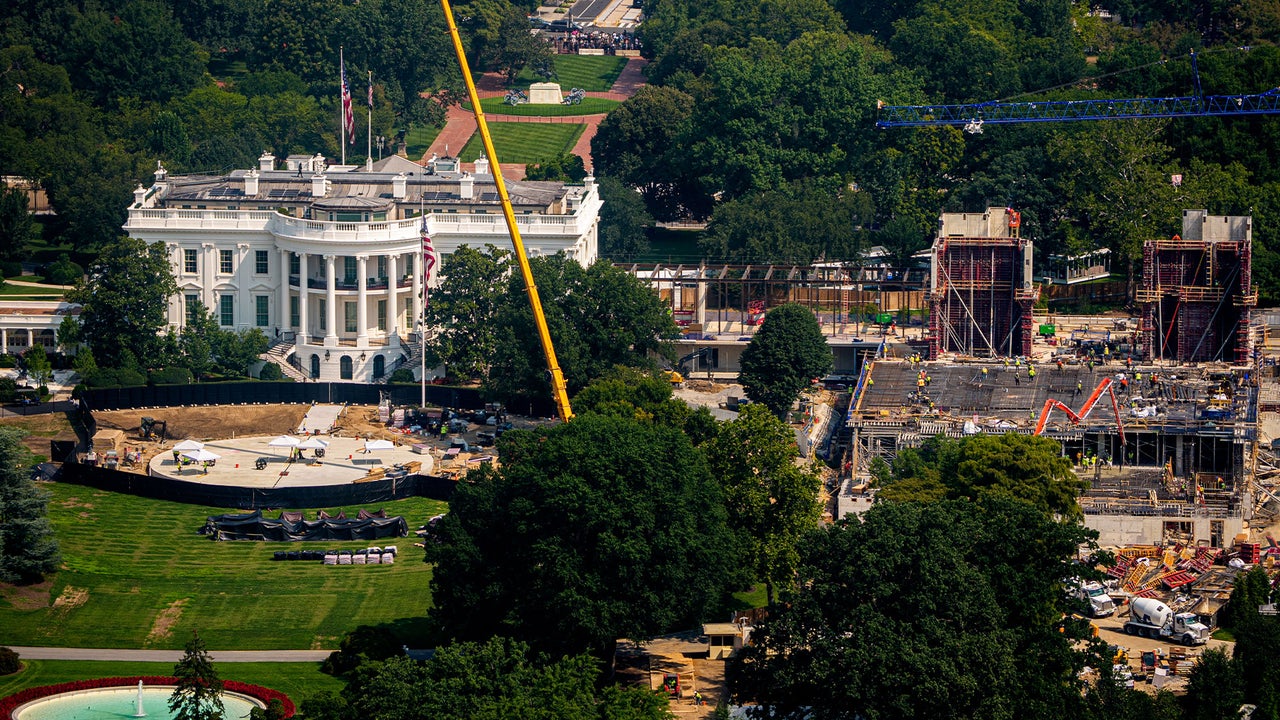
The Trump administration has taken its fight over a controversial White House construction project all the way to the Supreme Court, filing an emergency request on Friday to allow work to continue on a massive ballroom complex being built adjacent to — and partially in place of — the historic East Wing. A federal court had ordered a halt to construction, setting August 21 as the deadline after which no further work could proceed. The administration’s response was to invoke national security and argue that the project has already gone too far to stop. That argument deserves scrutiny, because the gap between what the administration promised and what it actually built is wide enough to drive a bulldozer through.
The basic question is straightforward: what is being built, and who authorized it? The East Wing of the White House, originally erected in 1902, has been substantially demolished to make way for a steel-and-concrete structure that now rises 70 feet above ground in places, covers a footprint of nearly 50,000 square feet, and involved, according to U.S. Solicitor General D. John Sauer’s own filing, “millions of pounds of steel procured, tens of thousands of cubic yards of concrete poured, and miles of conduit laid.” This is not a renovation. It is a construction project of extraordinary scale, carried out on one of the most symbolically significant pieces of public property in the United States — and it was authorized by no act of Congress.
The legal challenge comes from the National Trust for Historic Preservation, which sued to stop the project on the grounds that only Congress holds the authority to approve major structural alterations to the White House. Two federal judges agreed, halting construction last week in a ruling that carried a pointed historical observation: “We are aware of no instance in American history in which a President unilaterally and using privately collected funds demolished substantial portions of the White House that Congress authorized to be built and American taxpayers paid for.” That sentence is not rhetoric. It is a factual statement about the limits of executive power, and it frames the core constitutional issue at stake.
The administration’s emergency Supreme Court filing attempts to reframe the legal question entirely by pointing to the sheer scale of what has already been built. Sauer argues that construction is “too far along to be halted now,” writing that “respondent below conceded that at some point, construction will have gone beyond the point of judicial intervention — that line has long since been crossed.” In other words, the administration is arguing that completing an unauthorized project is now legally compelled because the unauthorized project is already mostly complete. That is a remarkable position, and one that, if accepted, would set a precedent allowing executive agencies to circumvent judicial review simply by moving fast enough.
What makes this harder to dismiss as procedural noise is the documented distance between the administration’s original promises and its actual conduct. When the ballroom plan first drew criticism, Trump himself insisted it would not interfere with the existing structure, saying it would be “near it, but not touching it” and would “pay total respect to the existing building.” White House Chief of Staff Susie Wiles further assured critics that the administration would work closely with historic preservation organizations throughout the process. Neither promise held. The East Wing came down. Preservation groups were not consulted — they were sued against. The administration’s current argument, that the project’s scale and partial completion justify letting it proceed, is the precise opposite of what officials said when seeking public acceptance of the plan.
The Supreme Court now faces a question that is partly constitutional and partly practical: does the executive branch have the unilateral power to demolish and replace a congressionally authorized public building using private money, and can it insulate that action from judicial review by building fast enough? The answer the Court gives will matter well beyond this particular ballroom. It will define how much deference courts owe to executive action when that action has already been carried out — a question with implications that extend far beyond the White House grounds and into every domain where regulatory oversight depends on courts being able to intervene before facts on the ground become irreversible.