
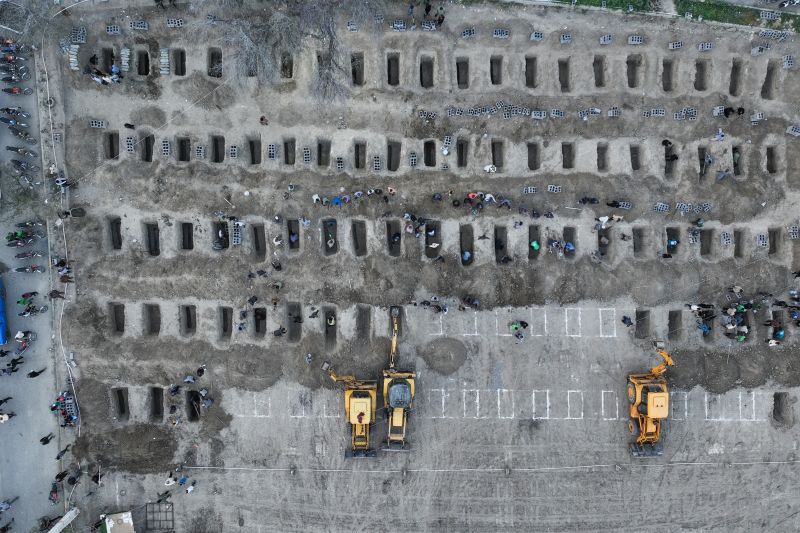
Senior US military commanders knowingly bypassed warnings that intelligence on Iranian targets was severely out of date, approving strikes — including one that killed at least 168 children and 14 teachers at an elementary school — in a rush to deliver targets at the outset of the war, three sources familiar with the decision-making process have told CNN.
The February 28 strike on the Shajareh Tayyiba school in Minab, Iran, stands as one of the worst civilian casualty incidents in recent US military history. The commanders’ decision to override explicit database warnings was made for “expediency,” two of the sources said. The Pentagon has not released its investigation into the incident, months after it was launched. A White House official confirmed only that “this investigation is ongoing.”
The targeting databases — the Modernized Integrated Database, known as MIDB, and the newer AI-powered Machine-Assisted Analytic Rapid-Repository System, or MARS — both clearly flagged that intelligence on Iranian targets needed to be updated before use, according to two sources. The warnings were embedded in the systems and required a senior officer to formally approve adding any flagged site to the strike list. Senior commanders approved them anyway.
The intelligence used to justify striking the site next to the school was more than ten years old. Satellite imagery from 2013 had shown the school and an adjacent Islamic Revolutionary Guard Corps facility as part of a single compound, but images from 2016 already showed a fence separating the two and a distinct school entrance. By December 2025, imagery captured dozens of people apparently playing in the school courtyard. None of that updated picture reached the commanders who approved the strike.
An analyst had in fact flagged changes at the site in a separate digital intelligence tool, but that tool was not connected to the official targeting database, the first source told CNN, and the information was never passed to military commanders. That gap — between what an analyst knew and what decision-makers acted on — is among the issues being examined in the ongoing investigation.
Military officials and intelligence analysts did attempt to update records before strikes began, but they prioritized what they called “upper-tier” targets: mobile assets and sites believed to pose the highest immediate threat to US forces, such as missile installations and aircraft. Fixed sites, including the IRGC facility adjacent to the school, were considered lower priority precisely because they don’t move — and many of those records were never refreshed before the first bombs fell.
The pressure to move fast came from the top. Multiple sources told CNN that senior Pentagon leaders were pressing military officials to rapidly deliver targets in the lead-up to the war, and that pressure continued throughout the weeks of conflict. “The Pentagon is pressing everyone to move faster,” one source said. “A lot of former hedge-fund people and made-for-TV personalities in the mix. But leadership at CENTCOM did not push back either.”
That institutional failure was compounded by deliberate policy choices made before the war began. Defense Secretary Pete Hegseth had already slashed the Civilian Harm Mitigation and Response program, cutting CHMR staff at military commands by more than 90 percent. At Central Command specifically, a team of ten specialists was reduced to a single full-time staffer. Civilian harm specialists were removed from target development strike teams entirely. Hegseth has publicly framed such cuts as enabling “maximum lethality, not tepid legality.” The Office of the Secretary of Defense did not respond to a request for comment on those changes.
“I know the CHMR team at CENTCOM was still trying to do the best possible work,” one source said. “They were just not staffed and resourced like they needed to be because of Hegseth.”
In the immediate aftermath of the strike, President Donald Trump suggested Iran might itself bear responsibility, and later said accountability might never be established. Hegseth said the incident would be “thoroughly” investigated and insisted the US had “attempted in every way possible to avoid civilian casualties.” The evidence emerging from inside the process tells a different story — one of warnings ignored, safeguards gutted, and a preventable catastrophe that killed nearly 200 people, most of them children.