
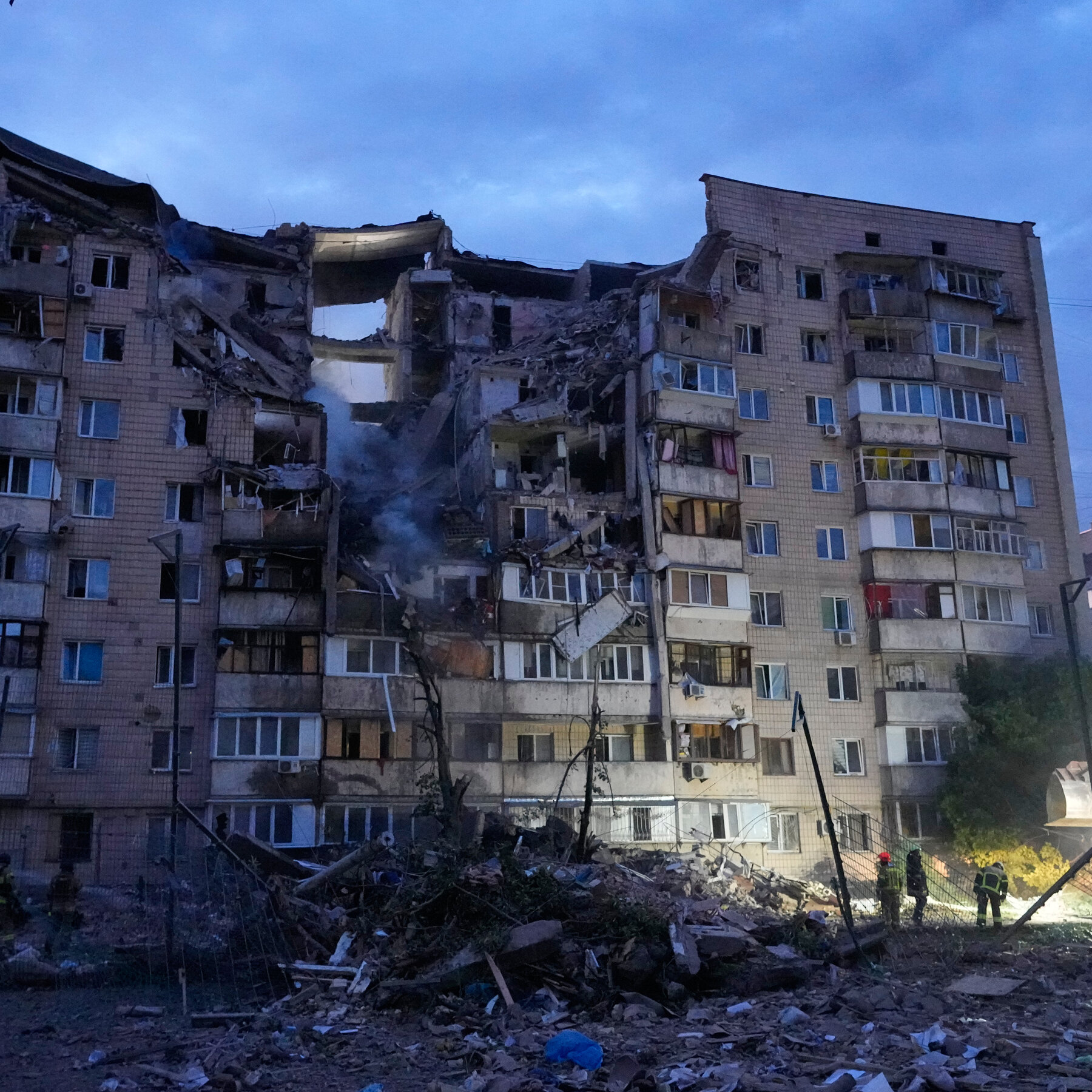
Russia launched one of its most devastating attacks on Kyiv in weeks early Monday morning, killing at least 15 people in the capital and three more in the surrounding region, wounding dozens, and reducing residential buildings to rubble — all on the eve of a NATO summit in Ankara where Ukraine’s survival will be very much on the agenda.
The scale of the assault was staggering. Ukraine’s military reported that Russia fired 68 missiles and sent 351 drones screaming toward Ukrainian territory overnight. Ballistic missiles tore into apartment blocks across four city districts, with the Podilsky district suffering the worst damage. In Kyiv’s southeastern Darnytskyi district — already battered by strikes less than a week earlier — roughly 30 residential buildings were hit. AFP reporters on the ground counted more than ten explosions during a single ballistic missile alert, watching flashes light the night sky as the blasts rolled through the city. One missile punched a crater directly into a multi-storey apartment block, ripping its upper floors apart. An entire family was pulled dead from the rubble. Cars burned in the streets.
Rescuers were still sifting through wreckage hours after the attack. Residents of the Kyiv suburb of Vyshneve were evacuated over fears of unexploded munitions buried in the debris. Mayor Vitali Klitschko confirmed the destruction and damage across the four districts, and the grim arithmetic kept climbing as the morning wore on.
This was the second major assault on Kyiv and its surroundings in under a week. Just days earlier, a Russian strike killed more than 30 people in the capital. The UN Human Rights Monitoring Mission in Ukraine noted on Monday that civilian casualties in 2026 are running significantly higher than during the same period in 2025 — a fact that ought to register with every government sending delegations to Ankara.
The timing of Monday’s strike was not incidental. Russian commanders know exactly when NATO foreign ministers gather, and they know how to send a message. Ukrainian President Volodymyr Zelensky read it clearly. He acknowledged that Ukraine’s air defenses had intercepted the Russian drones and cruise missiles, but made plain that his forces simply lack enough interceptor missiles to stop ballistic threats. The Patriot systems that could do so depend on US-manufactured interceptors, and those stocks have grown dangerously thin. “It is critically important,” Zelensky wrote on social media, “that the world — first and foremost the United States and our European partners — come out of the NATO Summit in Ankara with strong decisions in support of our air defense, and thus the protection of ordinary people’s lives.” That is not a diplomatic formality. It is a direct account of what happens when supply chains fail: families die in their apartments before dawn.
European Commission President Ursula von der Leyen said the attack demonstrated that Ukraine urgently needs more air defense capacity and confirmed the matter would be raised at the NATO meeting. The European Union echoed the call for reinforcements. These are welcome words, but words have been accumulating for months while interceptor stockpiles have not.
US President Donald Trump, who plans to attend the summit and is scheduled to meet Zelensky on Wednesday, said on Monday that a resolution to the war is “getting closer than people realize.” That claim deserves scrutiny. Trump entered his second term promising to end the war within 24 hours. More than 500 days later, his administration has not produced a credible path to peace, and the Kremlin confirmed that Trump and Vladimir Putin spoke over the weekend and agreed to talk again soon — a bilateral channel that has so far yielded no ceasefire, no framework, and no relief for the people of Kyiv. Optimistic presidential statements are not a substitute for policy, and the rubble in Darnytskyi district is a concrete measure of what stalled diplomacy costs.
Russia, for its part, described the overnight assault as a strike on “military-industrial enterprises and fuel and energy complex facilities” — the standard language Moscow uses to justify attacks that consistently kill civilians in their beds. That framing should be treated with the skepticism it deserves. Ballistic missiles do not discriminate between munitions factories and apartment buildings, and the evidence on the ground in Kyiv speaks for itself.
Ukraine has simultaneously escalated its own long-range operations deep inside Russian territory. Ukrainian drones struck the Omsk refinery in Siberia — the country’s largest — in what the Ukrainian military described as one of the longest-ranged Ukrainian strikes of the war. Russia claimed it shot down 519 Ukrainian drones launched overnight. In Russian-annexed Crimea, a Ukrainian strike near Sevastopol temporarily cut electricity. Moscow’s mayor reported that multiple waves of drones targeting the Russian capital were intercepted by air defenses. The war’s geographic reach is expanding in both directions, a development that underscores how thoroughly the conflict has defied every prediction of imminent resolution.
What Monday’s attack makes undeniable is that Ukraine’s air defense gap is not a bureaucratic procurement problem — it is a life-and-death emergency playing out in real time. The alliance gathering in Ankara has the means to address it. The question is whether the political will exists to match the stated commitment to Ukrainian sovereignty with the hardware that commitment requires. The dead in Kyiv’s apartment blocks did not have the luxury of waiting for the answer.