
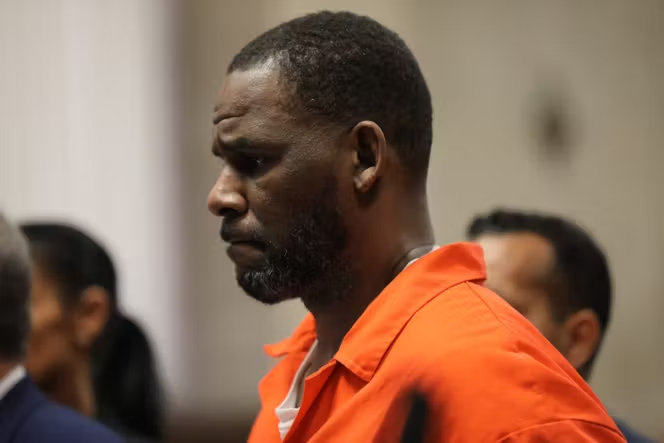
What is R. Kelly actually asking for?
R. Kelly, the R&B singer convicted of running a years-long criminal enterprise built on the sexual exploitation of women and girls, has formally petitioned President Donald Trump to commute his 31-year federal prison sentence. The filing, submitted to the Department of Justice’s Office of the Pardon Attorney, requests a commutation — a reduction of his sentence — not a full pardon, which would expunge his convictions entirely.
The request was made public this week through court records released by the pardon attorney’s office, which reviews all executive clemency filings on behalf of the White House. It is currently listed as “pending.” Kelly, whose full name is Robert Sylvester Kelly, is 59 years old and is being held at a federal prison in North Carolina. Under his current sentence, he will not be eligible for release until January 2046.
What was Kelly convicted of, and why is the sentence so long?
The sentence reflects two separate federal convictions. In 2021, a jury found Kelly guilty of racketeering and sex trafficking, determining that he had led a criminal enterprise that systematically recruited women and underage girls for illegal sexual activity and the production of pornography. That conviction carried a 30-year sentence. A year later, in 2022, he was convicted on three counts of producing child sexual abuse material and three counts of child enticement, adding a 20-year sentence — one that runs almost entirely concurrently with the first, except for one additional year, bringing the combined total to 31 years.
These were not isolated charges. Prosecutors built a case showing a sustained, organized pattern of predatory behavior targeting minors and vulnerable young women over decades. Kelly has consistently denied all allegations against him.
Who is driving the clemency campaign, and how?
Kelly’s attorney, Beau Brindley, has been publicly lobbying the Trump administration for the commutation for more than a year. The effort escalated earlier in 2025 when Brindley filed an emergency motion seeking Kelly’s immediate transfer from federal prison to home detention. The motion alleged that three prison officials had conspired with a terminally ill inmate — offering that inmate early release in exchange for killing Kelly.
Brindley framed the alleged threat as grounds for urgent executive intervention, writing publicly that “the only thing that can protect Mr. Kelly behind the prison walls now is the fact that now the world is watching,” and calling on both the courts and President Trump to act. Federal authorities have not publicly confirmed the alleged plot, and the emergency motion did not result in Kelly’s release.
What does this mean in the context of Trump’s clemency record?
The petition lands in a White House that has already demonstrated an unusually broad appetite for executive clemency. Trump’s second term has seen pardons and commutations extended to a range of individuals whose cases carried significant political or cultural weight, including figures convicted of serious crimes. The R. Kelly petition tests whether that appetite extends to someone convicted of some of the most serious sexual offenses in recent federal prosecutorial history — offenses whose victims were overwhelmingly Black women and girls.
Advocates for survivors of sexual violence have long pointed out that cases involving Black female victims receive less sustained public outrage and institutional protection than comparable cases involving white victims. A commutation granted to Kelly would send a direct and damaging signal to those survivors and to the broader infrastructure of accountability that federal sex trafficking prosecutions represent.
Where does this stand now?
The commutation request remains pending with no public timeline for a decision. The pardon attorney’s office will review the filing and make a recommendation to the White House, though the president retains full discretionary authority to act — or not — regardless of that recommendation. Kelly’s legal team continues to pursue parallel avenues in the courts while keeping public pressure on the executive branch. Whether the Trump administration treats this as a live political question or allows it to sit unresolved remains to be seen.
If you or someone you know has been affected by sexual violence, support is available. In the United States, RAINN operates a confidential hotline at 800-656-4673. In the United Kingdom, Rape Crisis can be reached at 0808 802 9999. In Australia, 1800Respect is available at 1800 737 732. Additional international resources are listed at ibiblio.org/rcip/internl.html.