
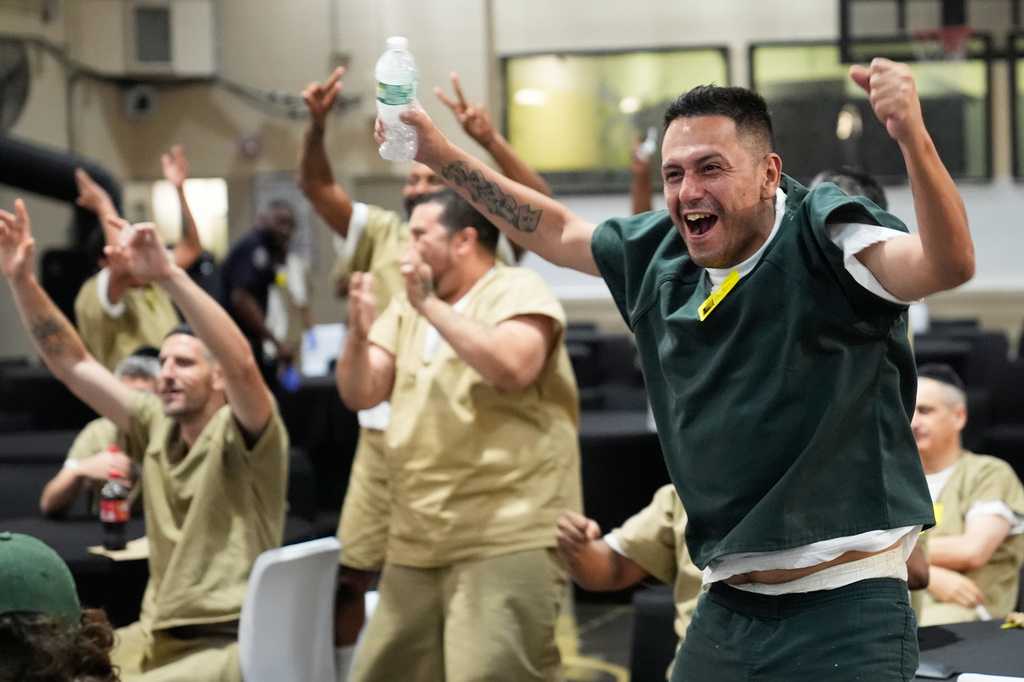
On a Wednesday afternoon inside a gymnasium on Rikers Island, more than a hundred men in tan uniforms watched Argentina defeat England in a World Cup semifinal, eating salmon and penne alla vodka off catered plates, cheering and groaning in unison at a large projection screen. Mayor Zohran Mamdani moved table to table, sleeves rolled up, chatting with inmates about soccer and life after release. For a few hours, the scene looked less like America’s most troubled jail complex and more like any other corner of a city gripped by World Cup fever. That contrast — between this carefully arranged moment of dignity and the documented, ongoing constitutional crisis inside the same walls — is precisely what demands serious attention.
The watch party was not a one-off gesture. Correction officials said Rikers has hosted roughly 90 such events since the tournament began, with approximately 4,500 of the facility’s 6,600 incarcerated people participating, each event reserved for those demonstrating model behavior. Correction Commissioner Stanley Richards, himself a former Rikers inmate, framed the program in explicitly humanizing terms: “Your humanity is seen, heard and valued.” Mamdani echoed that register, noting that the men inside are New Yorkers who will return to the city’s streets and communities. These are not empty words — they reflect a genuine, if nascent, philosophy that incarceration should not strip people of their basic social humanity.
The testimonies of the men who attended underscore why that philosophy matters. Ralph Veal, 53, incarcerated since November, said watching the match made him think about rebuilding his relationship with his soccer-loving son. Thomas McCoy, 52, who has been held for 21 months, described the catered meal — his first taste of what he called “real food” in nearly two years — with quiet devastation. Victor Caldas, a 39-year-old Ecuadorian immigrant cheering for Argentina, spoke of soccer as a language of cross-cultural bonding that transcends borders and prison walls alike. These are not abstract policy outcomes; they are human beings responding to the experience of being treated as such.
The Harder Truth Behind the Celebration
And yet the same week this watch party took place, the federal overseer appointed to manage Rikers — former Vermont corrections chief Nicholas Deml — submitted a reform plan that read as a damning indictment of the facility’s baseline functioning. His report described housing units filled with smoke from prisoner-set fires, blaring alarms, and people pounding on locked cell doors. It described a guard abandoning his post while prisoners streamed through an unsecured door and brawled. “Violence remains pervasive,” the report stated plainly, “basic correctional practices remain unreliable, and unconstitutional conditions persist.” A federal judge had already found conditions severe enough to warrant appointing an outside manager — a measure of last resort.
Mamdani has pledged to honor the 2019 city law mandating Rikers’ closure, but has conceded that the 2027 deadline is almost certainly unrealistic after years of institutional delay and political drift. That admission matters. A World Cup watch party, however meaningful to the individuals who attended it, does not substitute for the structural transformation that law demands — smaller, borough-based facilities with genuine programming, mental health support, and constitutional living conditions. The risk is that well-photographed moments of mayoral goodwill become a substitute for accountability rather than a complement to it.
What Wednesday’s event ultimately demonstrates is that humane treatment inside a correctional facility is not logistically impossible — it is a choice, and one that yields measurable results in safety and human dignity. Commissioner Richards was right to say that programs like these “equal safety.” The research on reducing prison violence consistently supports the conclusion that programming, structured activity, and the affirmation of personhood reduce dangerous incidents. The tragedy is not that Rikers held a watch party; it is that the same institution where men ate catered salmon and felt, briefly, like full human beings is also the institution where a federal overseer documents constitutional violations week after week. Both things are true simultaneously, and progressive governance demands holding both without flinching — using the former as proof of what is possible, and the latter as the standard against which all progress must be measured.