
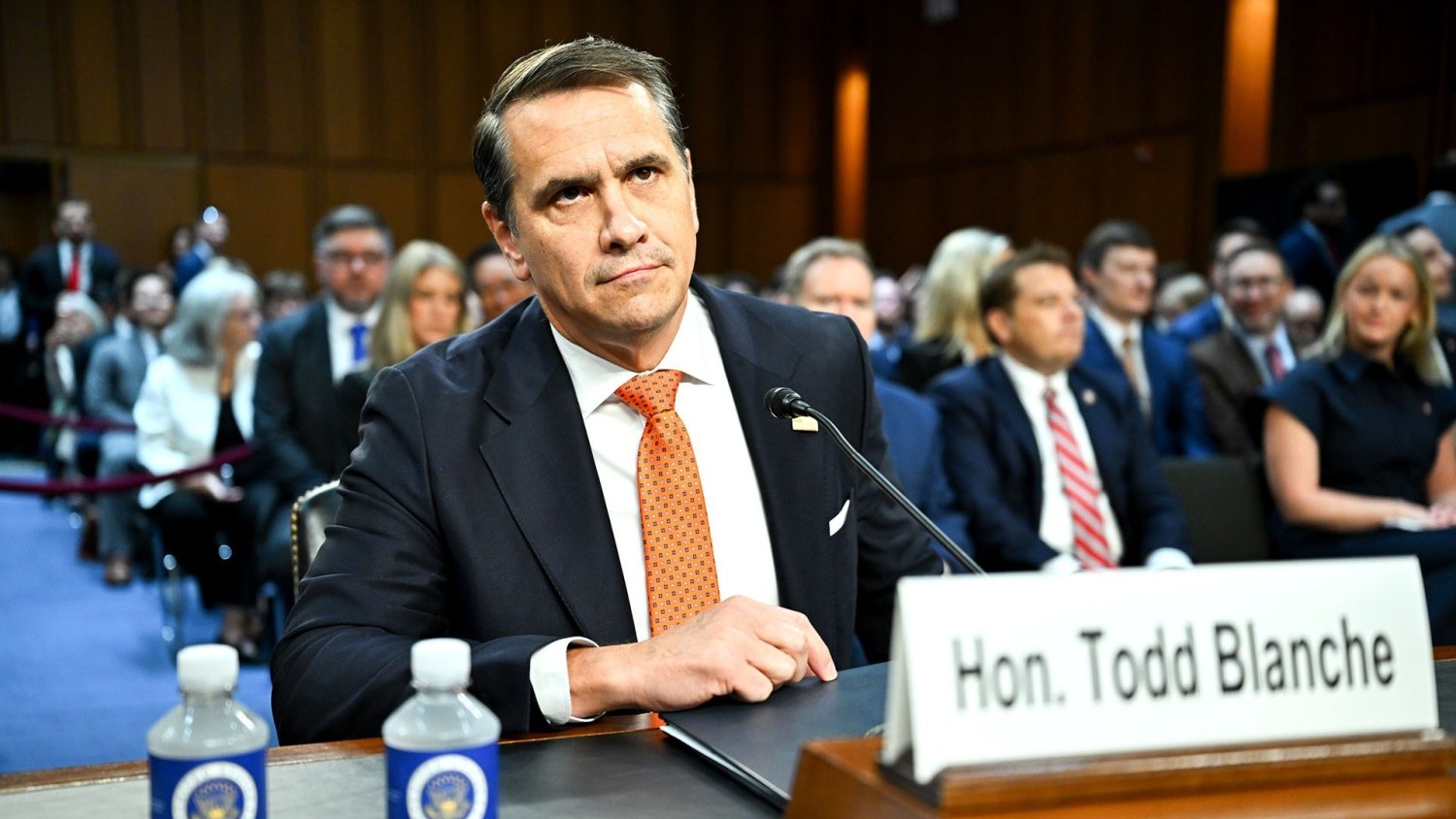
A Nomination in Peril — Then Rescued by a Single Order
Acting Attorney General Todd Blanche was staring down the collapse of his own Senate confirmation. Two Republican holdouts had drawn a hard line: they would not vote to confirm him until the so-called “anti-weaponization” fund was eliminated — in writing, beyond any ambiguity. Blanche blinked. He issued a formal order declaring, in his own words, that “beyond any doubt, there is no fund.” His nomination, previously teetering, now appears back on track.
The episode is worth examining closely. It reveals how even a nominee hand-picked by a Republican administration can find himself caught between competing factions within his own party — and how quickly institutional guardrails can be traded away for confirmation votes. What the fund actually represented, who opposed it, and what its elimination means for the Justice Department’s independence are questions that demand more than a two-minute news segment can answer.
What Was the ‘Anti-Weaponization’ Fund?
The name alone tells a story. The “anti-weaponization” fund was framed by its architects as a mechanism to push back against what conservatives have long characterized — with scant evidentiary basis — as the politicization of federal law enforcement against right-wing political figures. The framing is telling: it presupposes, without proving, that the Justice Department had been “weaponized” in the first place.
Critics, including civil liberties advocates and legal scholars, warned that such a fund could itself become a tool for political interference — insulating certain actors from legitimate prosecution or investigation under the guise of protecting them from partisan targeting. The fund’s existence inside the Justice Department raised immediate questions about who would control it, who would benefit from it, and what oversight mechanisms, if any, would apply.
Those questions were never fully answered publicly. Now, with Blanche’s order, they may never be.
The Republican Holdouts: Principle or Politics?
Two Republican senators refused to back Blanche until the fund was formally rescinded. Their objection, on its face, might look like a principled stand against executive overreach. It is worth being precise about what it actually was.
Their concern was not that the fund threatened prosecutorial independence or civil liberties. Their concern was procedural — they wanted the elimination documented in writing. That is a narrow demand. It says nothing about the broader architecture of political influence over the Justice Department that has been systematically constructed over recent years. Blanche gave them the paper they asked for. Whether that paper means anything substantive is a separate question entirely.
The episode illustrates a recurring pattern: Republican intra-party friction that looks like accountability from the outside, but resolves itself with cosmetic concessions rather than structural reform.
What This Means for Justice Department Independence
A Confirmation Process That Rewards Compliance
Blanche’s path to confirmation has been defined by accommodation. He has navigated a Senate process in which the price of confirmation is demonstrable loyalty — to party factions, to political narratives, and to an administration that has shown persistent interest in bending federal law enforcement toward its own ends. Eliminating the fund was the price of two votes. He paid it.
That dynamic should concern anyone who cares about an independent Justice Department. The Attorney General is the nation’s chief law enforcement officer. The role demands insulation from exactly the kind of transactional pressure that has characterized Blanche’s confirmation process. When a nominee’s fitness for office is measured by his willingness to issue orders satisfying political factions within his own party, something has gone structurally wrong.
The Broader Pattern of Institutional Erosion
This is not happening in a vacuum. The past several years have seen sustained, documented pressure on the Justice Department to align its prosecutorial priorities with political objectives. The “anti-weaponization” fund was one expression of that pressure — a bureaucratic structure designed to encode a political grievance into institutional form. Its elimination is not a victory for independence; it is the removal of one contested mechanism while the broader pressure environment remains fully intact.
What would genuine independence look like? Consider the contrast:
None of that is on the table. What is on the table is a signed order, a cleared procedural hurdle, and a nomination moving forward.
The Confirmation Calculus
Blanche’s situation reflects something important about how Senate confirmations now function. The process has become less about evaluating a nominee’s qualifications and more about negotiating the terms of political loyalty. Two senators held leverage. They used it. Blanche complied. The machinery moves on.
NBC’s Garrett Haake, reporting for TODAY, framed the development as Blanche’s nomination getting “back on track” — which is accurate as a description of Senate vote-counting. But “back on track” toward what, exactly? An Attorney General confirmed not because the Senate rigorously assessed his commitment to the rule of law, but because he issued an order abolishing a fund that two members of his own party found inconvenient.
That is the track this confirmation is on. It is worth naming clearly.
What Comes Next
With the two holdouts apparently satisfied, Blanche’s path to a full Senate confirmation vote is now considerably smoother. The Justice Department under his leadership will face immediate scrutiny on multiple fronts — ongoing investigations, civil rights enforcement, and the department’s posture toward state-level prosecutions that intersect with federal interests.
His willingness to issue a formal order eliminating the anti-weaponization fund on demand demonstrates something useful: he responds to documented, written pressure. That is a lever. Civil society organizations, oversight advocates, and members of Congress who care about prosecutorial independence should note it — and be prepared to apply it, consistently and publicly, from the moment he takes office.
The fund is gone. The underlying pressures that created it are not.