
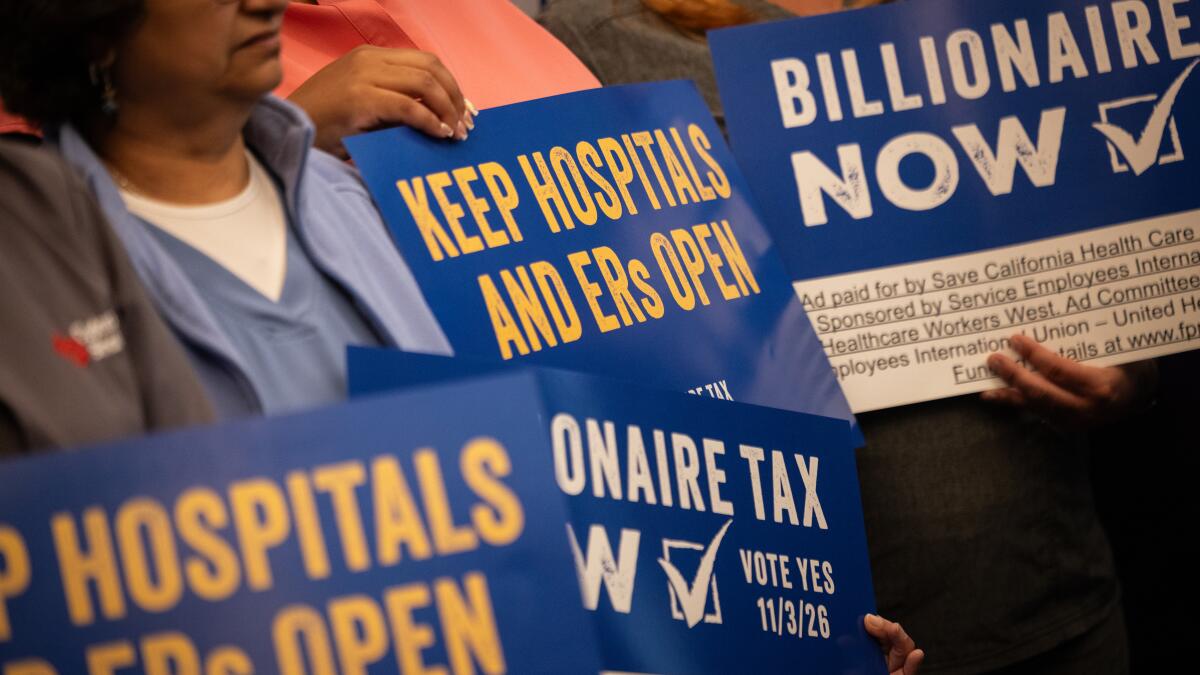
There is a particular kind of political audacity that announces itself not by retreating after a fight but by promising to take the fight everywhere. Dave Regan, the president of SEIU United Healthcare Workers West, embodies that audacity right now, and the billionaires of California — and perhaps of the entire country — are beginning to understand what that means for them.
The measure Regan’s union engineered, Proposition 40, is a one-time 5% tax on the net worth of any California resident whose accumulated wealth exceeds one billion dollars. That applies to roughly 200 people, according to Forbes — a vanishingly small number of individuals sitting atop a mountain of accumulated capital while the state faces a fiscal crater, estimated at around $100 billion, blown open by the federal healthcare cuts embedded in President Donald Trump’s One Big Beautiful Bill Act. The revenue generated by Proposition 40 would flow primarily into Medi-Cal, California’s Medicaid program, with additional allocations for food assistance and public education. It is, in other words, a direct and deliberate act of redistribution: taking from those who have accumulated generational wealth in quantities that no single human life could meaningfully spend, and directing it toward the healthcare and nutrition of people who have almost nothing.
SEIU-UHW filed the measure in October 2025, and by April 26, 2026, had collected 1.6 million signatures in support — nearly double the 874,641 required to qualify for the November ballot. That number is not a bureaucratic technicality; it is a signal of popular appetite for exactly this kind of policy. Senator Bernie Sanders of Vermont and economist Robert Reich have both lent their voices to the campaign, and the California Labor Federation endorsed Proposition 40 in an overwhelming institutional vote. The grassroots energy is real, the institutional backing is substantial, and the moral case is straightforward: when the federal government slashes healthcare for the poor to deliver tax cuts to the rich, states must find ways to fill the void, and those with the most should contribute the most.
Yet the measure has generated friction even within the progressive coalition, and that friction deserves honest examination rather than dismissal. Governor Gavin Newsom has opposed Proposition 40, not because he rejects the principle of taxing extreme wealth — he has been explicit that he supports that goal — but because he believes the battle belongs at the federal level and that fighting it state by state risks both legal vulnerability and economic self-sabotage. His objection is strategic, not ideological, and it is not without substance. Negotiations reportedly included a scaled-down proposal at 2%, routed through the legislature rather than the ballot, but Regan and SEIU-UHW declined, judging the compromise insufficient. Reasonable progressives can disagree about tactics; what matters is that this is a genuine internal debate about how best to achieve redistribution, not a debate about whether redistribution is legitimate.
The constitutional question hovering over the measure is genuinely complex. Proposition 40 proposes taxing individuals who were California residents as of January 1, 2026 — meaning those who have since relocated to Nevada, Texas, or Florida would still owe the tax. Critics call this retroactive and constitutionally vulnerable; supporters argue it is a reasonable mechanism to prevent wealthy individuals from simply fleeing ahead of a vote that the broader public has every democratic right to hold. The framing of billionaires “fleeing” California deserves scrutiny of its own: these are people with multiple homes, private aviation, and the financial architecture to claim residency wherever it suits them at any given moment. The idea that they constitute a persecuted class driven from their homes by an overreaching state is a narrative that serves their interests, not a neutral description of reality.
One billionaire has already spent $82 million to defeat the measure, and that figure is likely to climb steeply as November approaches. The scale of that spending is itself an argument for the tax. When a single individual can deploy $82 million to shape the outcome of a democratic vote, the concentration of wealth has already distorted the political system in ways that no amount of campaign finance rhetoric adequately captures. The opposition spending is not merely an obstacle to Proposition 40; it is a live demonstration of why policies like Proposition 40 are necessary.
What gives this moment its broader significance is Regan’s explicit framing of California as a national model. Whatever the November outcome, he has made clear that the campaign to tax billionaires is designed as a template — for other states facing the same federal disinvestment, and ultimately for the federal government itself. That ambition is worth taking seriously. The political conditions that produced this initiative — a federal administration actively redistributing resources upward while cutting programs that sustain working-class life — are not unique to California. They are national conditions, and the anger they are generating is national anger. California is simply the state with the institutional capacity, the labor infrastructure, and the political culture to act first. Whether it succeeds in November or not, the argument it is making will not disappear. The billionaires know it. That is why they are spending.