
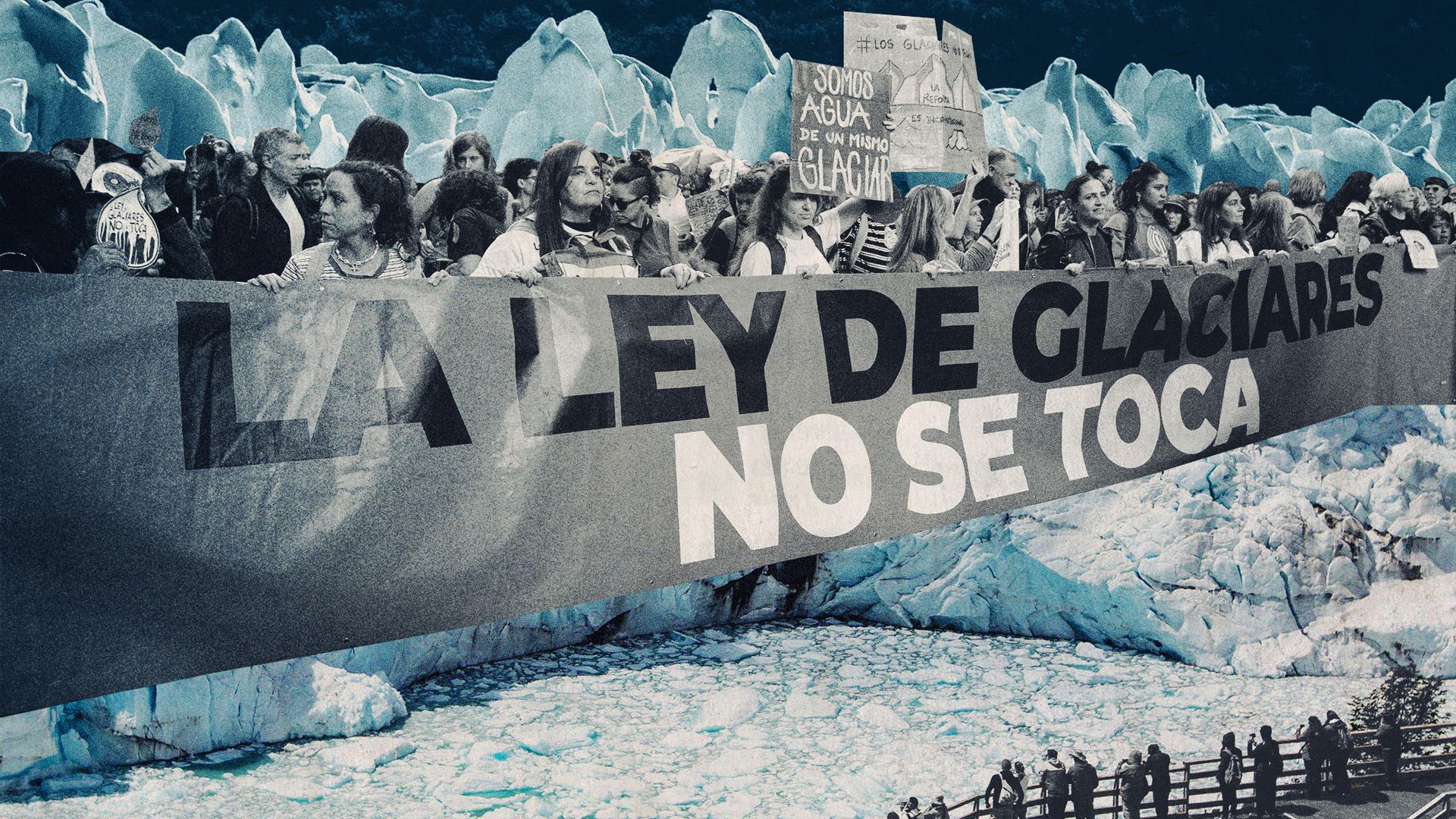
What is actually at stake with Argentina’s glaciers?
A quiet but consequential battle is unfolding across the Andes, where Argentina’s nearly 17,000 documented glaciers face mounting pressure from mining conglomerates, Big Tech data centre developers, and a federal government that has systematically dismantled the legal protections that once kept them off-limits. The consequences extend far beyond environmental aesthetics. These glaciers are the primary freshwater source for more than seven million people across 12 provinces and 36 river basins — a hydrological lifeline that, once severed, cannot be restored on any human timescale.
Scientists are not speaking in abstractions. A study using MapBiomas satellite data found that 42% of all Andean glaciers have already disappeared. According to the Argentine Institute of Snow Science, Glaciology and Environmental Sciences, the volume of ice Argentina loses every year could supply the entire country’s population with water for a year and a half. That is not a slow-moving environmental concern. That is an emergency unfolding in geological slow motion.
And yet President Javier Milei’s government is accelerating the very activities most likely to hasten that loss.
What did Argentina’s Glacier Law actually do, and what happened to it?
Passed in 2010, Argentina’s Glacier Law established a straightforward and ecologically sound principle: commercial activity that damages glaciers and periglacial zones is prohibited. The law required the national government to inventory and monitor glacial bodies, and it created a framework for holding extractive industries accountable when their operations encroached on protected ice. For over a decade, it served as one of Latin America’s more robust examples of environmental governance — imperfect in enforcement, but clear in intent.
In April of this year, Argentina’s parliament passed amendments that fundamentally altered that framework. Responsibility for defining which glacier areas deserve protection was transferred from the national government to individual provincial governments. Milei framed this as an act of federalism, arguing it would “empower” provinces to permit exploitation in glacial zones where local authorities judged there was “nothing to protect.” The circularity of that logic — letting the governments most eager for mining revenue decide which glaciers need no protection — was not lost on environmental scientists or the communities downstream.
The change effectively handed the keys to the protected zones to the political actors with the strongest financial incentives to open them up.
Who is driving the push to exploit these zones?
The answer involves some of the world’s largest extractive corporations and a cohort of Silicon Valley-aligned investors, all of whom have found in Milei a remarkably accommodating interlocutor. Executives from mining giants Glencore, Lundin, and BHP Group have all made the trip to Buenos Aires to meet with the president over the past year, according to Bloomberg. Together with other investors, they are reportedly eager to pour approximately $40 billion into Argentina’s largely untapped copper belt — deposits that sit, with geologically inconvenient precision, in and around the Andean glacial zones now being deregulated.
The tech sector’s interest is equally significant. Patagonia has attracted attention from data centre investors drawn by its cool temperatures, renewable energy availability, shale gas reserves, and — as Reuters noted with some candour — a relative absence of organised opposition. Last October, OpenAI announced a partnership with a local company to build a data centre powered by clean energy, with costs estimated at up to $25 billion. The infrastructure ambitions are enormous, but so are the unresolved questions: connectivity and physical infrastructure remain serious hurdles, and investors are already expressing anxiety about Argentina’s 2027 presidential election and the possibility of a left-wing successor to Milei who might reimpose regulatory constraints.
“They would feel more comfortable if Milei was re-elected,” said Luis Schilling, Latin America co-chair for iMasons, a US digital infrastructure non-profit. The candour is instructive: the investment calculus depends not on stable governance, but on the continuation of a specific deregulatory posture.
What do the glaciers actually mean for the people who depend on them?
Virginia de Valle, whose family operates a vineyard in the Mendoza region, explained the relationship between glacial melt and daily life with striking clarity when she spoke to the BBC. “The Andes mountains, with their winter snow and glaciers, feed the rivers and streams that flow into the valley to irrigate our crops,” she said. “This is also the water we consume in our homes. That is why people say ‘Mendoza is the daughter of water.'”
That phrase captures something the economic projections consistently fail to account for. In years of unusually low rainfall and snowfall — which are becoming more frequent as climate patterns shift — glacial meltwater acts as a buffer against drought, moderating what would otherwise be severe agricultural and municipal water crises. As BBC business reporter Rachel Flynn has noted, this moderating function is not incidental; it is structural. Remove the glaciers, and the buffer disappears permanently.
The public understands this. Changes to the Glacier Law have triggered widespread protests in communities that depend on glacial water systems, from wine-growing valleys to urban centres that draw their drinking water from Andean rivers. The opposition is not abstract environmentalism. It is people defending their water supply.
How serious is the flood risk, and has Argentina seen this before?
The catastrophic flooding that killed more than a thousand people in Nepal and Tibet last month has given the scientific warnings about Argentina’s glaciers an unavoidably concrete reference point. Glaciologists and geologists have long cautioned that accelerated glacial retreat creates unstable conditions — weakened moraines, sudden drainage of glacial lakes — that dramatically increase the risk of glacial lake outburst floods (GLOFs) and mudslides.
Argentina has already experienced this. In November 2005, the collapse of the Laguna de los Erizos reservoir in San Juan province unleashed a mudslide of 1.1 billion cubic feet that stretched for 155 miles. The event caused no deaths only because of its remote location — a piece of luck that cannot be assumed to repeat itself as development and population density in glacial zones increase.
Juan Pablo Milana, a researcher with Argentina’s National Scientific and Technical Research Council, was direct when he spoke to the Argentine news site Infobae: “What happened in Nepal has already happened in Argentina.” The distinction between a disaster that killed no one because no one was there and a disaster that kills thousands because cities and infrastructure now occupy the flood path is not a matter of geological difference. It is a matter of policy choices made before the water moves.
What does this tell us about the broader pattern of Milei’s governance?
Milei has positioned his deregulatory agenda as economic liberation — a necessary shock to a country battered by inflation, debt, and decades of mismanagement. And Argentina’s economic fragility is real; the need for investment and growth is not a fabrication. But the specific trade-offs being made here — weakening environmental protections that safeguard freshwater for millions of people, in order to accelerate mining and tech development that benefits global capital — reflect a familiar and well-documented logic: socialise the risks, privatise the gains.
The communities of Mendoza, San Juan, and Patagonia will bear the costs of accelerated glacial retreat. The copper extracted from the Andean belt will flow to global markets. The data centres will serve international clients. And the water — once the glaciers are gone — will not come back.
That is not a trade-off that any legitimate cost-benefit analysis, applied honestly, would endorse. It is the predictable outcome of a governance model that treats environmental regulation as an obstacle rather than as the infrastructure of survival.